One Day in Manila: Chinatown to the Walled City
I flew into Manila two days before my Crystal cruise departed. Most people fly in and head straight to the ship. I wanted one full day in Manila to explore before that. That gave me one solo morning and one guided afternoon before embarkation.
This post covers both. A Chinatown wander on my own. Then a private tour through flower markets, lechon stands, a cemetery, and the walled city of Intramuros. It is a lot of ground for one day. It was a lot of ground in real life too.
Prefer to watch instead of read? Watch the video →
One Day in Manila, Two Ways to See It
Manila does not hand itself to you all at once. Some of it you find by accident. Wandering a neighborhood with no plan. Some of it needs a guide who knows exactly where to take you. I got both, in the same 24 hours.
Binondo: A Solo Wander Before the Tour
I flew into Manila two days before my Crystal cruise departed. That first evening was for nothing more than checking into my hotel and getting a real night’s sleep after the flight. My private tour did not start until the afternoon of my second day. That left one solo morning to myself before the itinerary took over. I was staying in Binondo. Everyone calls it the oldest Chinatown in the world. The Spanish established it in 1594, as a settlement for Chinese traders who converted to Christianity. Four hundred and thirty years later, it is still the commercial heart of the district. My assignment for the morning was simple. Walk somewhere. See what happens.
Lucky Chinatown Mall
What happened was Lucky Chinatown Mall.
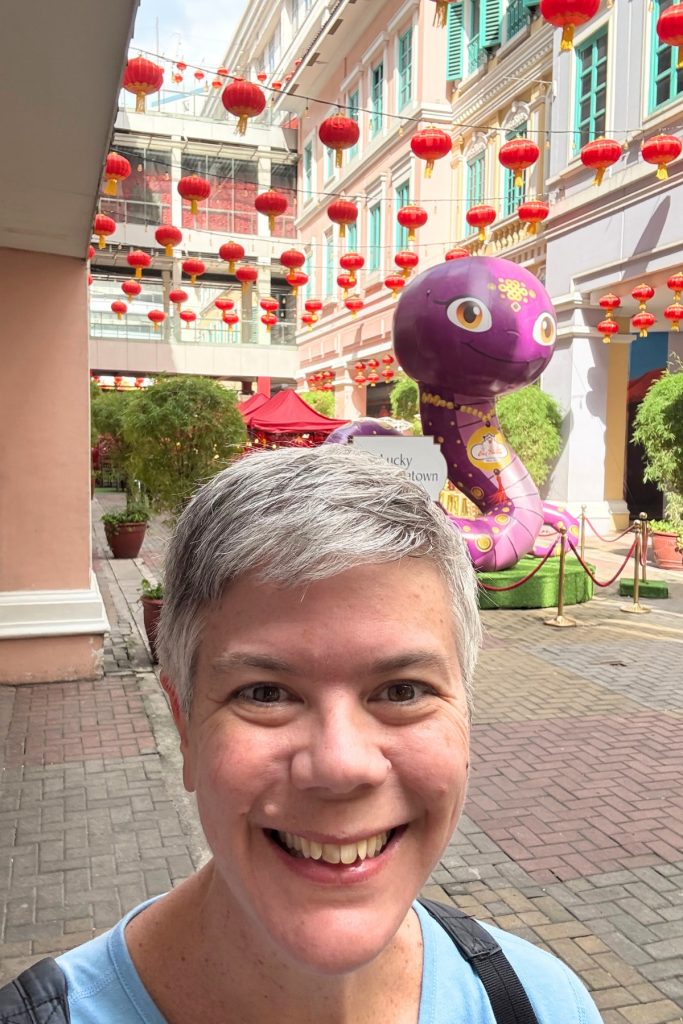
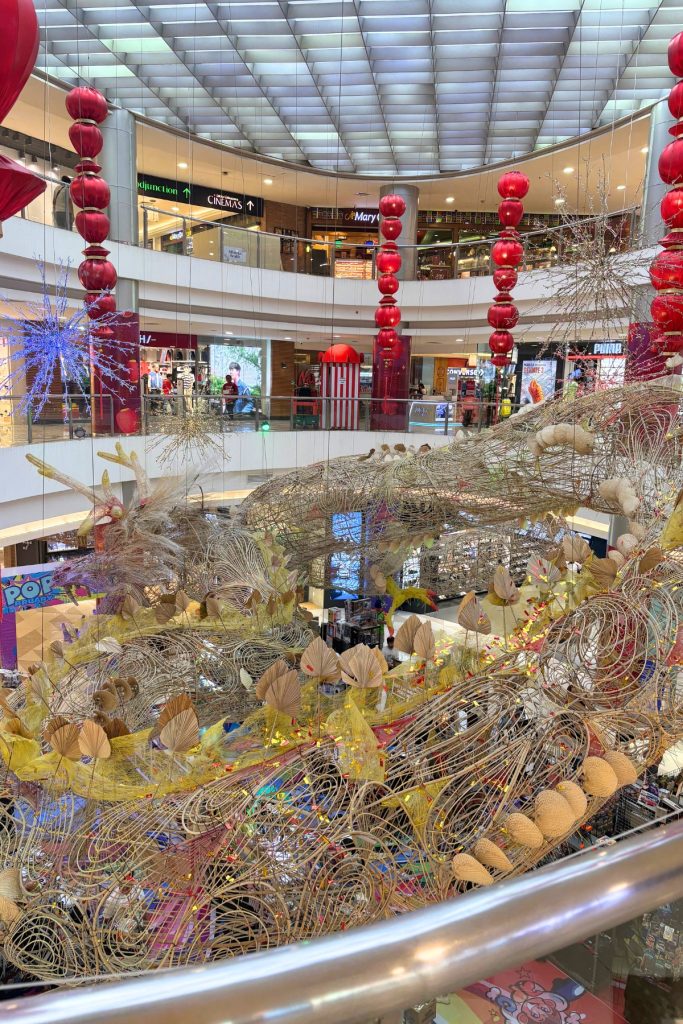
It is not subtle. Red lanterns hang from the ceiling. The count stops making sense somewhere around the hundredth one. Lunar New Year decorations were still fully installed, a solid month after the holiday itself. 2025 was the Year of the Snake. So I got to take a selfie with an inflatable purple snake mascot roughly the size of a compact car. Not something I planned for when I set out that morning.
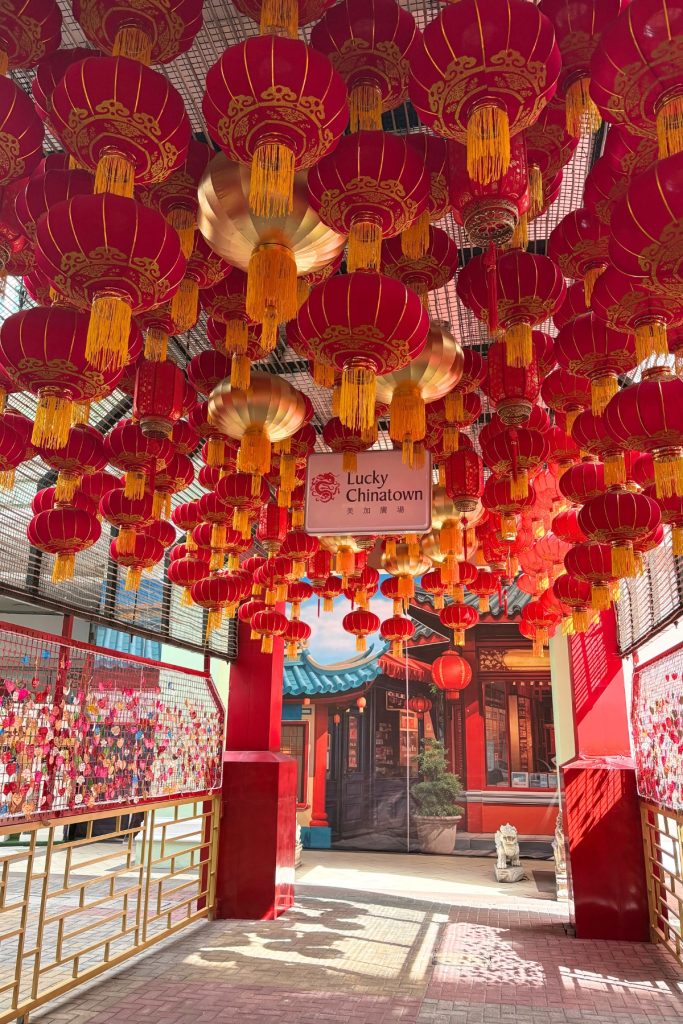
Inside, gold Buddha statues lined a hallway on individual pedestals. Each one apparently wards off a different category of bad luck. There was a tree made entirely of gold leaves and hanging coin charms.
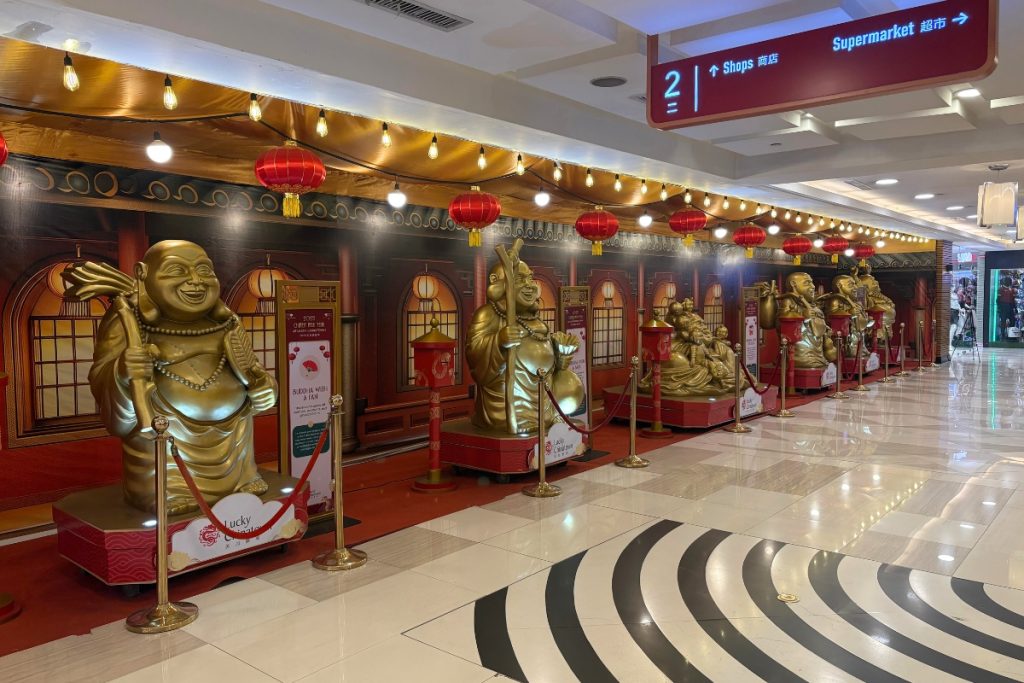
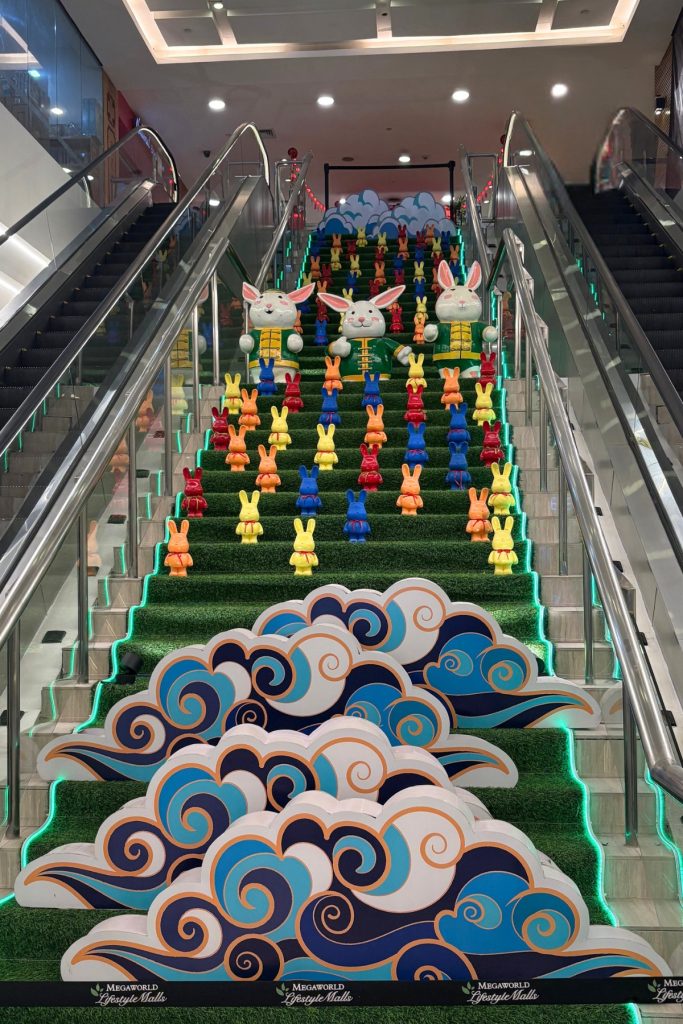
There was also a woven dragon sculpture, suspended between two floors of the atrium. You only fully appreciate it by leaning over the railing and looking straight down. And there was a staircase, wrapped in AstroTurf and ocean-wave graphics. A small army of painted rabbit figurines stood at attention on the steps, like they were guarding something. I never did figure out what.
None of this is why anyone flies to Manila. It is also exactly the kind of morning that makes a trip feel like yours, instead of a brochure’s. I had no itinerary. No guide. No idea what I was walking into. I got lanterns, a giant snake, and a staircase full of rabbits. Worth the walk.
Dangwa Flower Market & La Loma Lechon
My tour guide, Margareth, picked me up in the afternoon. The first stretch of the tour was two very different kinds of overwhelming.
Dangwa Flower Market
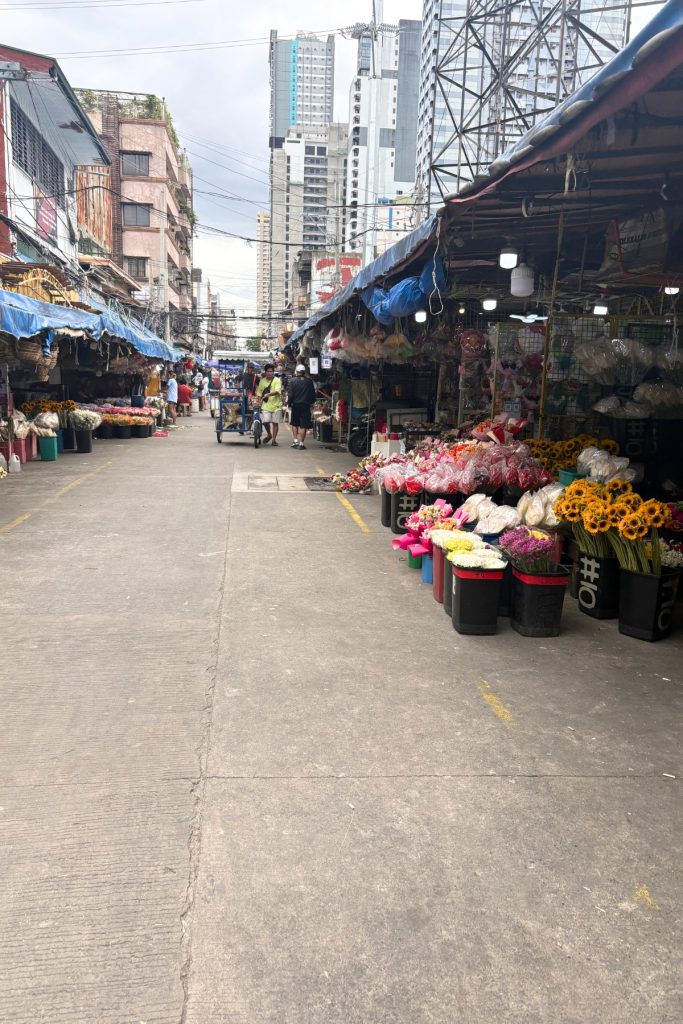
First stop was Dangwa, Manila’s flower district. It does not so much have a boundary as a general vicinity. Stalls spill down entire blocks. Buckets of sunflowers and dyed carnations line the curb, like a parade that forgot to move. Somewhere under all those tarps is an actual neighborhood. You would be forgiven for not noticing. The flowers currently outnumber the buildings.
La Loma Lechon
Then we drove to La Loma. It has earned its unofficial title as the lechon capital of the Philippines the old-fashioned way. Lechon is whole roasted pig, a Filipino specialty, cooked slowly over coals until the skin turns dark and crackling. La Loma is extremely good at it, and it never stops.
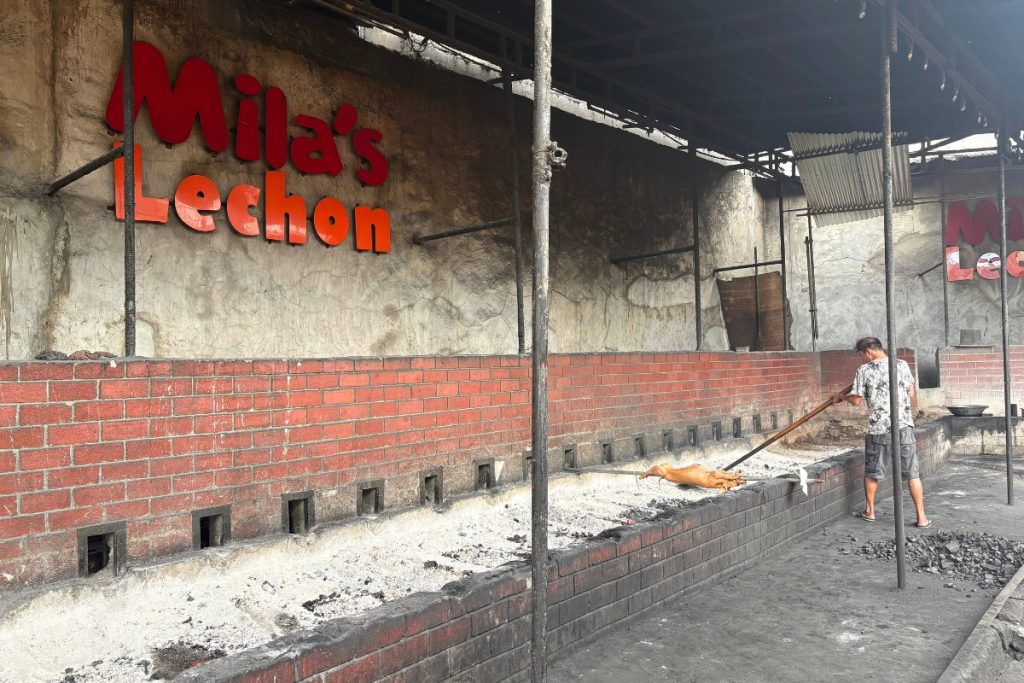
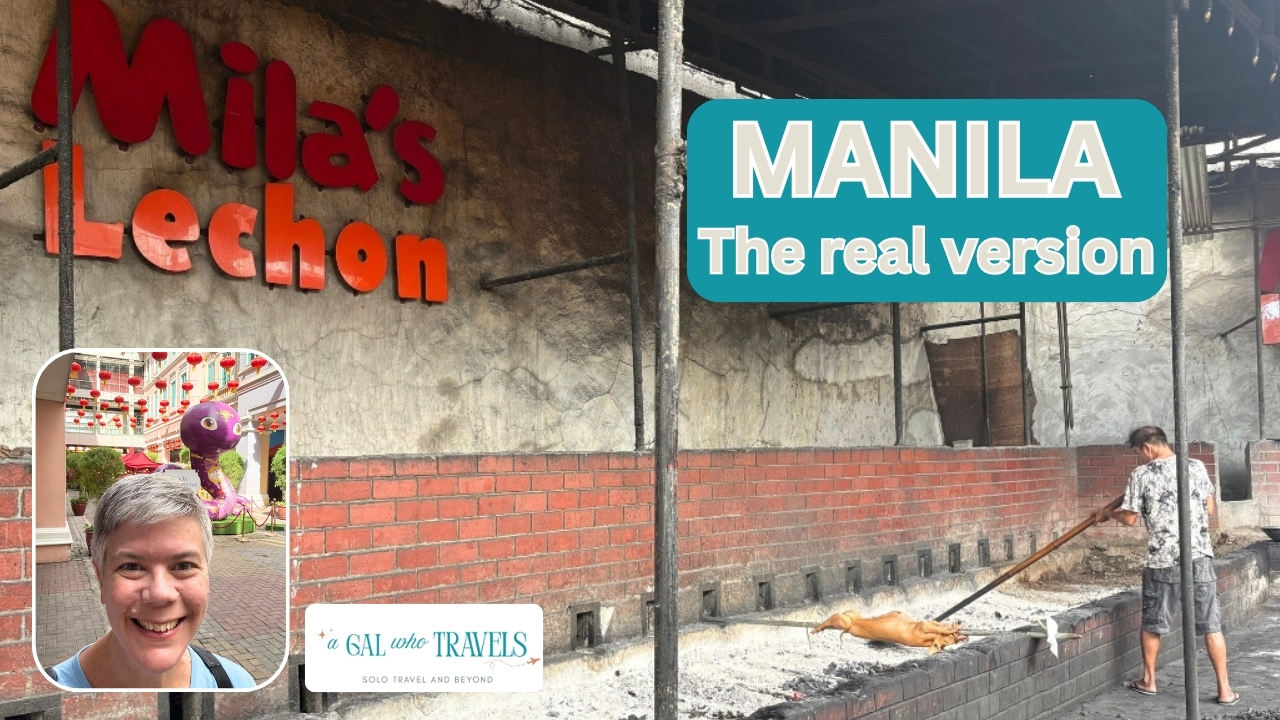
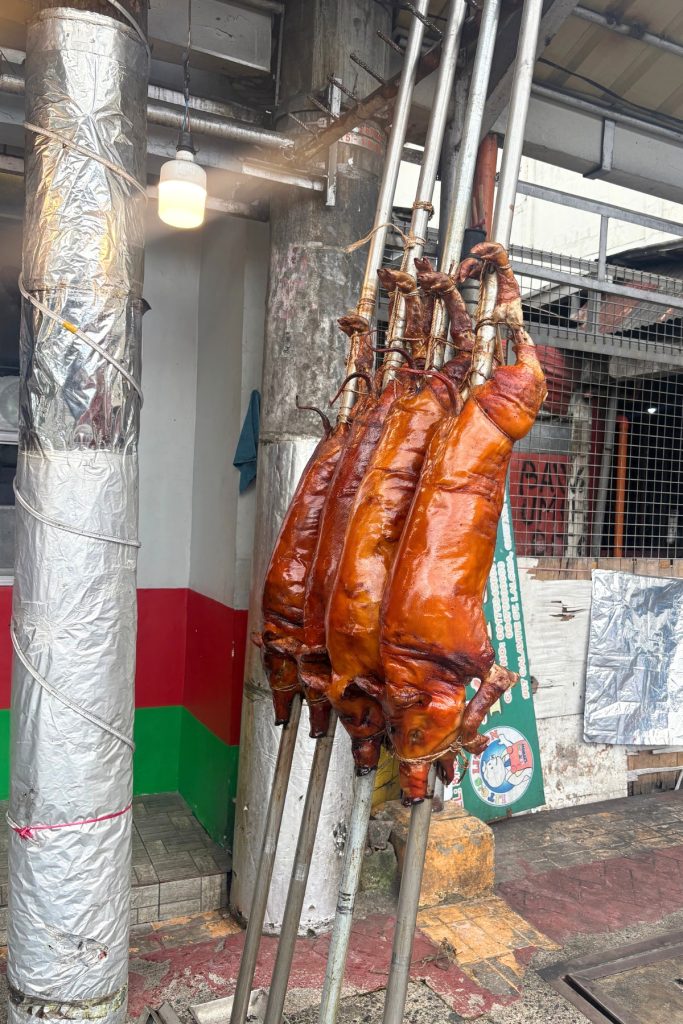
My guide took me to Mila’s Lechon, a name that means something in this city. Milagros, the daughter the shop is named after, was born in 1968. The family has been roasting pigs ever since. I watched a full pig get pulled off the coals. A few doors down, another vendor had four of them hanging by their feet, in a neat row, like some kind of trophy display.
Nearby, a stand sold chicharon by the gram. Chicharon is fried pork, crisp and salty, usually sold by the bag back home. Here it is sold by weight, and this particular stand specialized in bituka and bulaklak, pork intestines and pork maw, fried until crunchy. One hundred grams runs two hundred pesos, and it goes up from there. That is for anyone keeping a running tab of their pork consumption. By this point in my trip, I was not.
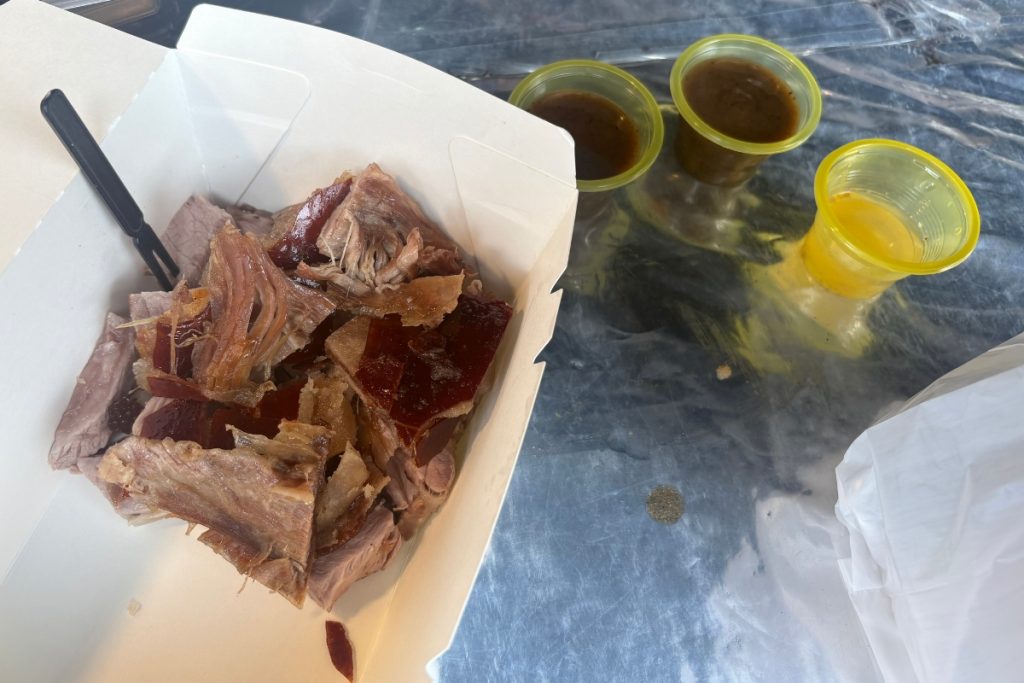
The lechon itself came in an unassuming takeout box. Crackling skin the color of stained glass, layered over shredded meat underneath. Three sauces on the side: something dark and savory, something sharper, and a bright citrus one that cut through all of it. I ate this on the tailgate of a tricycle. Felt correct.
Manila Chinese Cemetery
The tour’s next stop looked nothing like the two before it. No pigs. No flowers. Just stone streets and quiet.
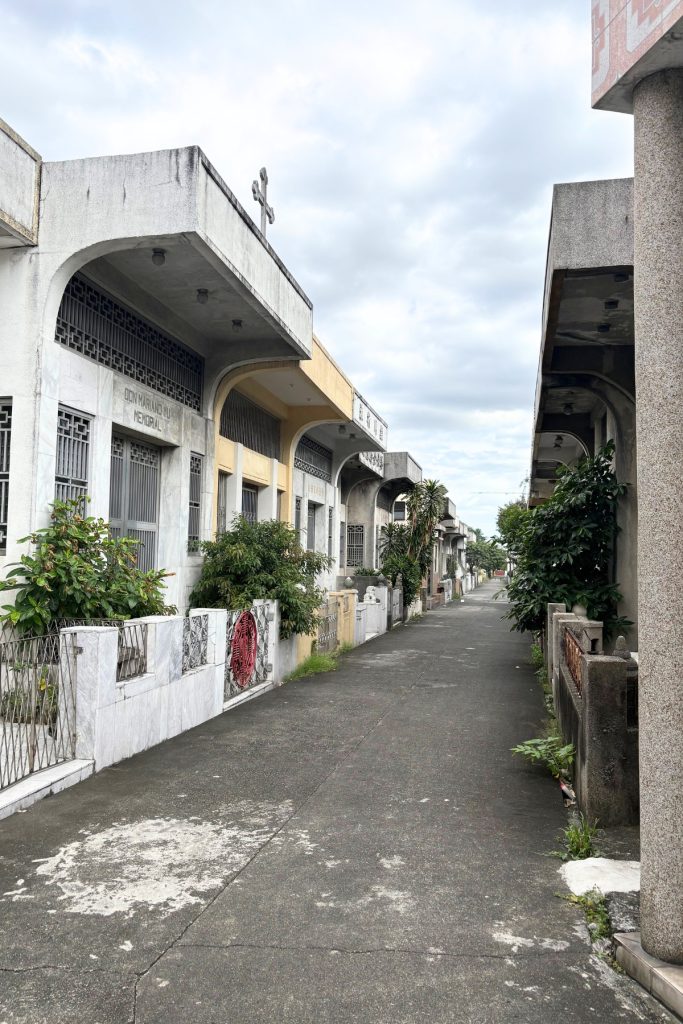
The Manila Chinese Cemetery dates to 1879. Spanish colonial law barred non-Catholics from burial in Catholic cemeteries. The Chinese community built their own instead. It sits right next to the older La Loma Cemetery. What resulted is less a cemetery and more a small city. Streets have names. Some tombs have doorbells. A few even have air conditioning.
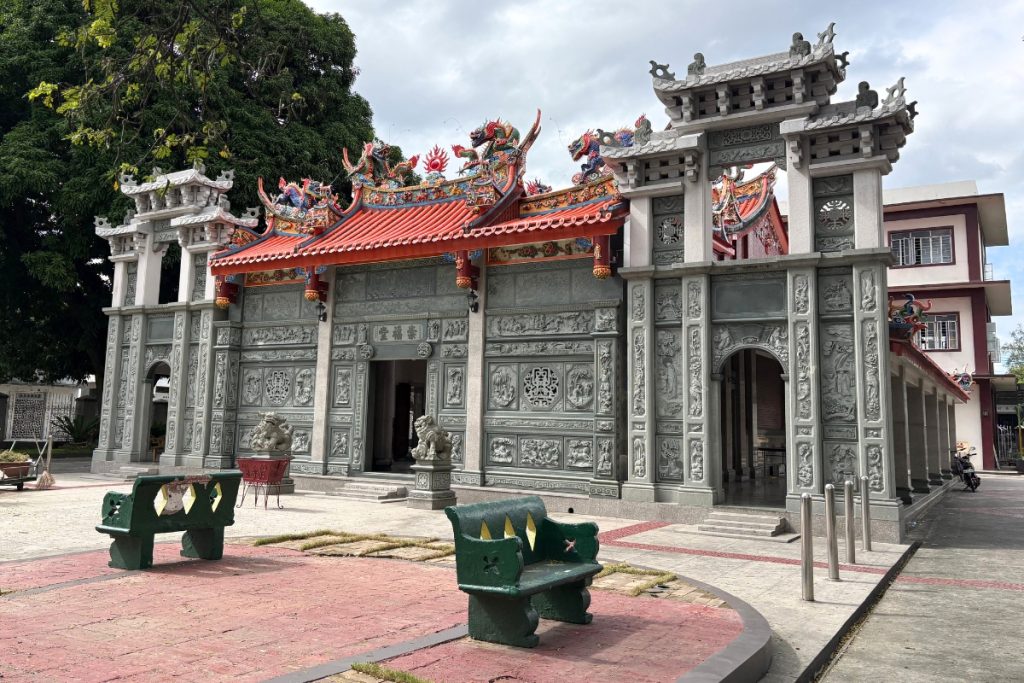
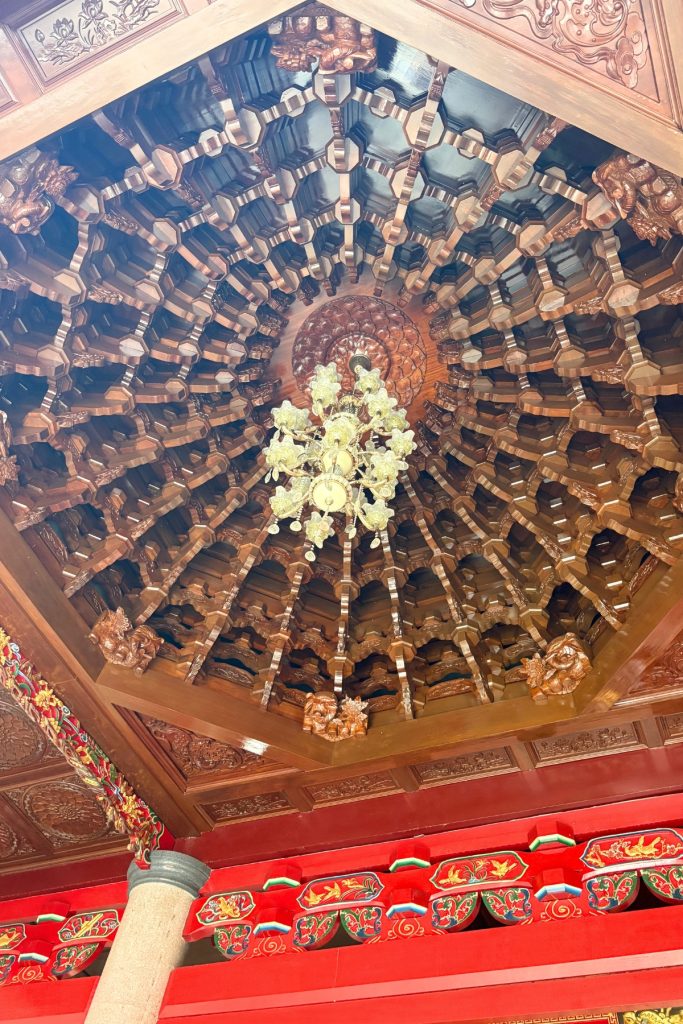
At the center sits Chong Hock Tong, a temple built for the community. Its carved stone gate is topped by ceramic dragons in full color. Guardian lions flank the entrance, worn smooth in places by decades of hands. Inside, the ceiling fans out in an octagonal pattern of dark wood. A chandelier hangs dead center, like something salvaged from an old hotel ballroom.
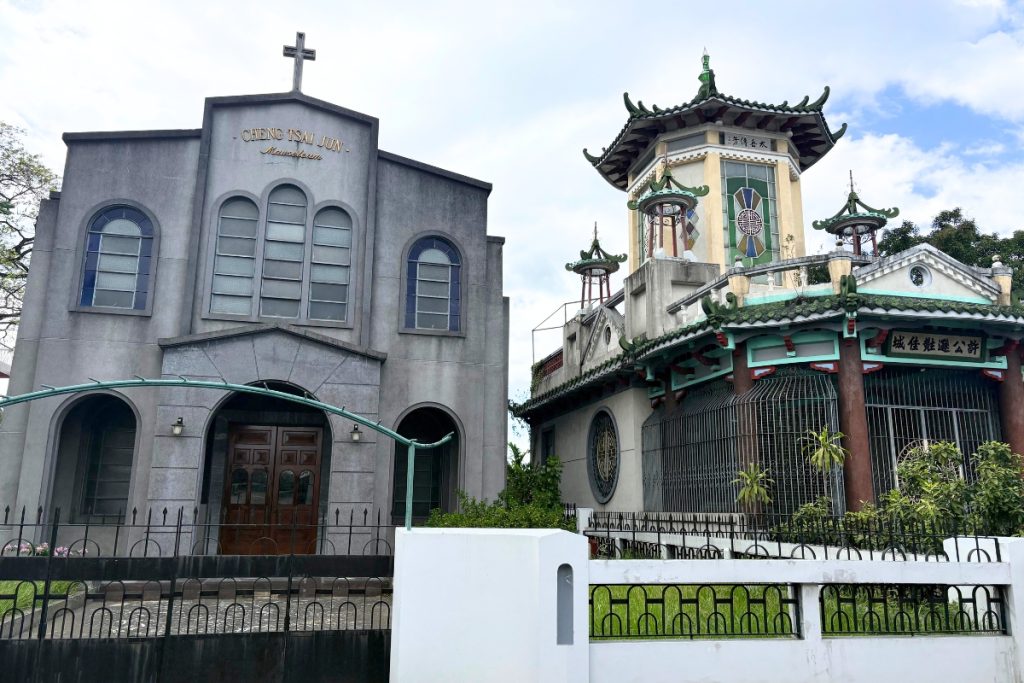
Past the temple, the mausoleums take over. Some read more like small houses than graves. One family tomb resembles a small gray chapel, with a cross on top and arched windows. It sits almost shoulder to shoulder with a green-roofed pagoda-style tomb next door. Another has a family name carved directly into a marble facade, more monument than headstone. Walk the narrow lanes between them, and it starts to feel less like sightseeing. More like wandering through someone else’s neighborhood. One where everybody happens to be permanently home.
San Agustin Church
The drive from the cemetery to Intramuros did not take long. It felt like crossing into a different city.
Intramuros means “within the walls.” The Spanish built it starting in the late 1500s, as the political and religious center of their colony. Thick stone walls once ringed the entire district, built to keep out pirates and rival powers. Only Spanish elites and mestizos were allowed to live inside. Everyone else lived outside the walls. Today the gates stand open, and the walls enclose museums, churches, and cobblestone streets instead of a closed colonial city.
San Agustin Church sits near the heart of it. It is the oldest stone church in the Philippines, completed in 1607. It survived a Chinese uprising, several earthquakes, and British occupation. During World War II, Allied bombing leveled most of Intramuros. San Agustin was the only building left standing. UNESCO added it to the World Heritage List in 1993, alongside three other Baroque churches in the country.
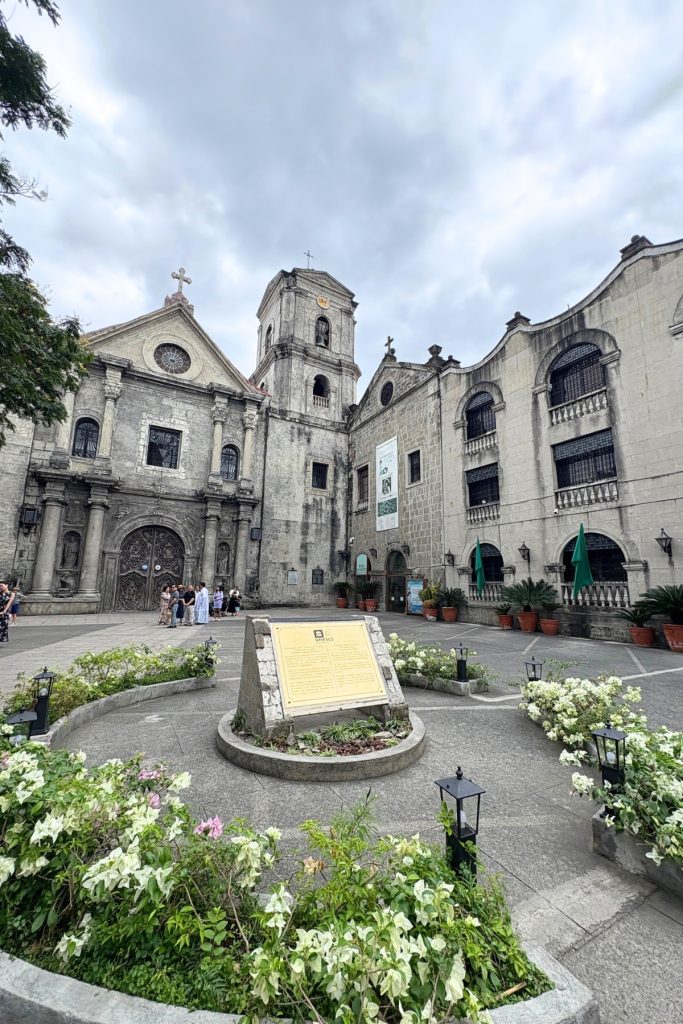
The twin bell towers and carved stone facade look almost plain from the plaza. Nothing prepares you for what is inside.
The Cloister Museum
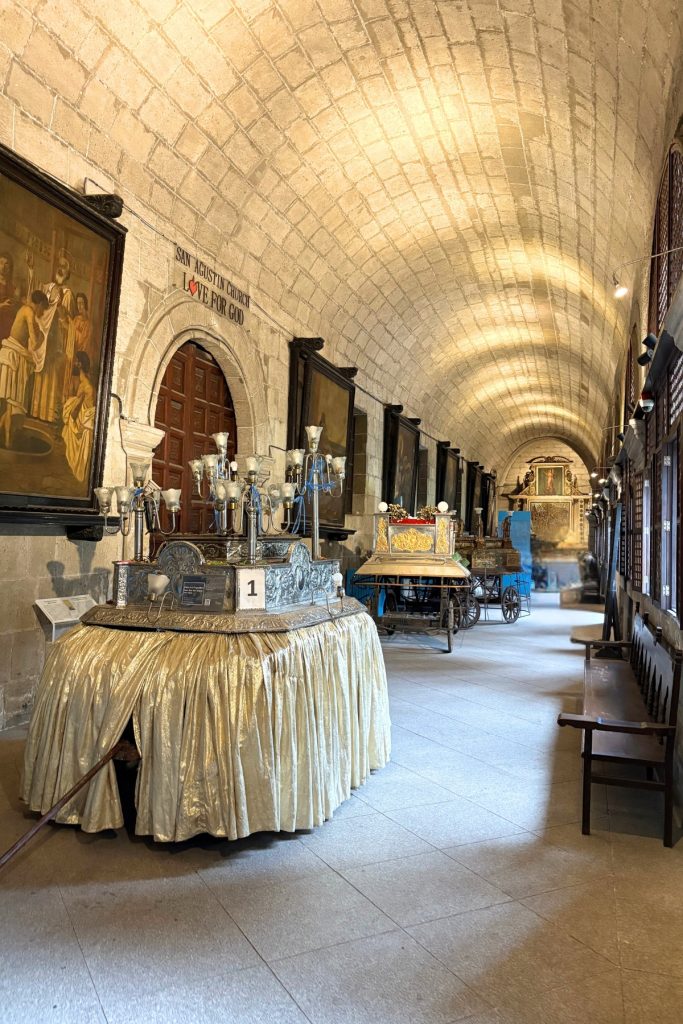
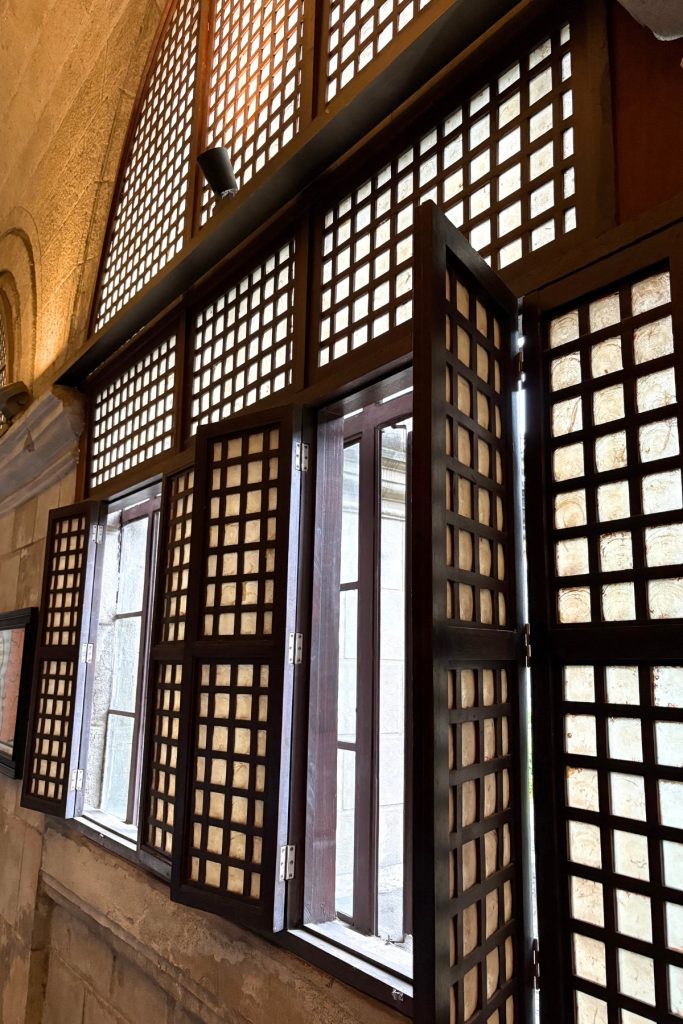
The cloister now runs as a museum. Vaulted stone ceilings stretch overhead. Old religious carrozas line the corridor, the kind once carried through the streets during processions, gilded and draped in fabric. Portraits watch from the walls the whole way down. Sunlight comes through capiz shell windows, the native shell used across the Philippines in place of glass, and it turns everything the color of weak tea.
Inside the Church
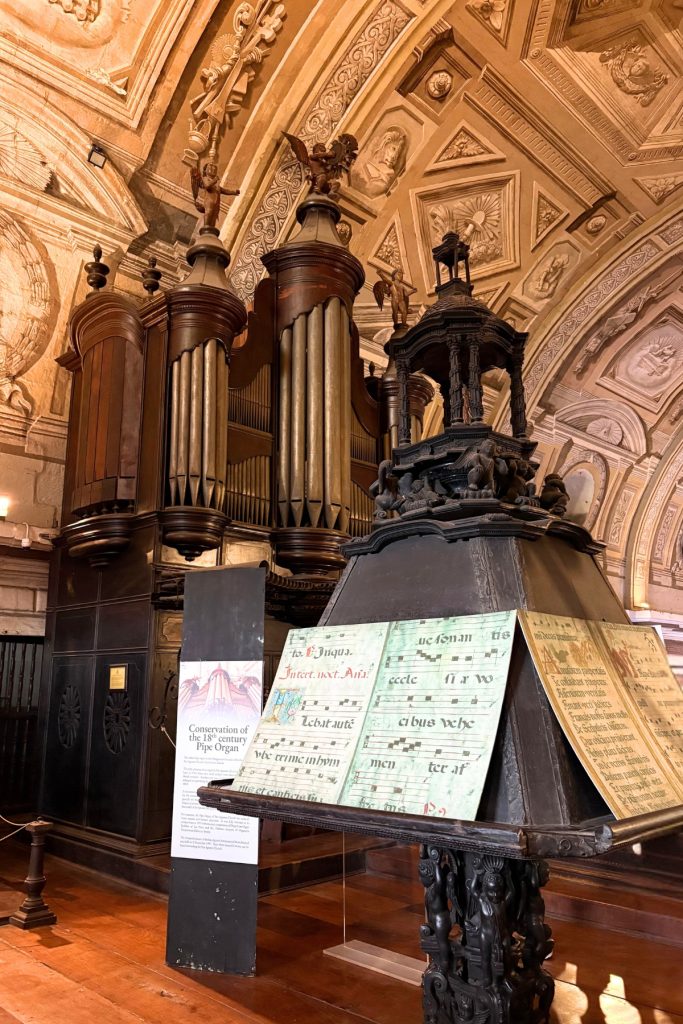
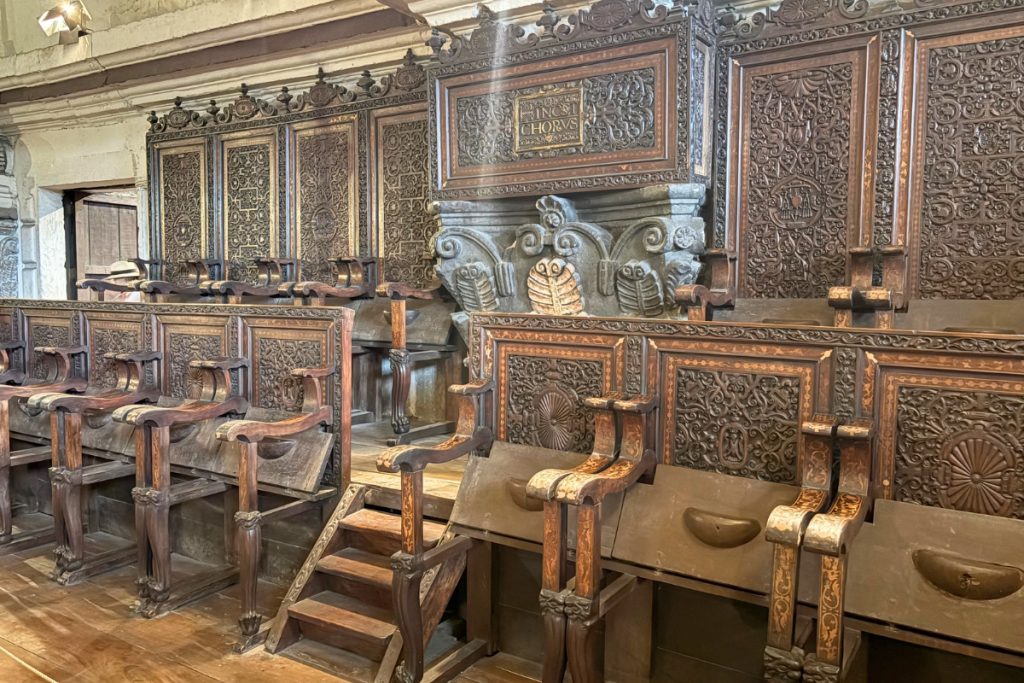
An 18th century pipe organ still stands behind the altar, under active conservation. Nearby, the choir stalls are carved dark wood, inlaid with gold leaf. Above them, a Latin inscription reads INCIPIT CHORUS. Here begins the chorus. This is where the friars once sang the divine office, several times a day, every day, for centuries.
The nave itself is almost overwhelming. Trompe l’oeil ceiling murals fool the eye into seeing three dimensional carving where there is only flat paint. Chandeliers dropped low over the pews, catching the light from the stained glass above.
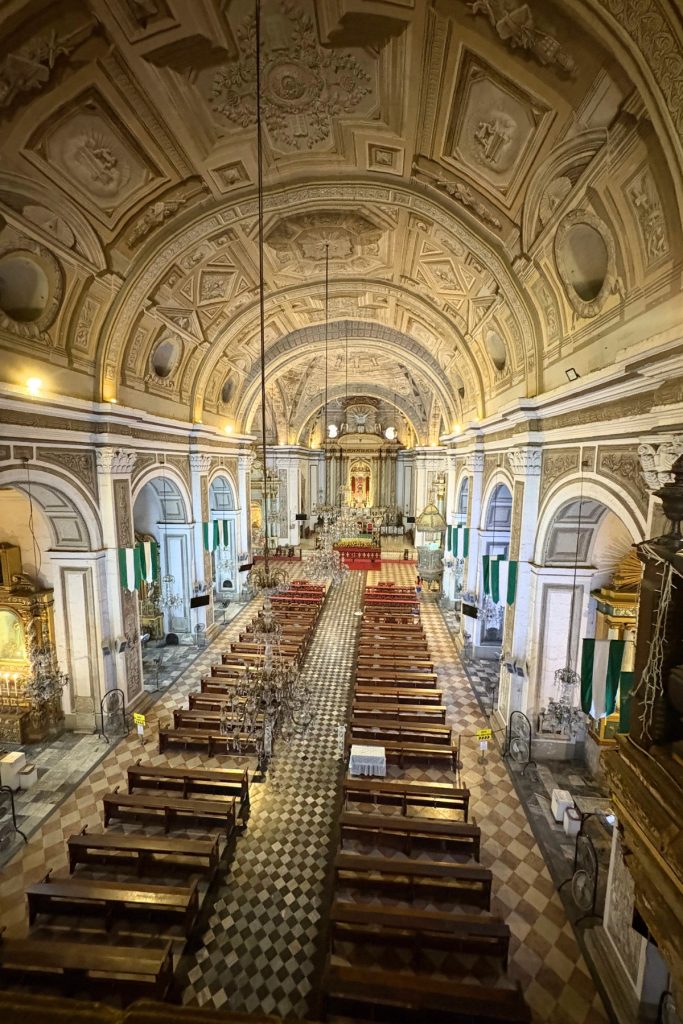
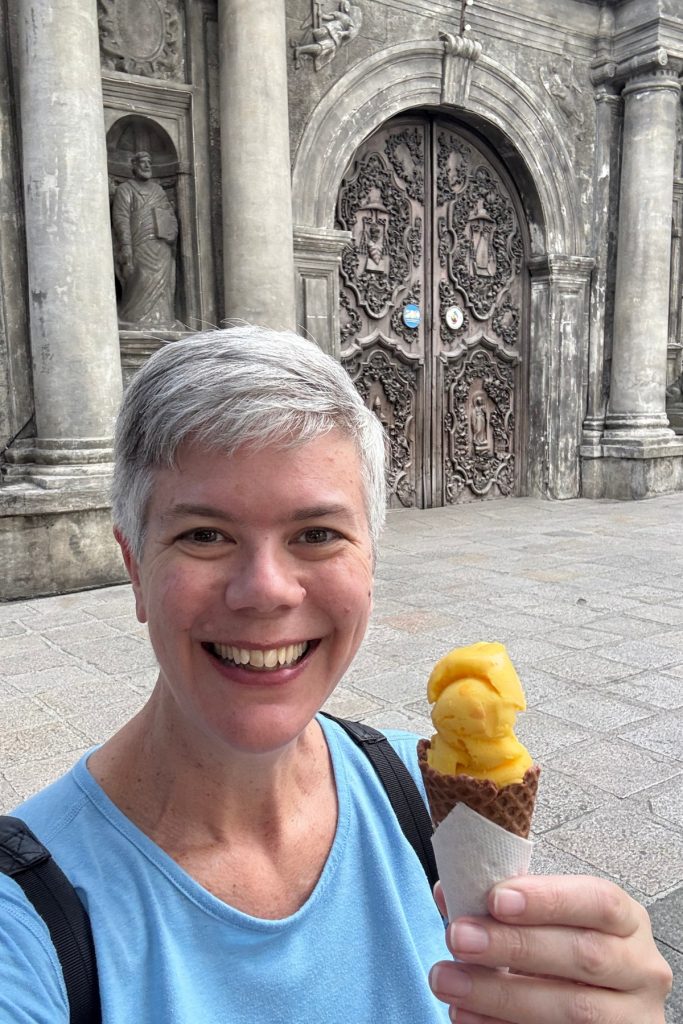
I left through the same carved wooden doors I came in, and Margareth bought us mango sorbetes from a cart parked just outside. Soft serve, in a cone, from a small hand-cranked machine. Four hundred years of history, and then ice cream. Not a bad way to end a church visit.
Manila Cathedral
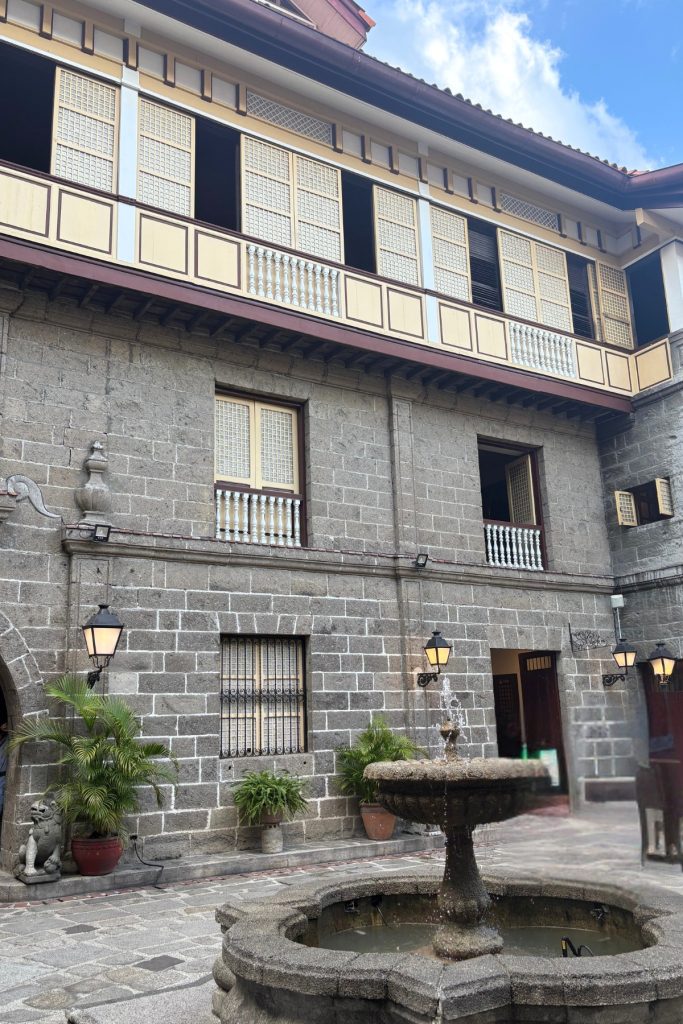
From San Agustin, the walk to the cathedral cut through Casa Manila. It’s a preserved colonial-era house turned museum, all carved wood balconies and stone courtyards. We did not go inside. We walked through its open courtyard on the way, past a fountain and a set of worn stone stairs, guarded by a small stone lion at the base. A few minutes later, we reached Plaza de Roma, and Manila Cathedral.
Eight Times Rebuilt
San Agustin survived the war. The cathedral did not.
Allied bombing in 1945 nearly destroyed it, the same fighting that leveled most of Intramuros around it. This building is the eighth version of the cathedral to stand on this site since 1571. Earthquakes, fires, and war took the previous seven. Architect Fernando Ocampo designed the current structure in a Neo-Romanesque style, and it was consecrated in December 1958.
A Wedding, Then the Quiet
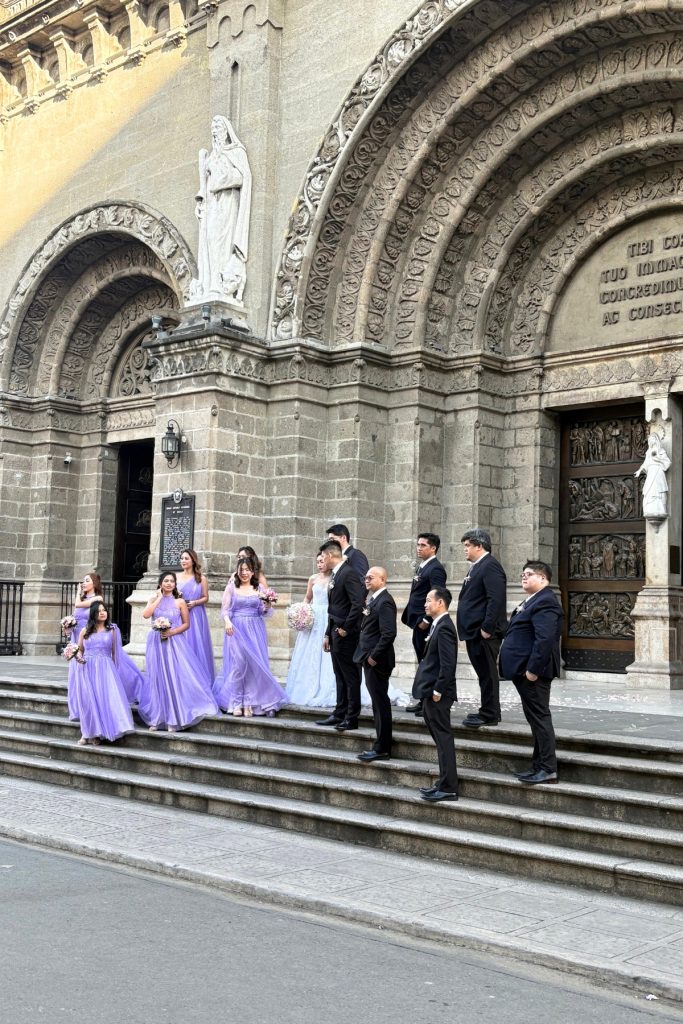
We arrived as a wedding was wrapping up. Bridesmaids in lavender dresses posed on the front steps, next to groomsmen in black suits, all of it framed by the carved stone archways over the doors. I waited for a gap in the photos before heading inside myself.
The interior earns the rebuild. Vaulted stone arches rise overhead in long rows, catching color from the stained glass windows. Chandeliers hang low over the pews, more delicate than San Agustin’s, less gilded and more restrained. At the far end, a golden image of Our Lady sits inside its own arched shrine, ringed with candles.
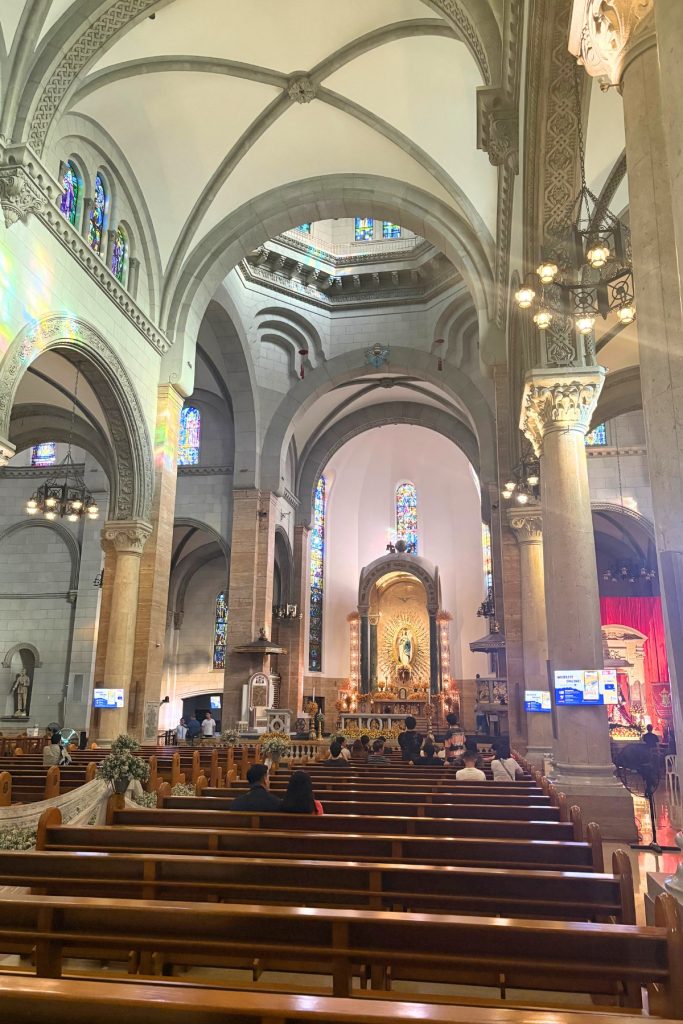
Between the wedding party out front and the quiet arches inside, the cathedral does not feel like a single building. It feels like two different moods, standing a few feet apart.
Fort Santiago & Baluarte de Santa Bárbara
The walk from the cathedral ended at the river. Fort Santiago sits at the edge of Intramuros, where the Pasig meets the bay.
Fort Santiago
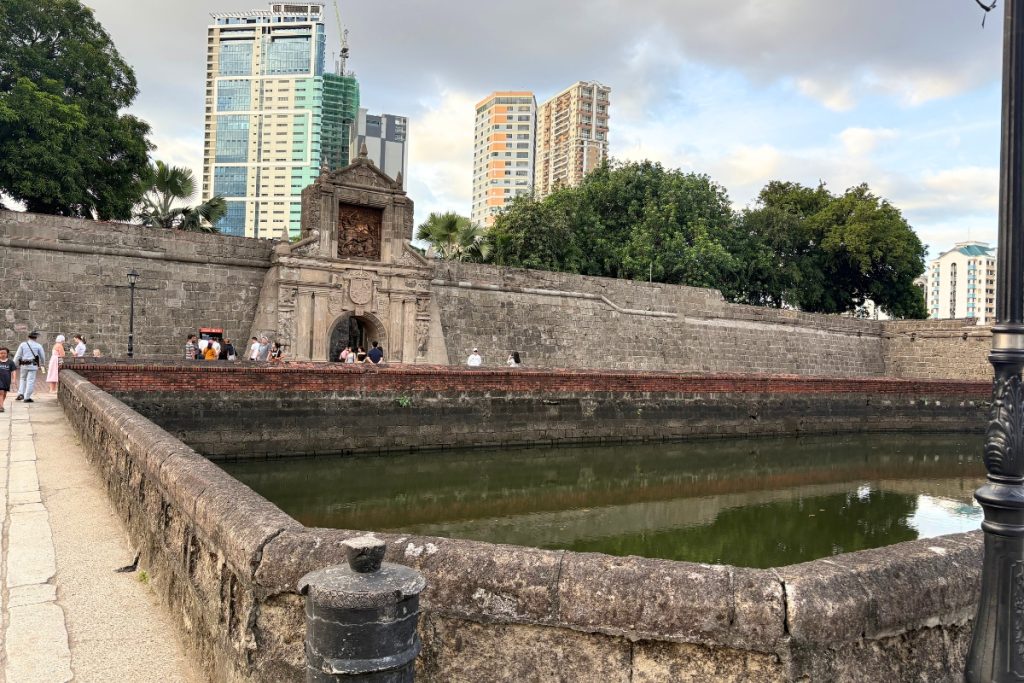
The Spanish built the fort in 1571. It guarded the mouth of the river for over three hundred years, under Spanish, British, American, and Japanese control. A stone moat still surrounds part of it, and the main gate carries a carved coat of arms above the entrance.
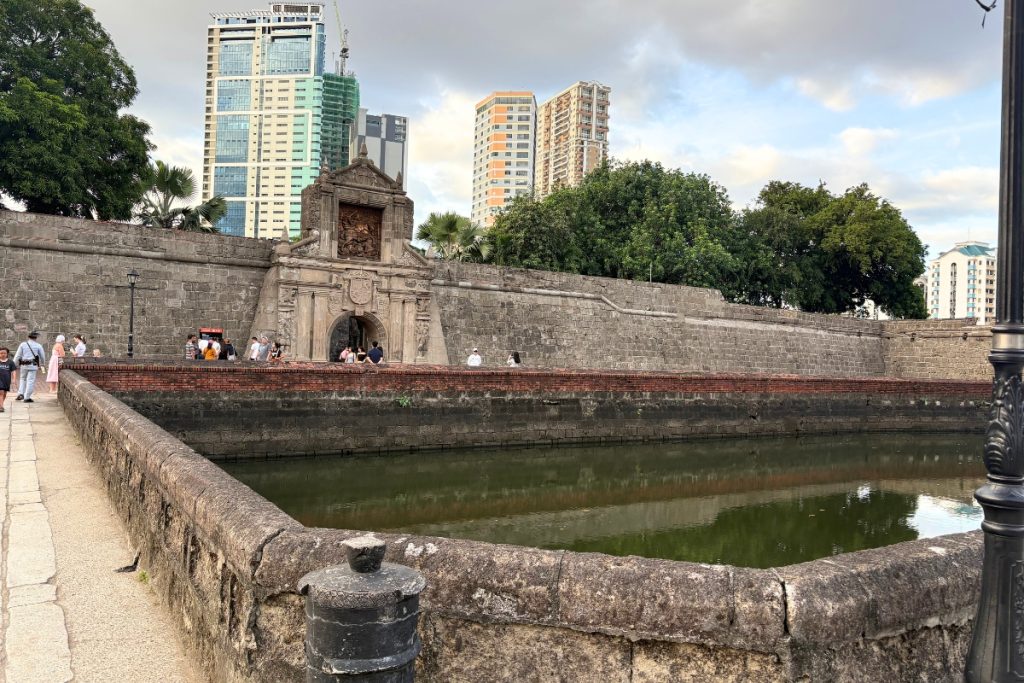
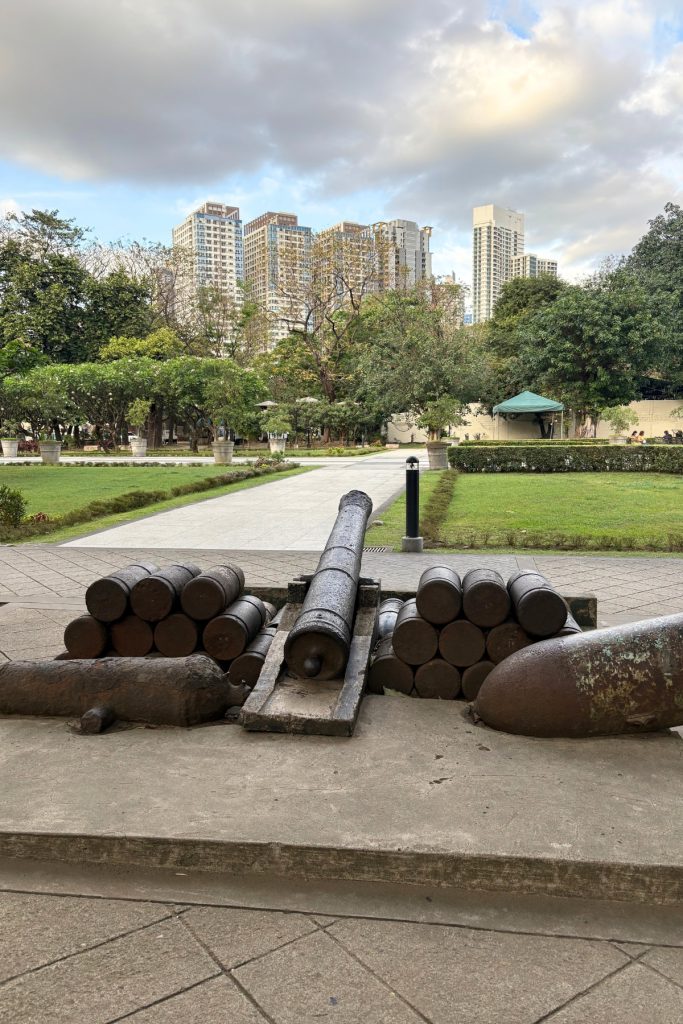
Inside, much of the fort stands in ruins. Stone archways open onto empty courtyards. Roofs are gone in places, walls stop mid-air, and grass grows where floors used to be. A cannon display sits near the fort’s edge, old iron pointed out toward a skyline of modern towers.
The Rizal Shrine sits within the fort grounds, a restored building where Jose Rizal spent his final days. Rizal was a writer and physician, and the country’s national hero. His novels exposed abuses under Spanish colonial rule, and his writing helped inspire the independence movement, though he never advocated for it directly himself. He was imprisoned here for 56 days, from November 3 to December 29, 1896, before his execution the following morning.
Baluarte de Santa Bárbara
At the north end of the fort is Baluarte de Santa Bárbara. Spanish soldiers built it in the 1590s, as a defensive bastion overlooking the river. Underneath it, they carved storage vaults for gunpowder. The dampness from the river made the vaults useless for that purpose, so they became prison cells instead.
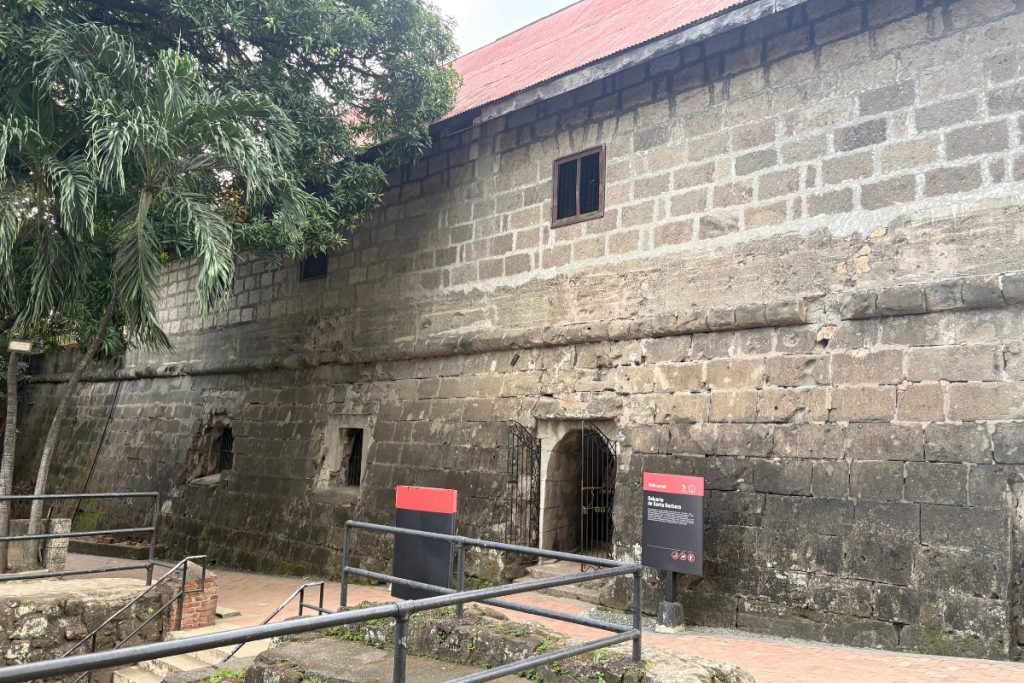
During the final days of the Battle of Manila in 1945, Japanese forces held hundreds of Filipino and American prisoners in these vaults. Most did not survive. A white marble cross now stands near the entrance to the dungeons, marking a mass grave.
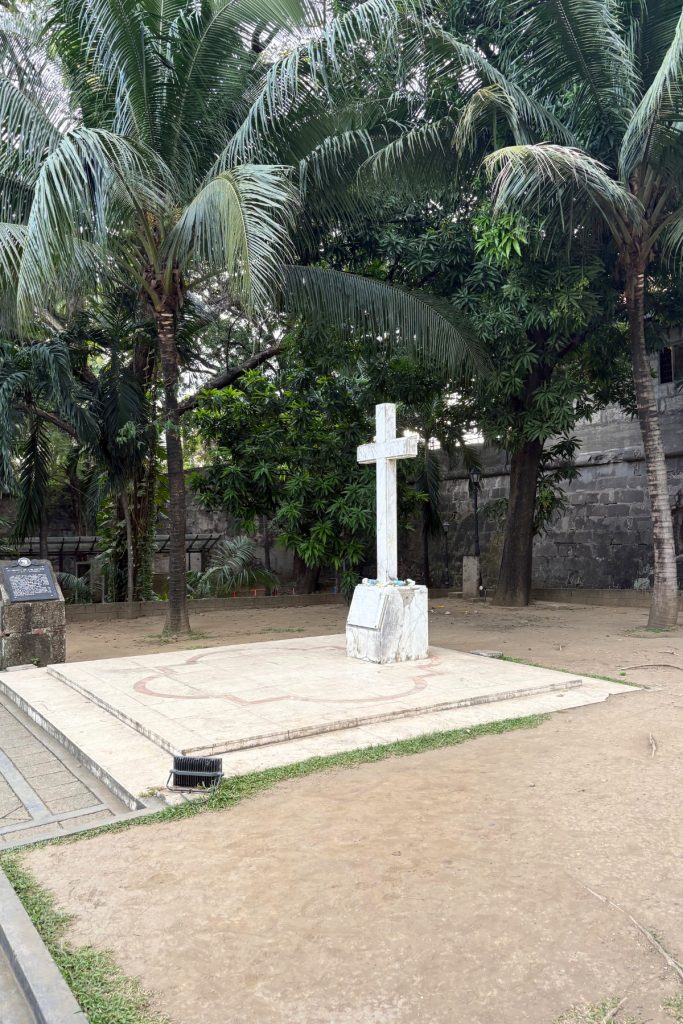
Some places do not need commentary. This is one of them.
Rizal Park
From Fort Santiago, it is a short walk out of the fort and along the water, to the open lawns of Rizal Park.
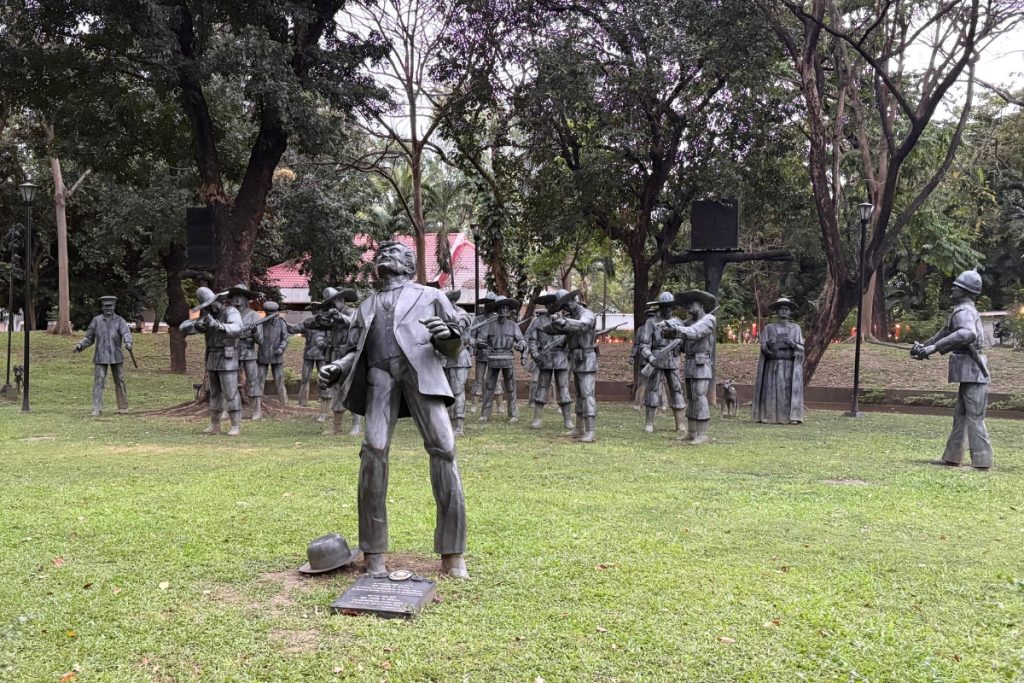
This is where Jose Rizal was executed, on the morning of December 30, 1896, at 7:03 AM. He was made to face away from the firing squad. Witnesses say he twisted around at the last moment, so he could face them as he fell.
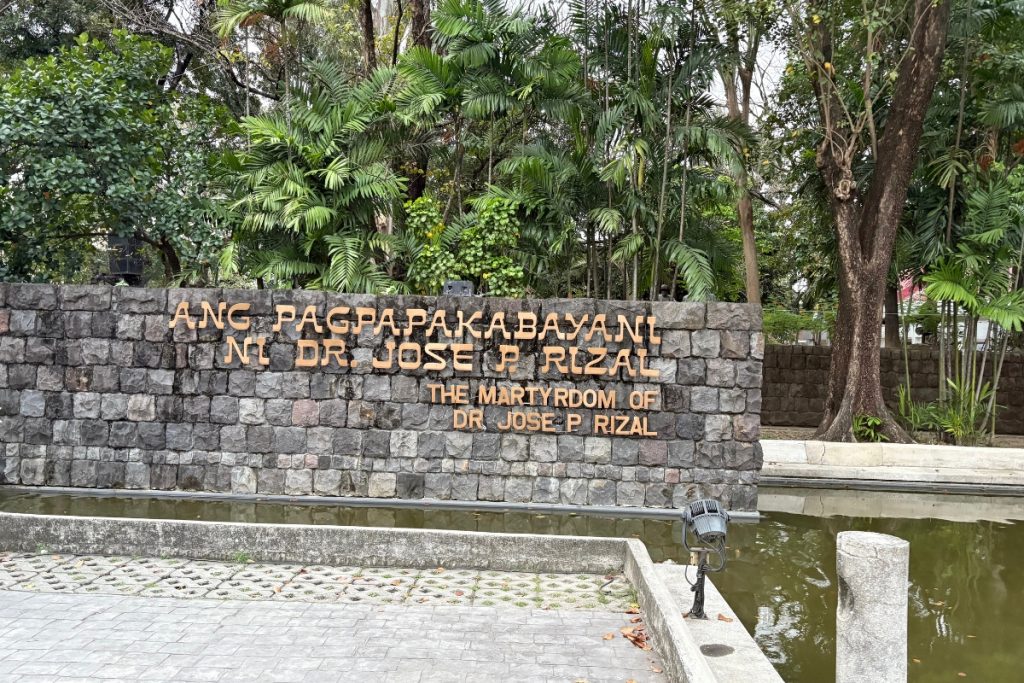
A stone marker reads “Ang Pagpapakabayani ni Dr. Jose P. Rizal,” the martyrdom of Dr. Jose P. Rizal. Nearby, a life-size bronze tableau recreates the execution itself. Soldiers stand in formation, rifles raised. Rizal stands at the center, alone, moments before turning to face them.
Further into the park, the Rizal Monument rises above the trees, an obelisk built over the site of his actual burial. Two flags fly beside it, the Philippine flag and a memorial flag marking the spot. I visited as the sun was setting, the sky behind the monument turning orange and gray.
Rizal’s execution helped ignite the revolution that eventually ended Spanish rule. He was thirty-five years old.
Worth the Time if You Have It
The day was full, but Manila had more on offer than any one itinerary could cover. A few worth adding if you have the time:
- National Museum Complex. Three museums, Fine Arts, Anthropology, and Natural History, sit right on the edge of Rizal Park, and admission is free. The Fine Arts building alone holds Juan Luna’s Spoliarium, a massive 1884 painting that won gold at an exposition in Madrid. Easy to pair with a Rizal Park visit, since they share the same block.
- Divisoria Market. If Dangwa was overwhelming in flowers, Divisoria is overwhelming in everything else. This is Manila’s main bargain shopping district, blocks of stalls selling textiles, housewares, holiday decor, and food, at prices locals actually shop at. Less curated than a tourist market, and better for it.
- Paco Park. A circular garden in the Paco district, built in the early 1800s as a cemetery for wealthy Spanish families and cholera victims. Jose Rizal was actually buried here first, before his remains were later moved to the monument at Rizal Park. Burials stopped in 1912, and the space is now a quiet public garden, walled in adobe, with old crypt markers still lining the interior walls.
Closing Thoughts
The night before I embarked, I stood in Rizal Park after sunset. The Crystal Symphony was docked nearby, just visible past the trees behind the monument.
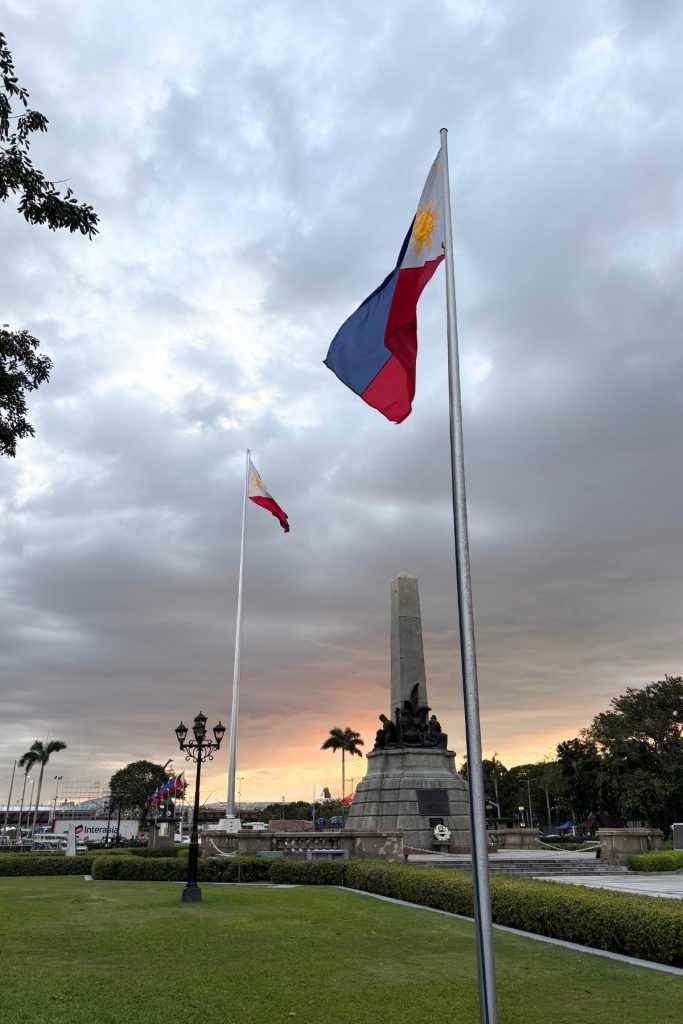
The next afternoon, I stood on the ship’s upper deck as we pulled away from port. Rizal Park was right there, across the water. I could pick out the flagpole, the same one I had stood in front of the day before.
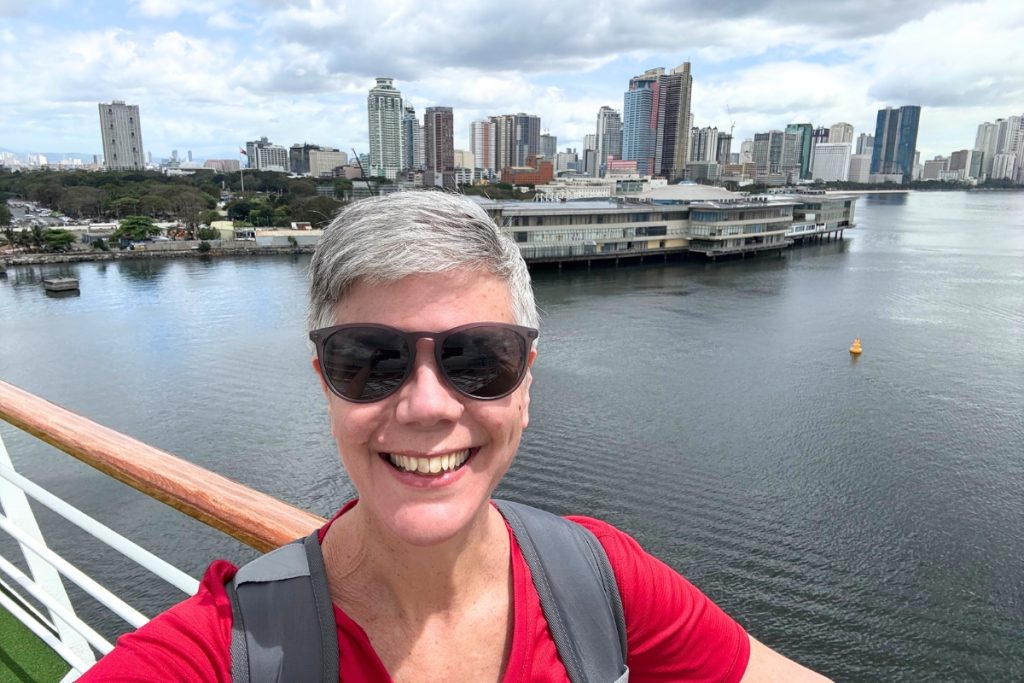
Two viewpoints, one view. Manila, looking at the ship. Then the ship, looking back at Manila.
This is the version of this city I got. Not the whole thing. Not even close. Just one solo morning, one guided afternoon, and enough lanterns, pork, cemetery, and colonial stone to fill both.
Common Questions
I walked it solo in the morning with no issues. Like any dense urban neighborhood, stay aware of your surroundings, keep valuables secured, and stick to busier streets, especially early in the day before it gets crowded.
You can absolutely explore Intramuros independently. Fort Santiago, San Agustin Church, and Manila Cathedral are all set up for self-guided visits, with signage and, in some cases, on-site museums. A private guide adds context and saves time, which mattered for me since I only had one afternoon.
Through Tours By Locals. I booked this one months ahead of the trip, and it covered the flower market, La Loma Lechon, the Chinese Cemetery, and Intramuros in a single afternoon.
Not really, but it is enough to get a real feel for it. I split mine between a solo morning and a guided afternoon, and still only scratched the surface. If you have more time, add a full second day for the National Museum Complex, Divisoria, or Paco Park.
Look for stands with steady turnover and a visible crowd, since that usually means the food is fresh and moving fast. Mila’s Lechon and Ryan’s Lechon in La Loma are established, well-known spots, not random roadside carts.
No advance booking is required for either. Both charge a small entrance fee, paid on-site.
Keep Wandering
Hiroshima & Miyajima: Sacred, Scarred, and Spectacular