Swipe, Ride, Explore: Tokyo’s Subway Made Easy
Tokyo’s subway system might look like a tangle of colorful spaghetti on the map, but don’t let it intimidate you. It’s actually one of the most efficient and foreigner-friendly transit networks in the world. With a simple IC card tap, you’ll be gliding beneath the city like a local in no time. Whether you’re chasing ramen in Shinjuku or temples in Asakusa, this guide will have you riding with confidence from day one.
This post walks through everything you need to hit the ground running on your first Tokyo subway adventure. You’ll learn how to get and load a Suica card (your all-in-one transit pass). Plus, learn how to use a Maps app to plan your routes like a seasoned commuter. I will also share some insider tips on navigating the sprawling underground system so you never find yourself lost in the crowd.
Navigating Tokyo’s Subway System
I recently visited Tokyo for the first time. I had some time on my own to explore the city before embarking on a cruise. Normally I try to plan my itinerary to maximize walking (it really is the best way to see a city!). But a huge city like Tokyo often means using public transportation from time to time. I took the plunge and decided to take the subway a few times. While it was a bit overwhelming at first, I quickly realized it is a very efficient and effective system. Here are my tips for how to navigate everything like a pro.
Suica Card
The first important tool in your Tokyo subway toolkit is a Suica card. This is a rechargeable smart card that acts as your all-access pass to public transportation throughout Tokyo. Use your Suica card on trains and buses. You can even use your Suica card for convenience store purchases!
Getting a Suica card is easy. You can add it digitally to your iPhone or Apple Watch via the Wallet app before you even leave home. Or, you can purchase a physical card at any JR station ticket machine once you get to Tokyo. Use the iPhone Wallet app and Apple Pay to load a digital card with money. Use any ticket machine inside any station to load a physical card with cash. Once your card is loaded with money, it’s a simple tap and go to use it in any station!
Cost of the Rides
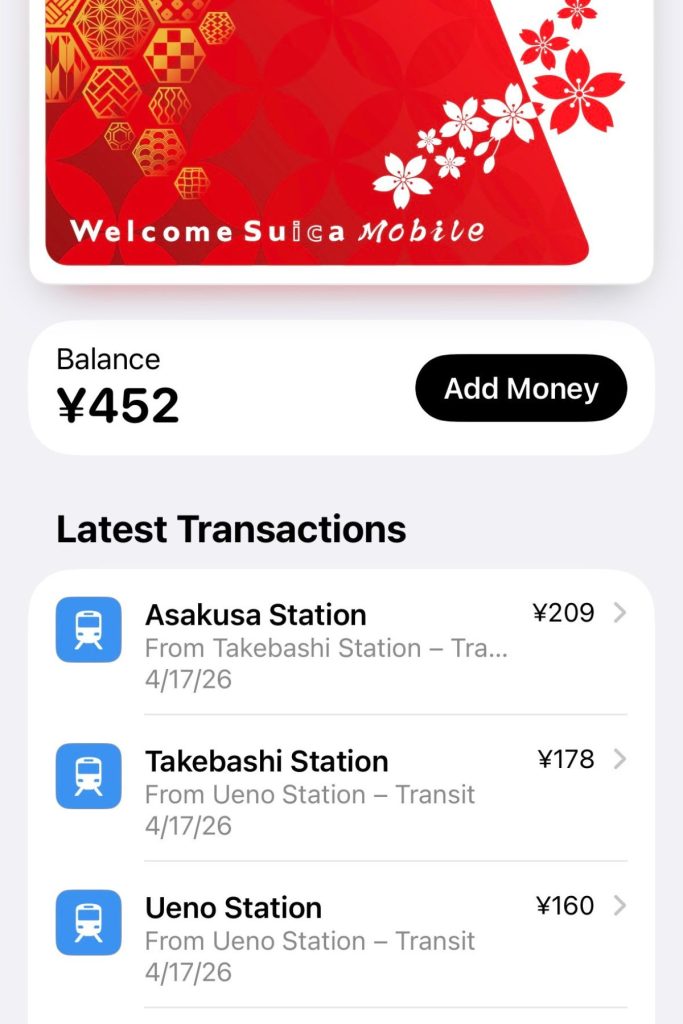
Most single rides within central Tokyo cost between ¥150 and ¥300. For a few days of exploring, loading ¥3,000–¥5,000 is a comfortable starting point. But you can top up at any time, so don’t worry if you don’t get it exactly right! If you don’t use it all up on your trip, you can get a refund of any remaining balance on a physical card at a JR station service counter, minus a small ¥220 handling fee. Digital Suica card balances cannot be refunded so they will just stay on the card. Or, you can spend the balance on your digital card at a convenience store. Trust me…those egg salad sandwiches are worth the hype!
- Download a digital Suica card to your Wallet app or purchase a physical card in a station
- Load your card with money to get started, and top it off along the way as needed
- Use your Suica card for public transportation and in convenience stores
Planning Your Route
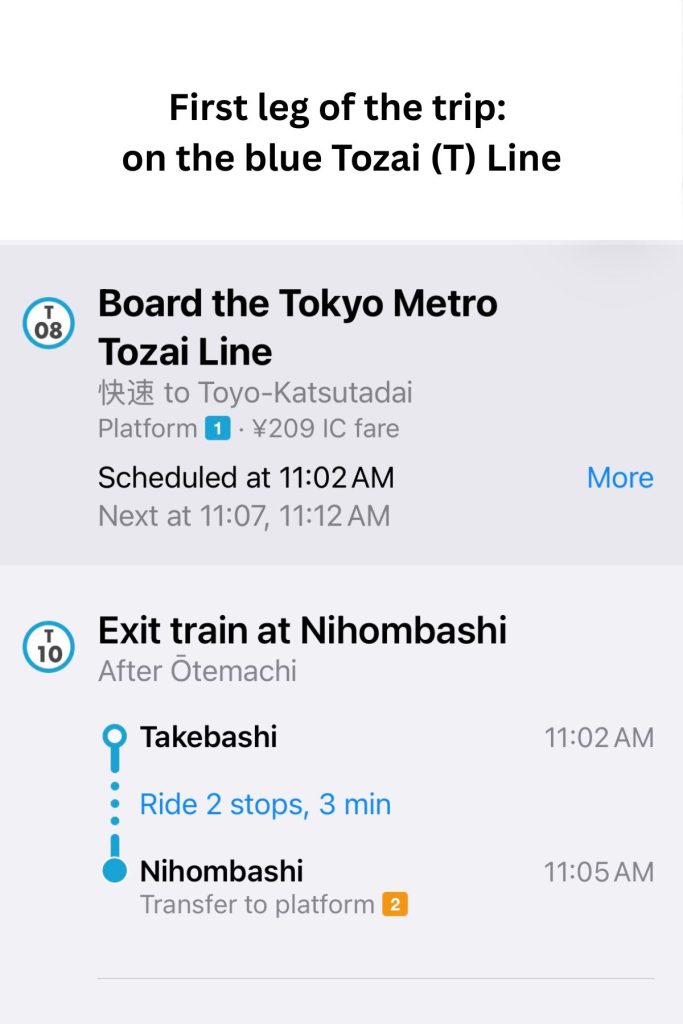
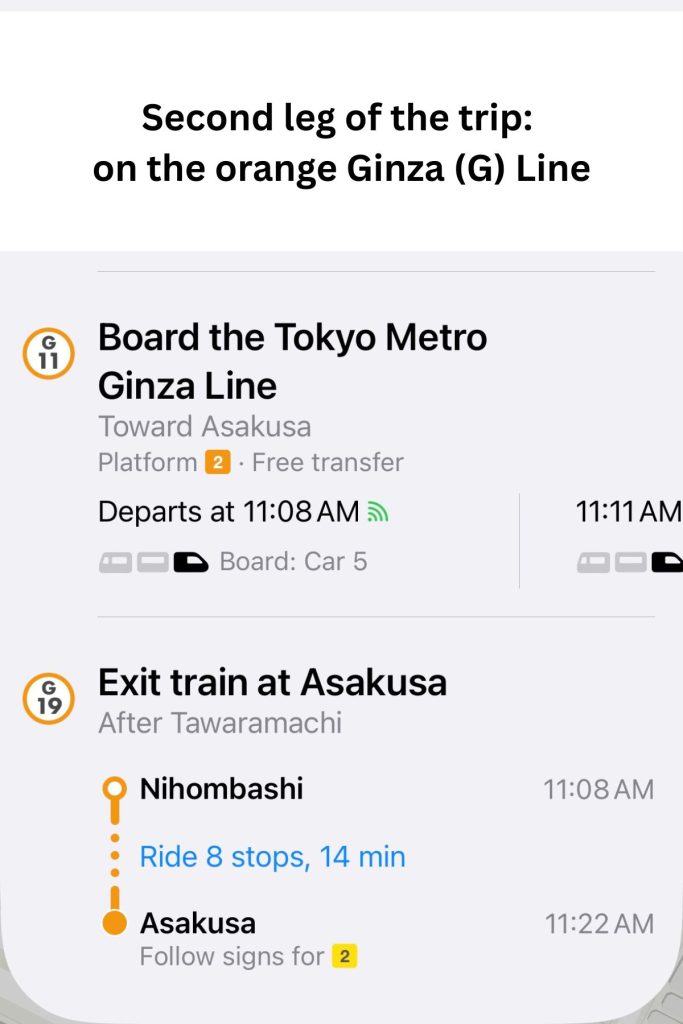
The next step is planning your route. I used Apple Maps for this, and I found it extremely helpful. Google Maps provides similar functionality. Enter your starting and ending point. Then, choose the ‘public transportation’ option (the icon that looks like a subway car) to see the route choices. Each route provides detailed steps for the entire journey. It will including any walking you need to do to get to/from a station. Detailed information about the specific trains and platforms you will use along the way is also included. The details will also indicate how many stops you will ride. Sometimes, the best car to board is even called out.
The below pictures show the details of my trip from the Imperial Palace East Gardens to my hotel in Asakusa. This trip had two legs. The first was on the blue Tozai Line. Here, I boarded at stop T08 (at platform 1) and exited at stop T10. The second leg required me to transfer to the orange Ginza Line. Here, I boarded at stop G11 (at platform 2, on car 5) and exited at stop G19. Once at my final stop at G19, Asakusa, I followed the directions to exit at gate 2.
- Get step-by-step directions in Apple Maps or Google Maps
- Pay attention to the details within the directions, including:
- The name and color of the line
- The platform number
- The recommended car and/or door (if provided)
- The number of stops
- The best exit gate number
- If you miss a train, the Maps app will help you find the next option
Inside the Station
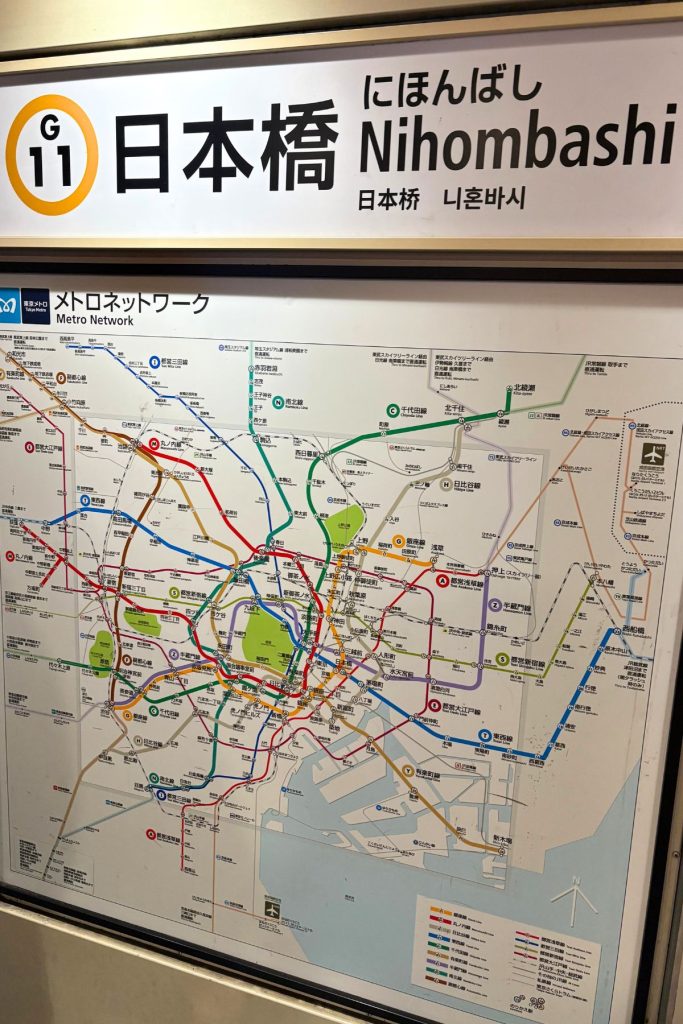
The stations themselves can be very intimidating once you are inside. The good news is that there is ample signage everywhere, and everything is in Japanese as well as English. Everything is easy to find by using the color-coding. The signage clearly indicates the platform numbers and the name of the line. So, it really is pretty easy to just follow the signs to find what you need.
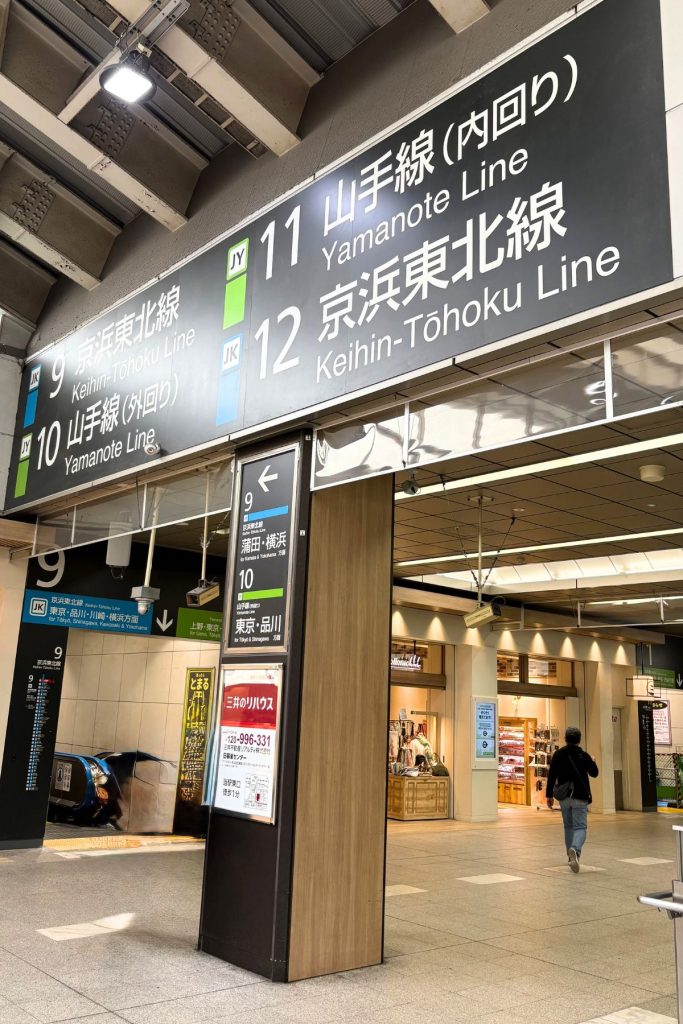
Navigating the Stations
The Tokyo subway is very crowded, so expect to see a lot of people at the stations! But again, rely on the signage to point you in the right direction. There are lots of friendly people around who can help get you back on track If you get lost or turned around. There are also service desks throughout the stations with employees who can help as well.
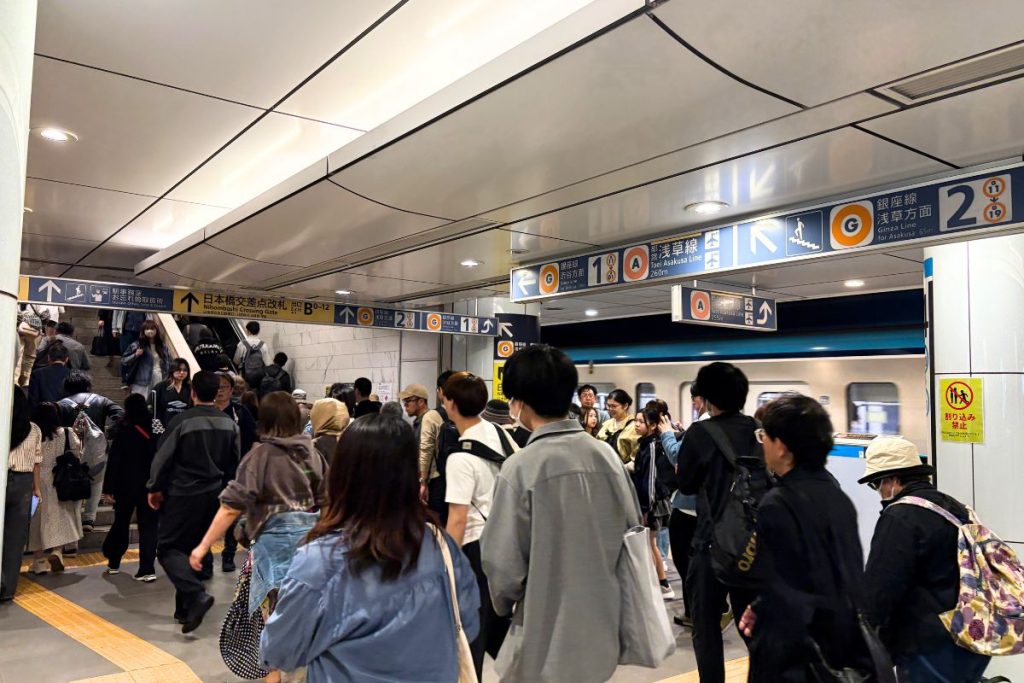
Loading Zones in the Stations
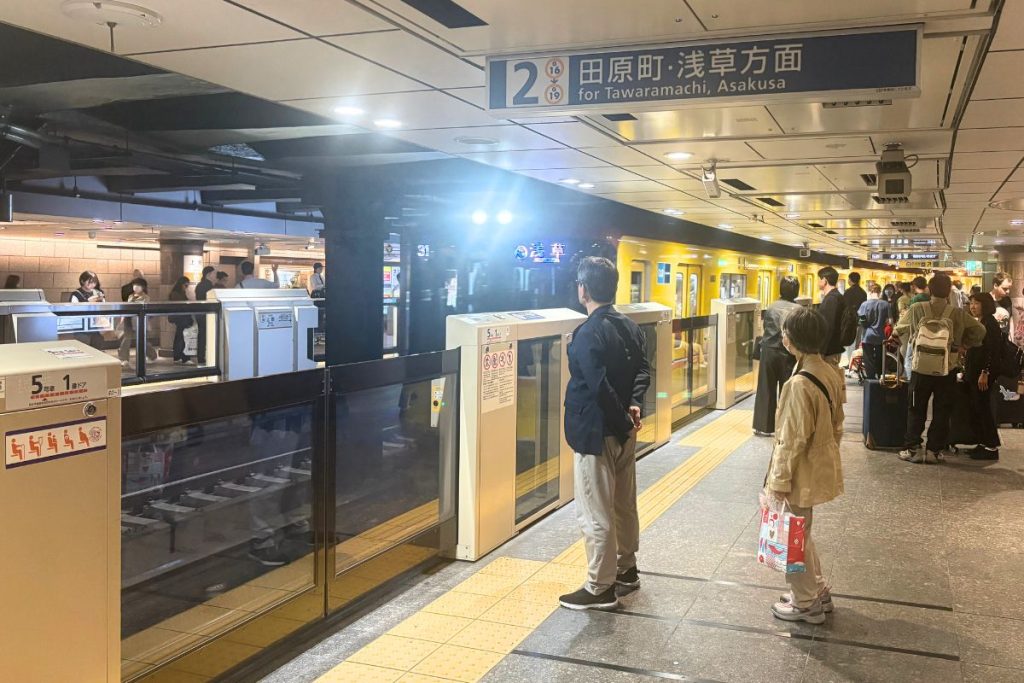
Once you find the right platform (this one is platform 2 on the orange Ginza Line towards Asakusa), you will see several different loading zones. There are glass doors that will automatically open once the train has arrived, and passengers will line up at each doorway to board the train.
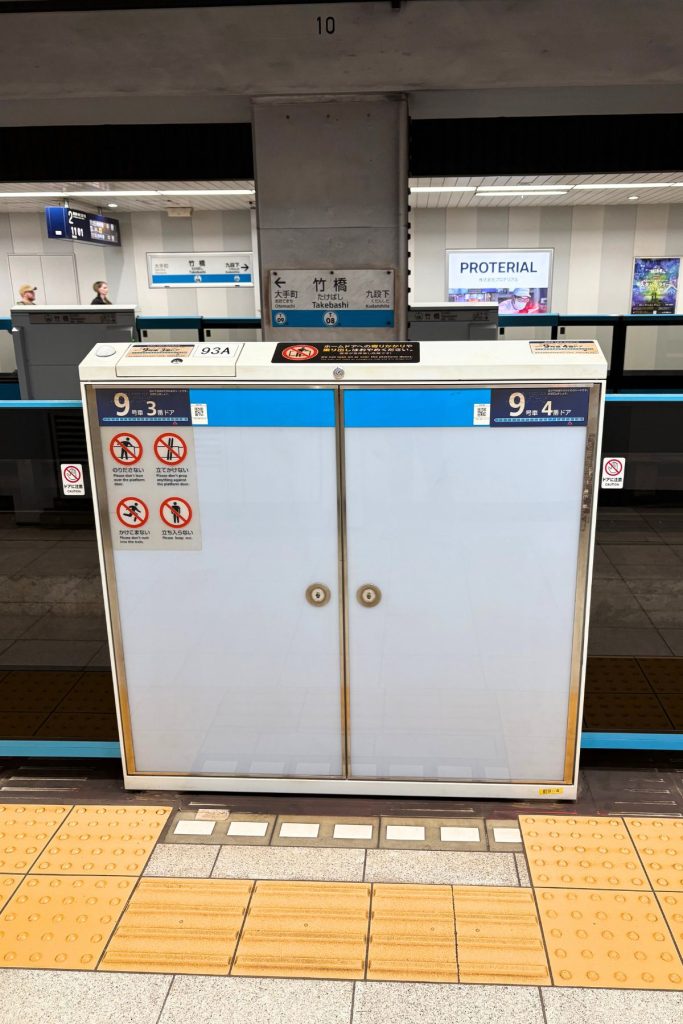
Each boarding door will indicate the car and door associated with it. The picture below shows that car 9, door 3 is on the left and car 9, door 4 is on the right. If the Apple Maps directions indicate a specific car and/or door, this is where you will look for it. If none is specified, go ahead and choose whichever one has the smallest line. As is standard practice around the world, always allow passengers to exit the train first before you board the train.
- Use the plentiful signage within the stations to help guide you to the right line, platform, car, and/or door
- Color coding helps distinguish the different lines
- Ask for help if you get lost or confused
Exiting the Station
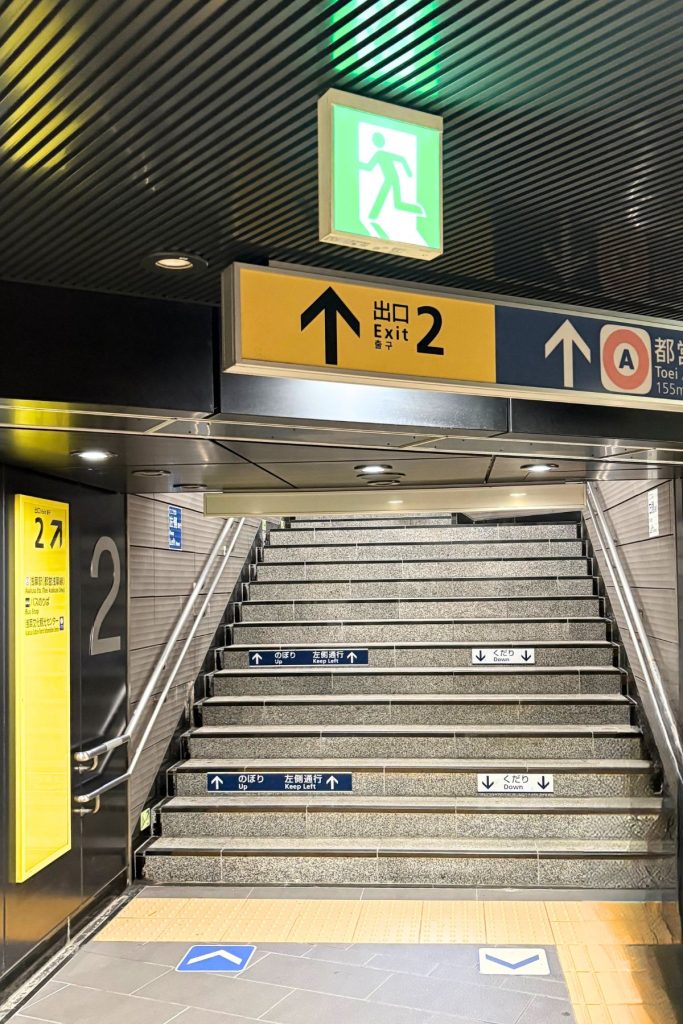
Once you have reached your final destination, refer to the Apple Maps directions to determine the best exit to take. All exits in all stations are marked with these yellow signs, as shown below. Sometimes the exits are referred to as ‘gates.’ Note also, per the photo below, that there are usually signs on the stairways to indicate which side you should stay on. I found that nearly all of the stations I visited had everyone keeping left, to help with the general flow of pedestrian traffic.
- Find the right exit (or ‘gate’) to use in the Maps directions
- All exits are indicated with yellow-colored signs throughout the stations
- Pay attention to which side of the stairs and/or walkway you should stay on to help the flow of traffic
Common Questions
Absolutely! Tokyo’s subway system is considered one of the safest in the world. It has extremely low crime rates, well-lit stations, and helpful staff available if you need assistance. As with any crowded space, you should always be aware of your surroundings and pay attention to your possessions and valuables. But I felt very safe while riding the Tokyo subway system.
Don’t panic – it happens to the best of us! The simplest option is to find the station attendant at the fare adjustment machine near the exit gates, and they can help you get it all sorted out quickly and easily.
Some of the basic etiquette rules that Tokyo commuters take seriously include: keep you phone on silent, avoid talking on calls or listening to anything without earphones, give up priority seats (well marked) to those who need them, and avoid eating and drinking on the trains. Probably the biggest point is to ensure you form an orderly line on the platform when boarding a train, and let the passengers exit before you board.
Even More Travel Ideas
Ancient Gates, Endless Streets: A Quick Dive into Tokyo’s Soulful East Side