One Day in Quebec City: A Self-Guided Walk Through Old Quebec
My Virgin Voyages cruise from New York City ended in Quebec City in early October. My flight out was the next morning, which left me with one day in Quebec City and, for once, no plan. I did not book a tour, hire a guide, or build an itinerary, which is unusual for a natural control freak. I just started walking.
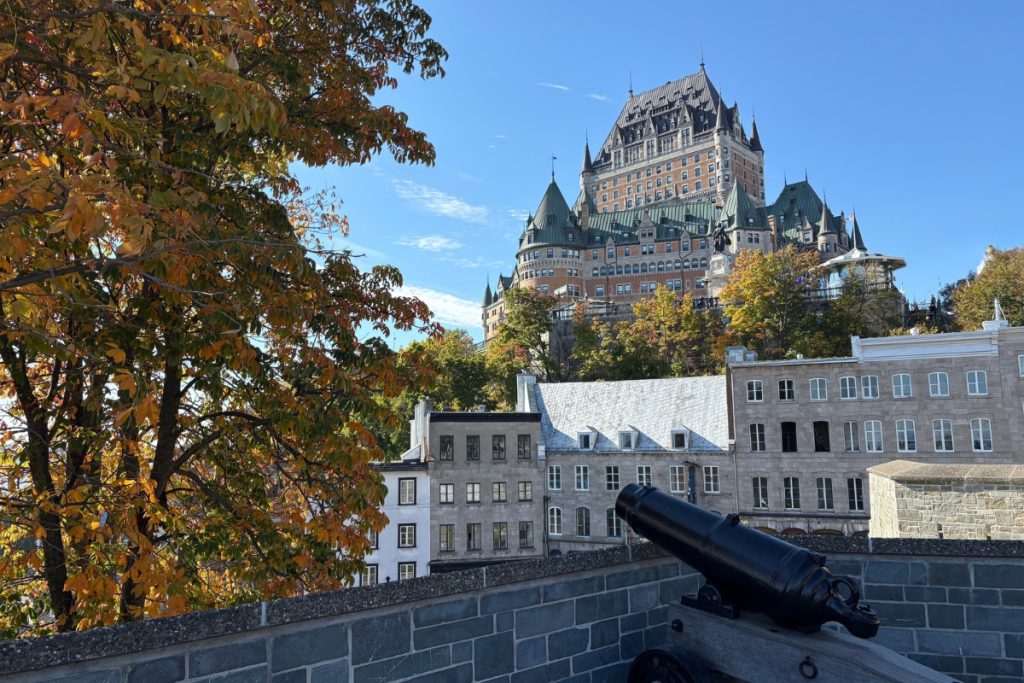
Here is what a day without a plan looks like. The Château Frontenac shows up in nearly every photo of this city. I have a few of my own. But Quebec City has more going for it than one very large hotel. There were a great many stairs and a fair number of cannons. There was a crepe topped with maple leaf cookies. It may be the most Canadian thing I have ever eaten. Lunch happened under a canopy of umbrellas. The trip ended at an airport exhibit about a snowman, which I did not see coming… It turns out the plan was optional. That is a difficult thing for me to admit.
Prefer to watch instead of read? Watch the video →
One Day in Quebec City, Up and Down
Old Quebec is built on two levels, and my day was mostly a loop between them. I went up, came back down, and stopped to eat more often than a strict plan would have allowed. By the end, I had wandered through a good part of the old city without a single appointment. Here’s how my day unfolded.
Umbrellas, a Mural, and a Lot of Stairs
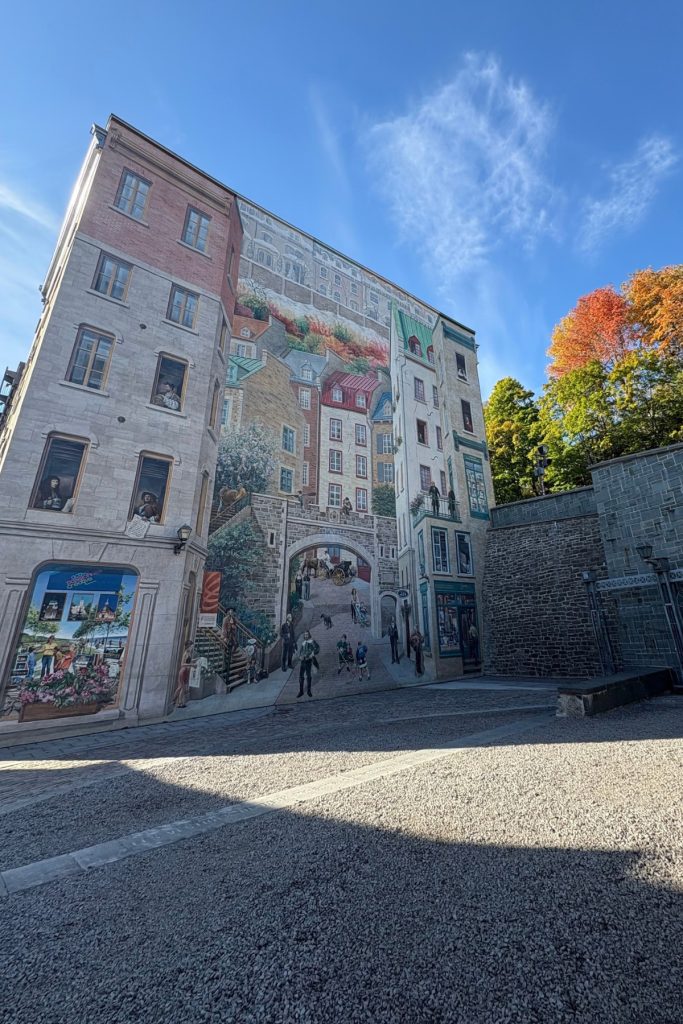
My first real stop was a wall. The Fresque des Québécois covers the side of a building at the corner of Rue Notre-Dame and Côte de la Montagne, near Place Royale. It is a trompe-l’oeil, which is a painting designed to trick the eye. Painted figures lean out of painted windows. A painted staircase and archway look like a street you could walk down. Twelve artists from France and Quebec painted it over nine weeks. It was inaugurated in 1999. It covers a wall of 420 square meters, or roughly 4,500 square feet. That is a lot of wall.
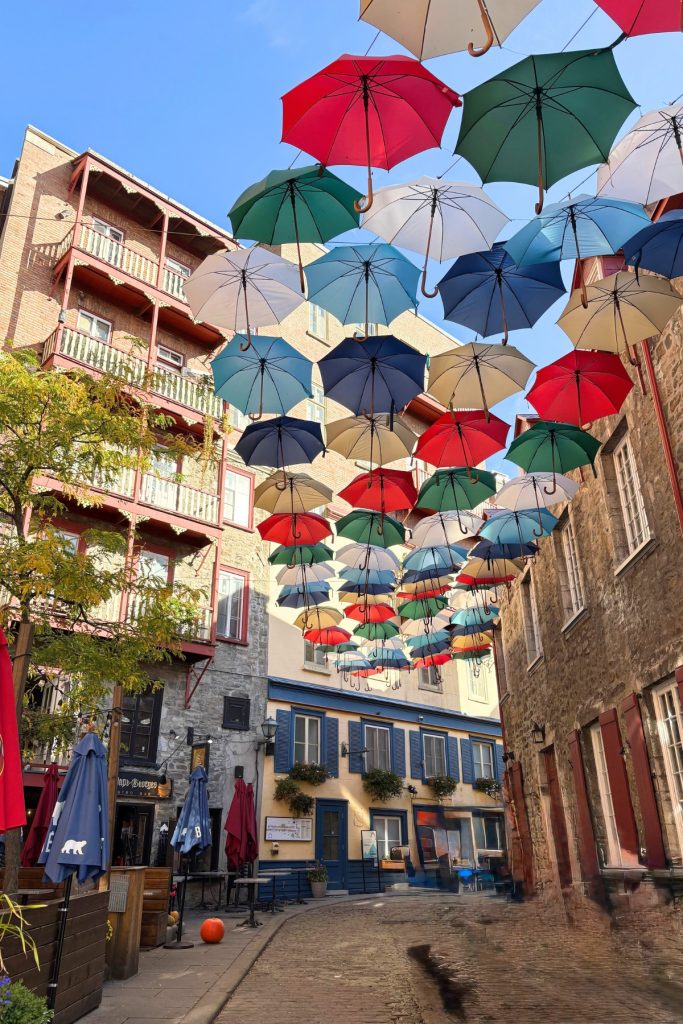
A short walk away, the sky filled up with umbrellas. Rue du Cul-de-Sac in the Petit-Champlain district is known as Umbrella Alley. About 95 umbrellas hang above it in red, blue, green, white, and beige. They usually go up in June and come down in October. I caught them near the end of their run. In January and February, the umbrellas are replaced by hockey sticks. They are strung up for the Québec City International Pee-Wee Hockey Tournament. Same idea. Different weather. I took an obligatory selfie underneath the umbrellas. They did most of the work.
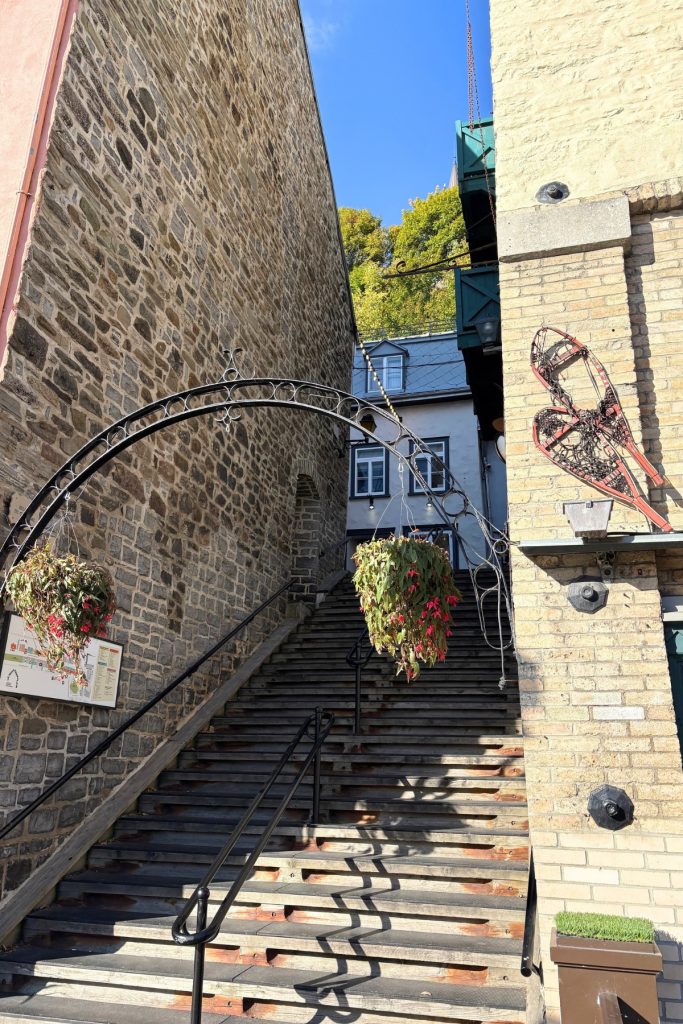
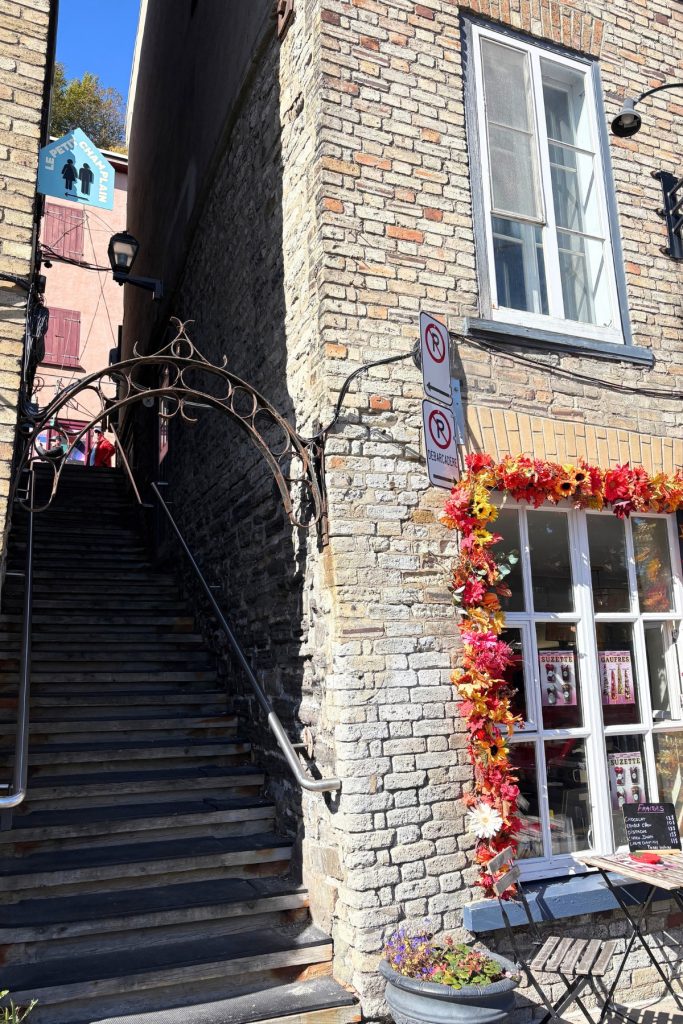
Then came the stairs. Old Quebec sits on two levels. A great many staircases connect them. This one, the Cul-de-Sac Stairs, had a wrought-iron arch, hanging flower baskets, and a snowshoe mounted on the wall. I walked past it. A staircase like this is the reason the funicular exists. The funicular was next. I would get my stair-climbing in later, on a set with a much more dramatic name.
The Funicular: A 45-Degree Shortcut
The funicular starts at the foot of the cliff on Rue du Petit-Champlain. The lower station is inside Louis Jolliet House, at number 16. The upper station sits on Dufferin Terrace near the Château Frontenac. The building at the bottom has FUNICULAIRE spelled across the front, in case anyone is confused about the point of the trip.
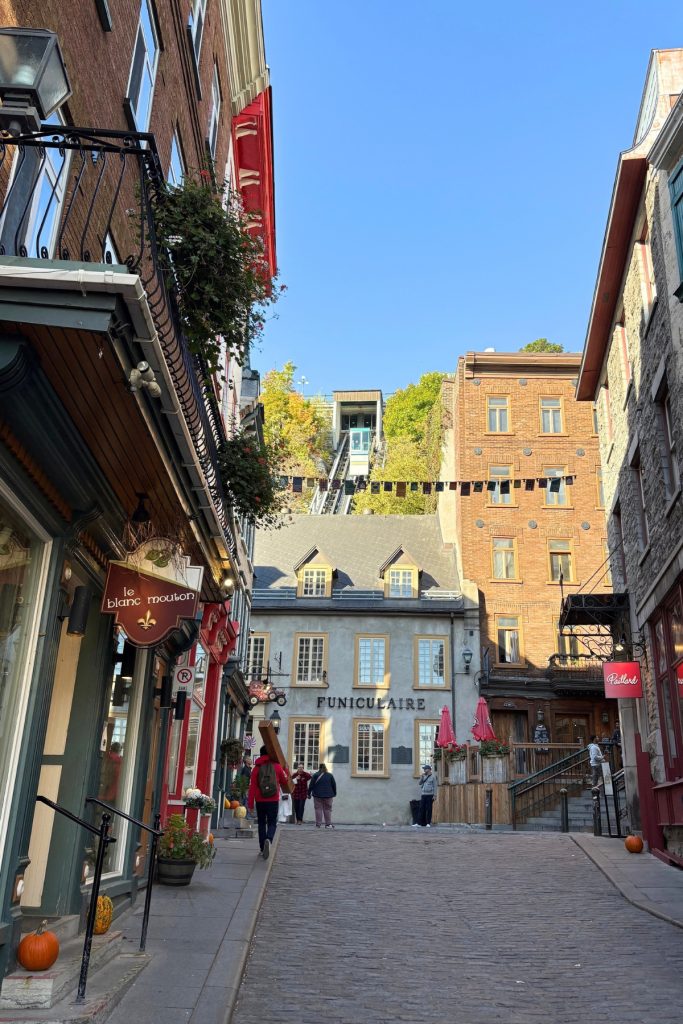
It opened in 1879 as a water-counterweight railway. It switched to electricity in 1907. A fire destroyed it in 1945, and it was rebuilt the following year. It was completely rebuilt again in 1998. Technically, it is now an inclined elevator, not a true funicular. Everyone still calls it a funicular. I am not going to be the one to start that correction.
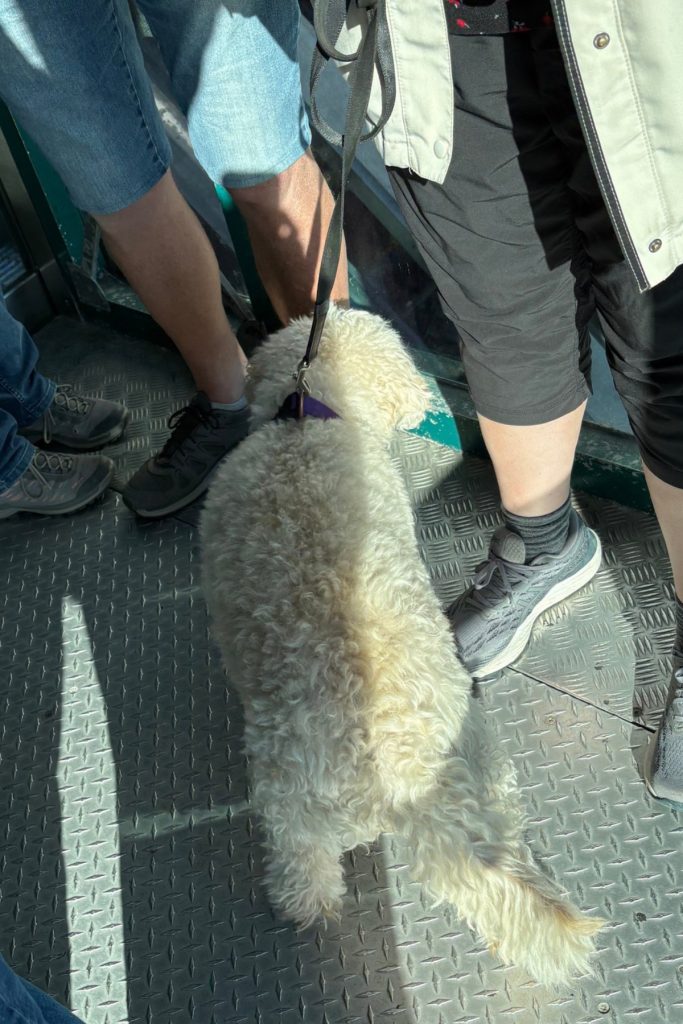
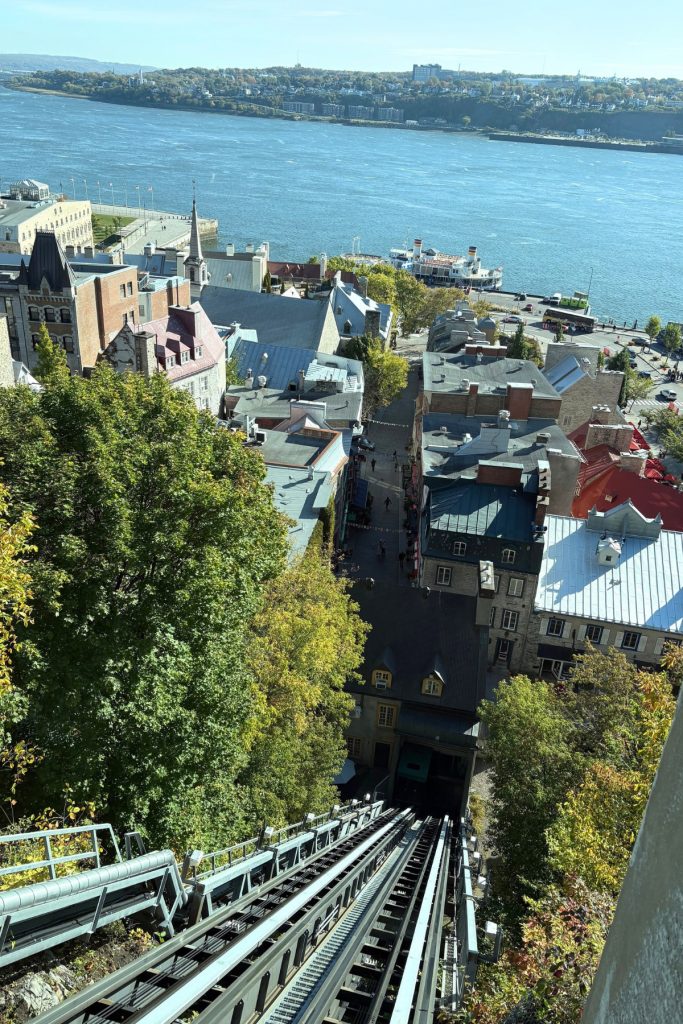
The ride climbs at a 45-degree angle and covers about 64 meters, or 210 feet. The funicular takes cash only. There is an ATM inside the station, which helps anyone who stopped carrying bills years ago. I rode it a little before 10 a.m. It was not busy. I walked in, bought a ticket, and boarded with a handful of other people. One of them was a dog. Her owners, a local couple, told me she loves the ride. I believed them.

The glass sides show Lower Town rooftops and the St. Lawrence River on the way up. Looking straight down the tracks is a strong argument for skipping the stairs. At the top, I walked to an overlook near the station. From there I could see the rooftops, the river, and a great many red maple leaves.
Parc Montmorency: Cannons With a View
Near the top of the funicular, Old Quebec turns into a monument garden. A Gothic-style fountain is topped by a bronze woman holding a cross, and a bronze bishop roughly the size of a small building stands nearby. Flower beds, flags, and a great many people photographing all of it fill the rest of the plaza. I learned quickly that Quebec City likes a statue.
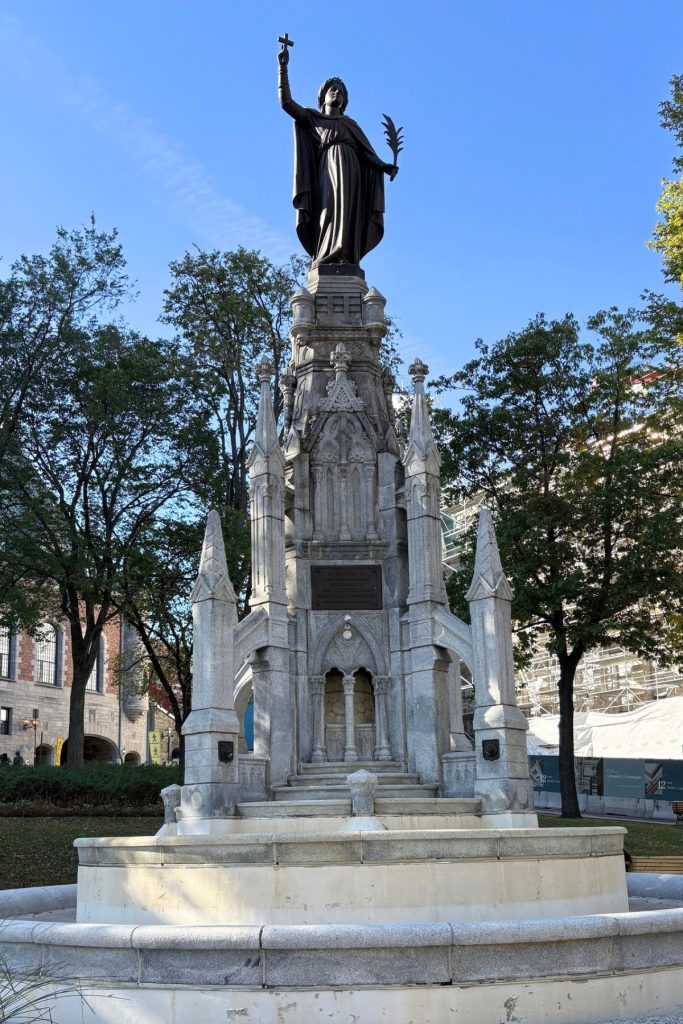
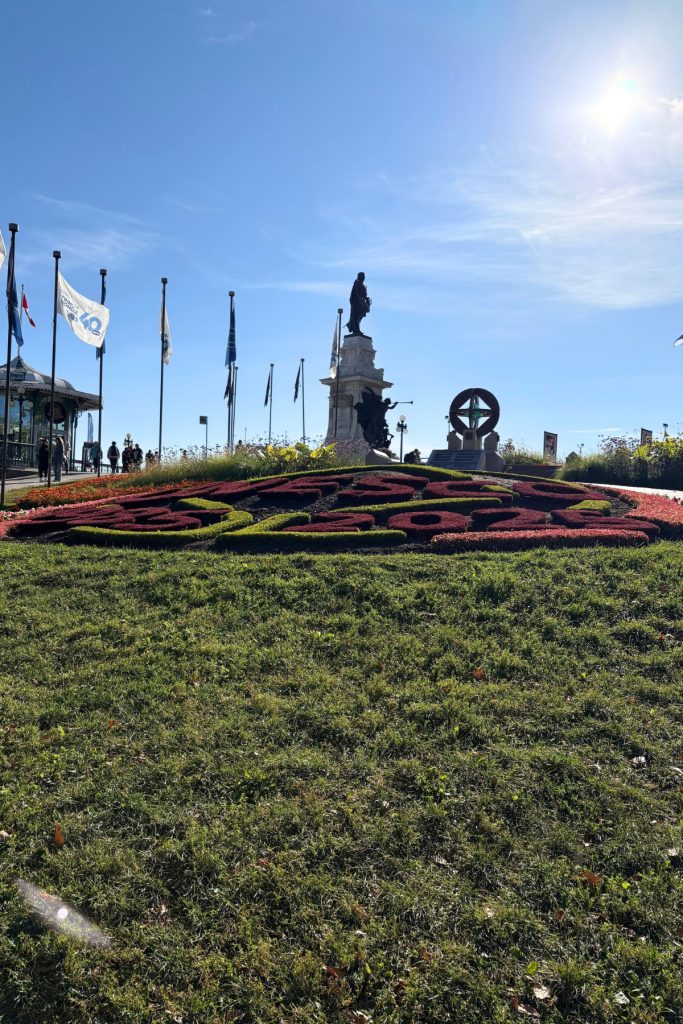
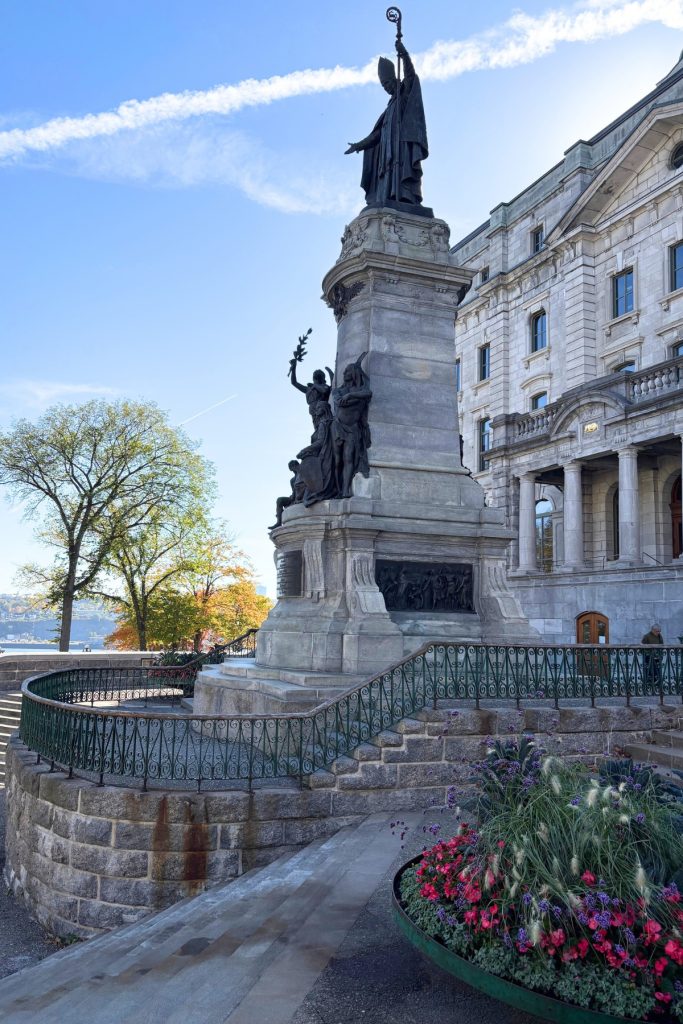
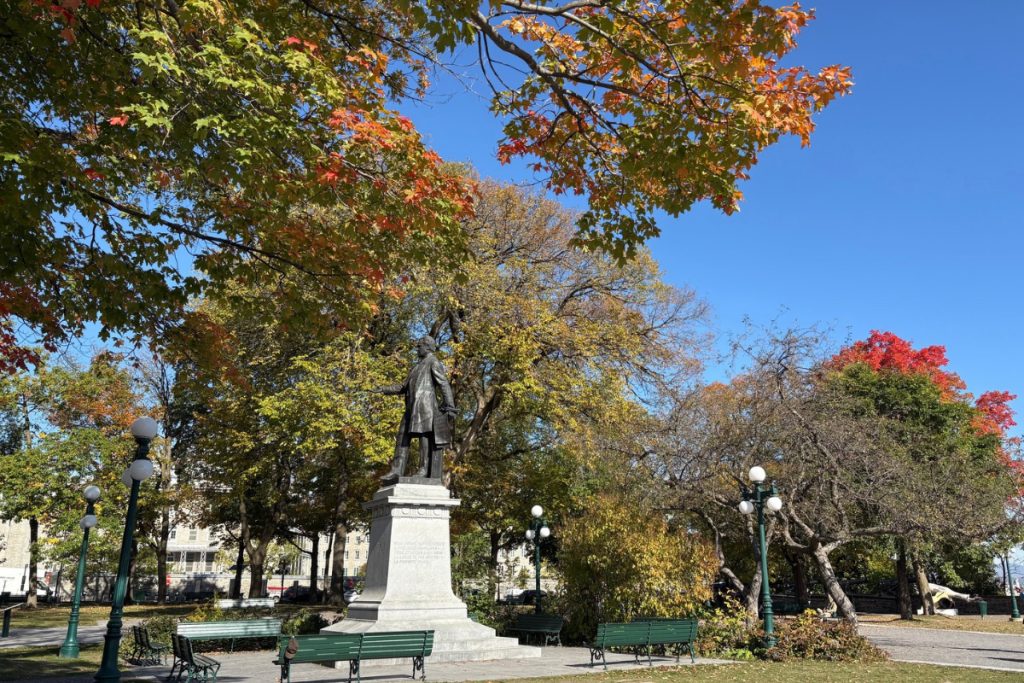
Parc Montmorency sits at the top of Côte de la Montagne. It is a national historic site. The colonial parliament met on this ground until the building burned in 1883. Today it holds a few monuments to figures from Canadian history, a scattering of green benches, and a great deal of fall color.
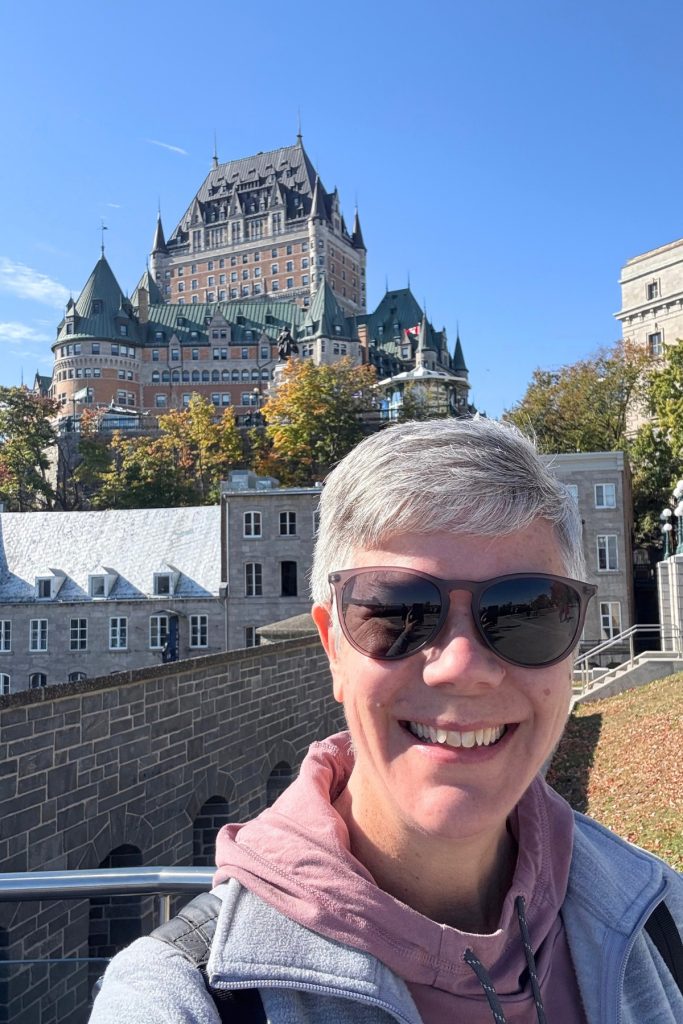
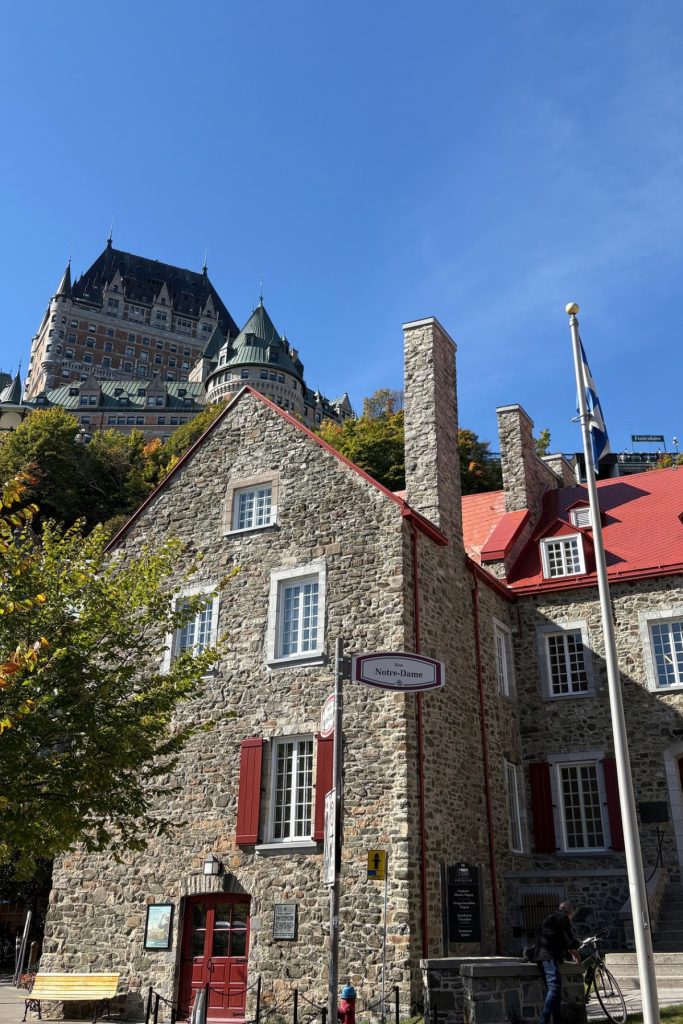
Tourism sources list a photo in front of the Château Frontenac as one of the best things to do here. I took the selfie. Then I took a second photo without me in it, because the hotel is the real subject.
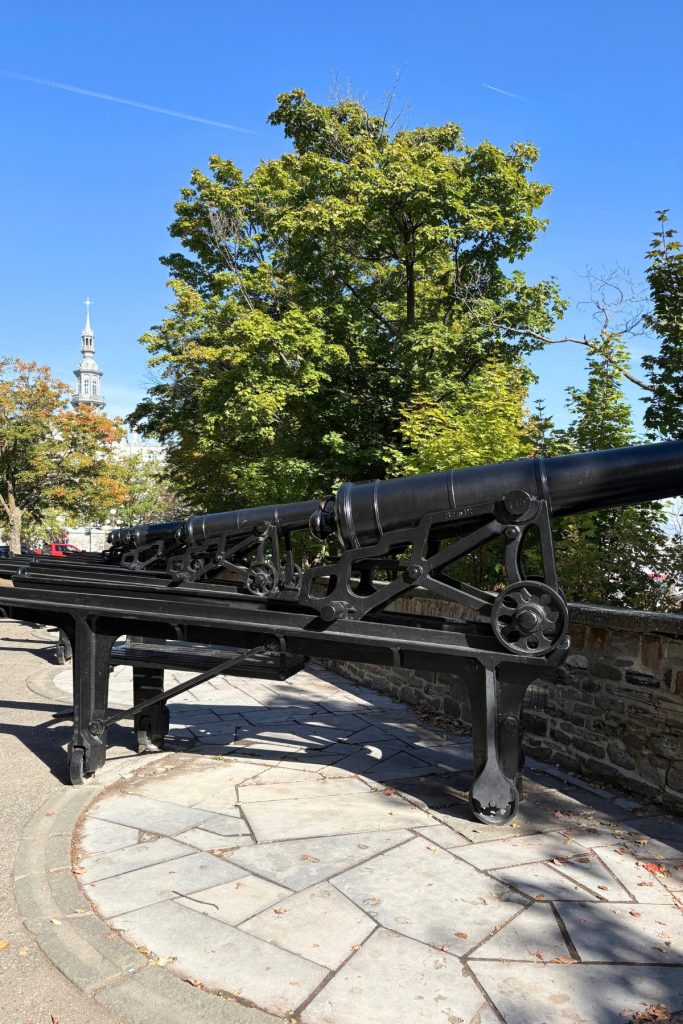
The other attraction is the cannons. Several of them point over the old defensive walls. They belong to the Fortifications of Québec, which encircle the Upper Town for about 4.6 kilometers, or roughly 2.9 miles. That makes Quebec the only fortified city left north of Mexico.
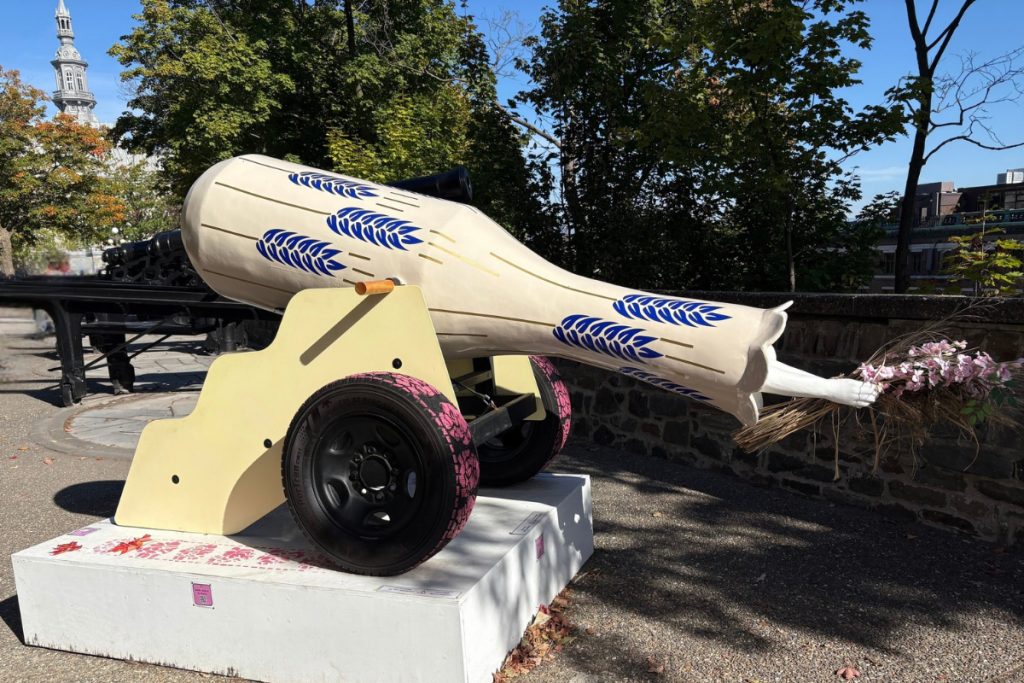
One cannon was not like the others. It had a cream-colored barrel with blue wheat stalks, tires painted with pink patterns, and a white hand holding a bouquet where the muzzle should be. A QR code on the base said “Send a Picture for Peace.” A cannon that hands out flowers is not subtle. It does not need to be.
Rue du Petit-Champlain: Stairs, Doors, and a Crepe
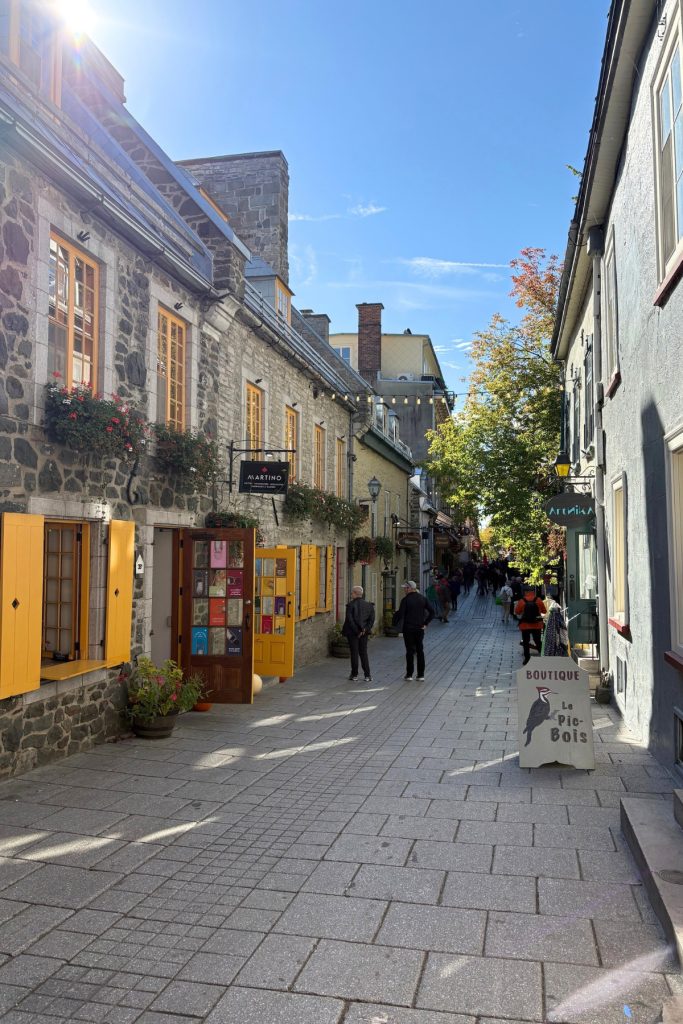
Rue du Petit-Champlain is about 0.26 kilometers long, or 0.16 miles, and its district claims to be the oldest commercial district in North America. The rest of my day happened in and around it.
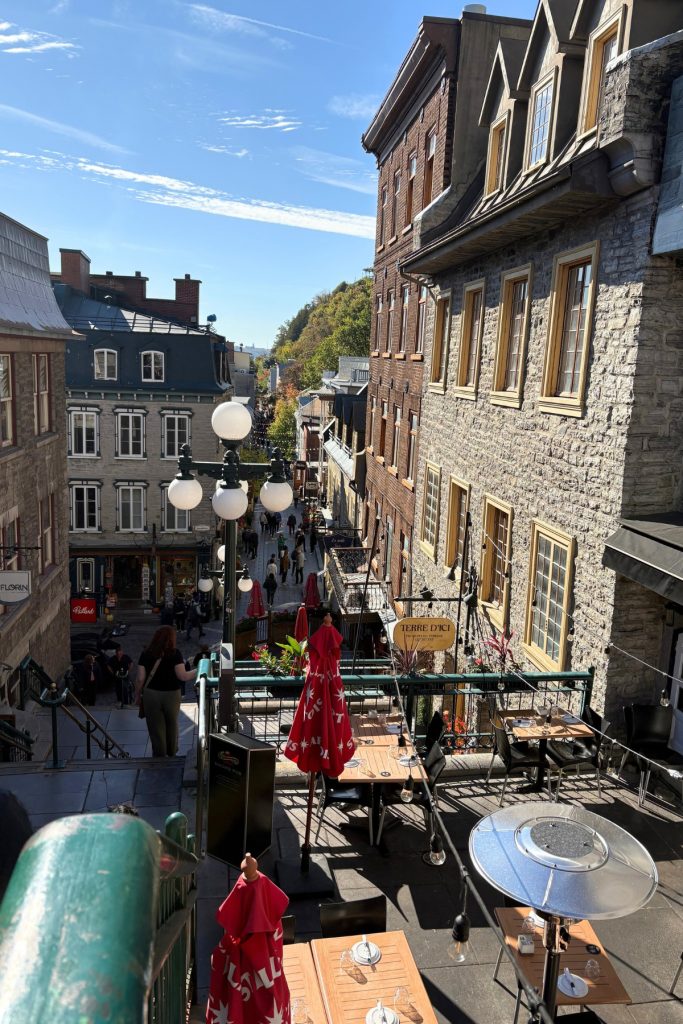
The Breakneck Stairs were my way in, reached from the top after winding my way over from Parc Montmorency. I had seen them from the bottom that morning, on my way to the funicular, but did not climb them then. This time I took them down to Rue du Petit-Champlain. They have 59 steps and connect Côte de la Montagne with the street below, and the version standing today dates to the late 1960s. The view from the top is the reason they are photographed so often.
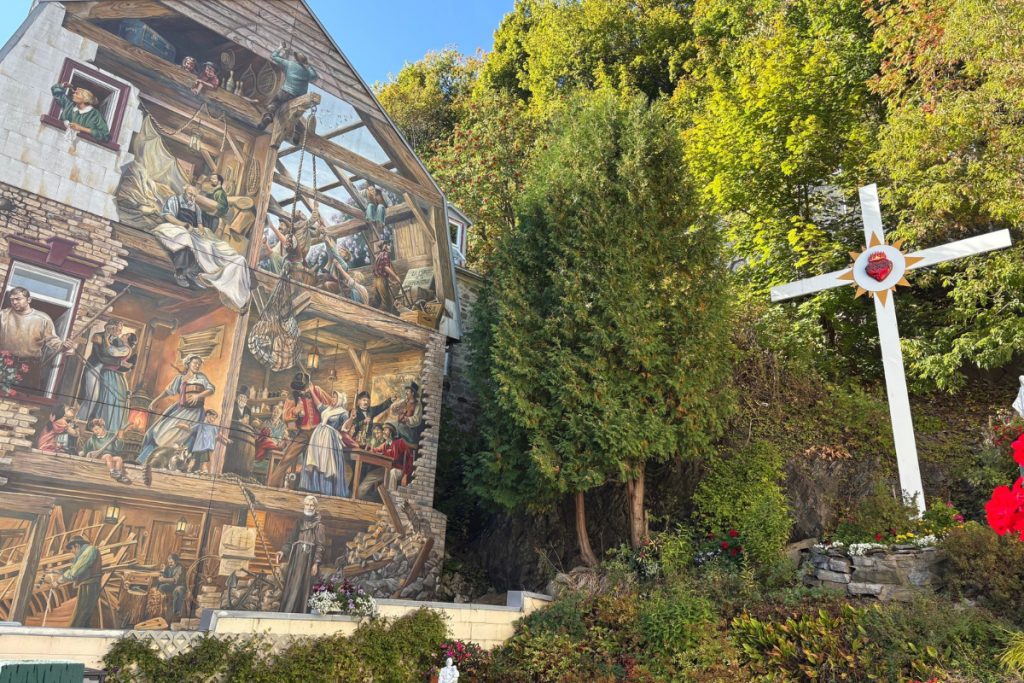
At number 102 Rue du Petit-Champlain, a trompe-l’oeil mural covers the side of a building, measuring about 100 square meters, or roughly 1,100 square feet. Painted in 2001, it shows the fishing and shipping trades of the old port district, and a cannonball lodged in a painted brick wall recalls the English bombardment of 1759.
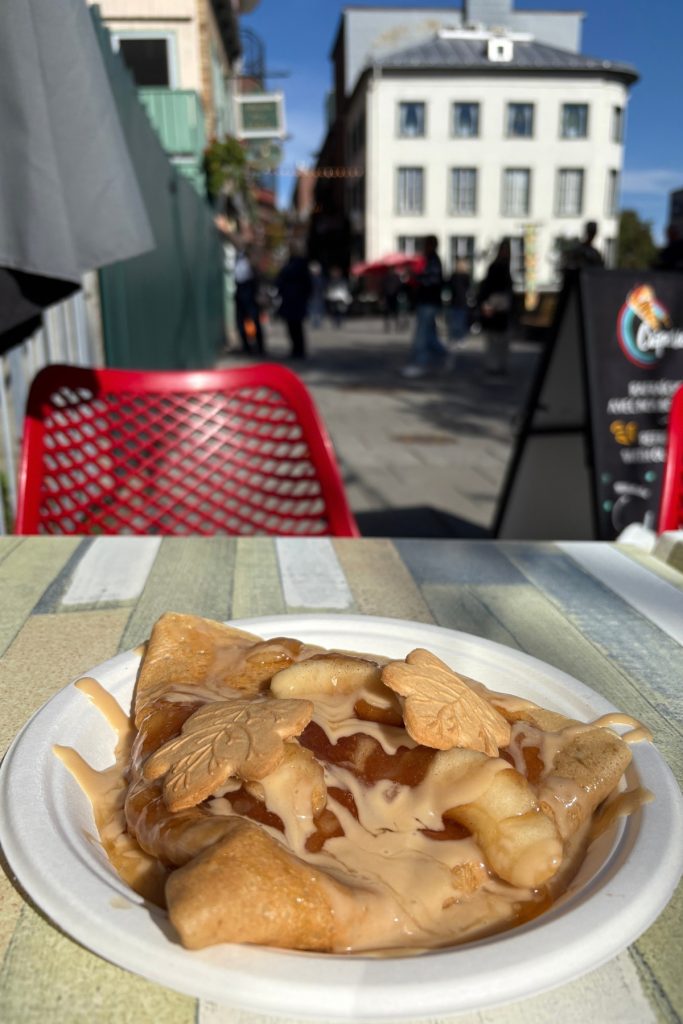
Right beside it, in what looks like the same building, is Crêperie et Cie 5.0. I stopped here for a mid-morning snack and picked the crepe that sounded the most Canadian on the menu. It came with apples, maple syrup, and cookies shaped like maple leaves, so I think it delivered. Sweet does not begin to cover it, and it was very good.
Later, I walked back up the Breakneck Stairs, partly to work off the crepe and partly to say I had done it. Fifty-nine steps is a reasonable exchange rate for a maple crepe.
Doors, Decor, and a Detour Past the Funicular
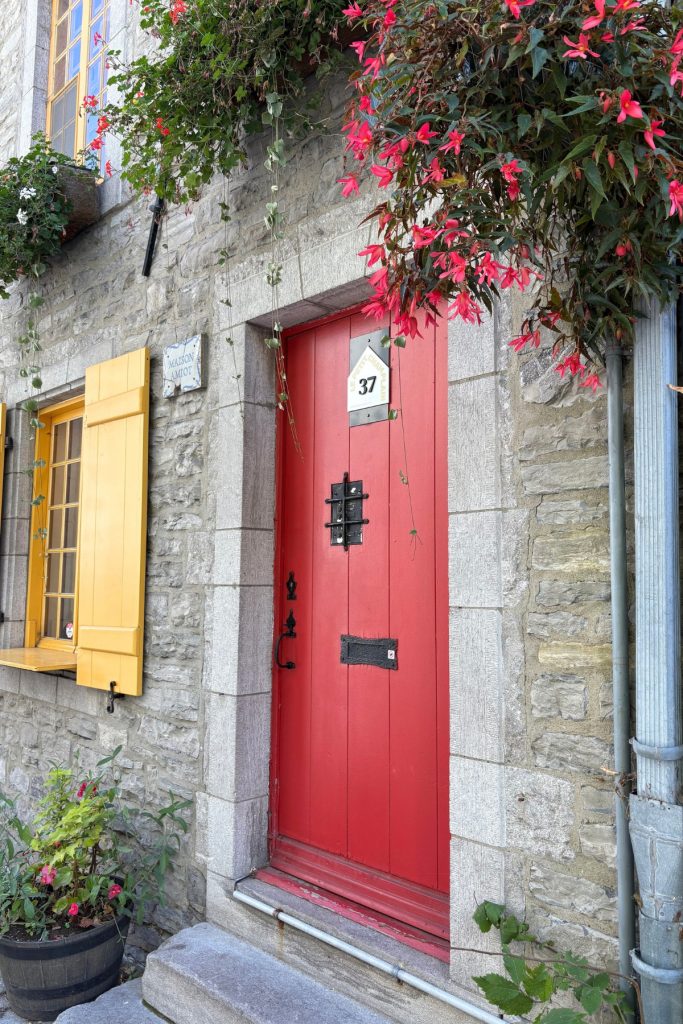
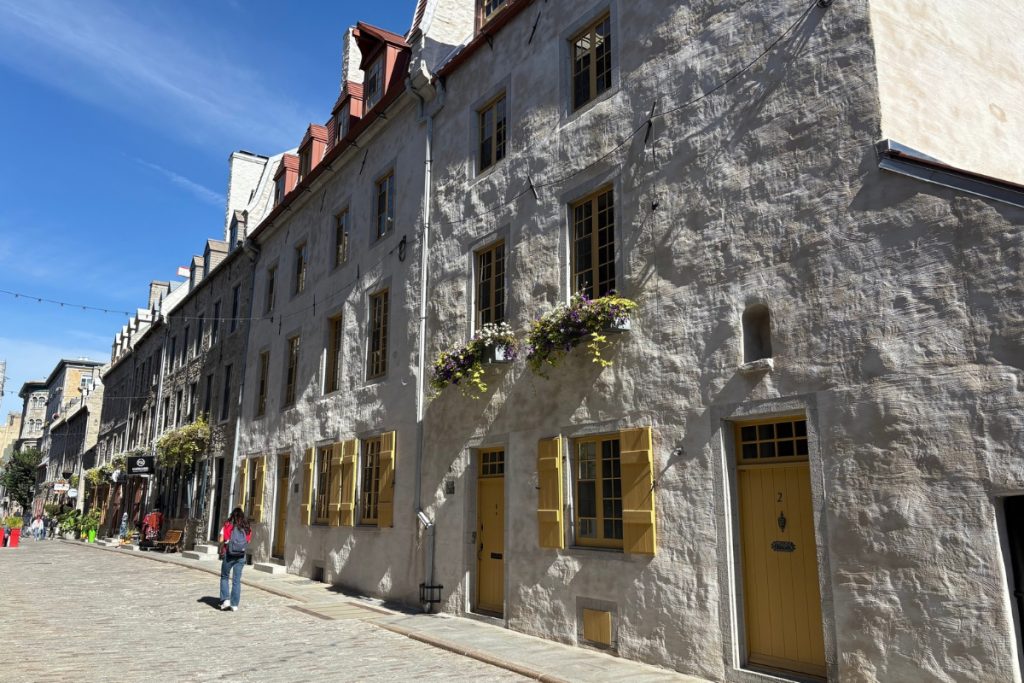
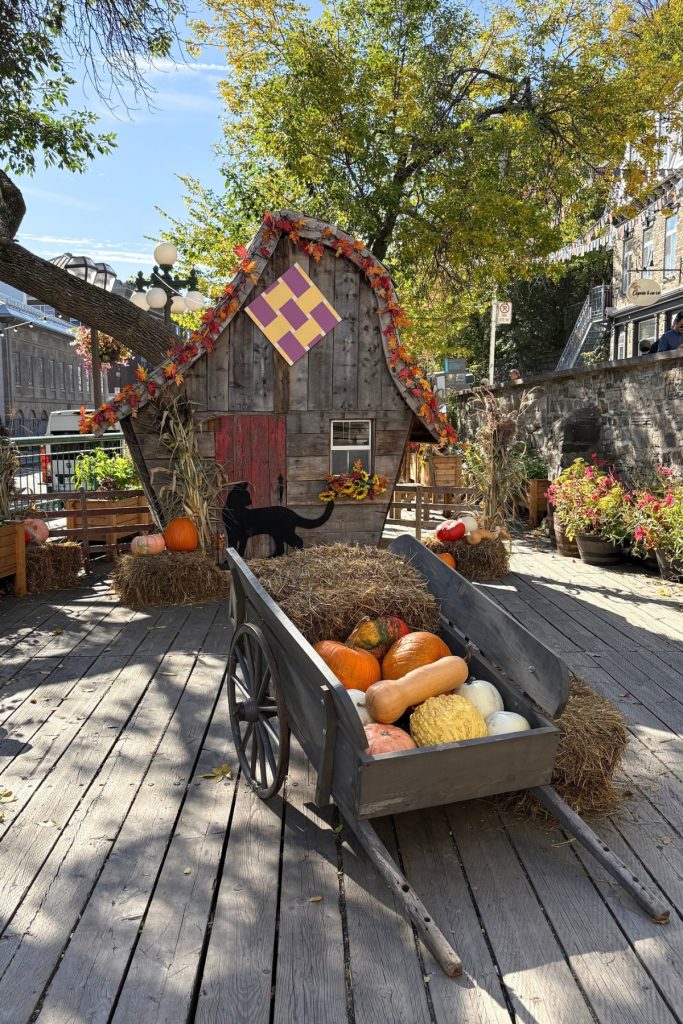
The rest of the street is shops, stone buildings with yellow shutters, and red doors with flowers hanging over them. In October, the neighborhood goes all in on fall. There were pumpkins, hay bales, a scarecrow, and a small wooden house with a black cat on the door. I ate a blueberry ice cream cone in front of it later in the afternoon.

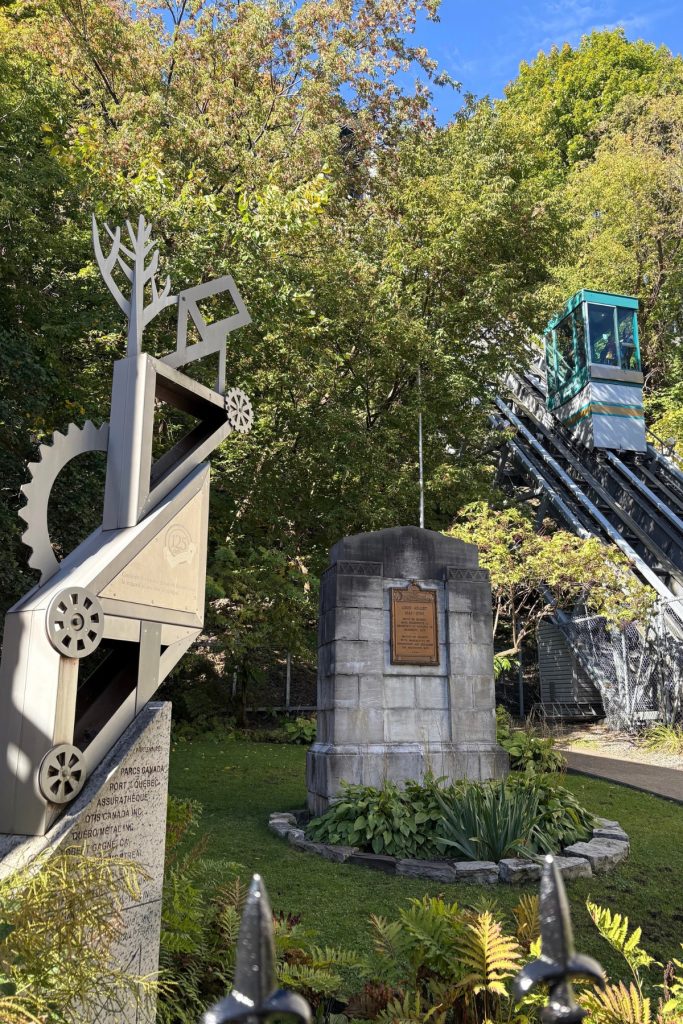
The funicular runs right past all of this. A stone marker in the garden honors Jolliet, who explored the Mississippi River in 1673. Beside it stands a sculpture by Lucienne Cornet, created for the funicular’s 125th anniversary.
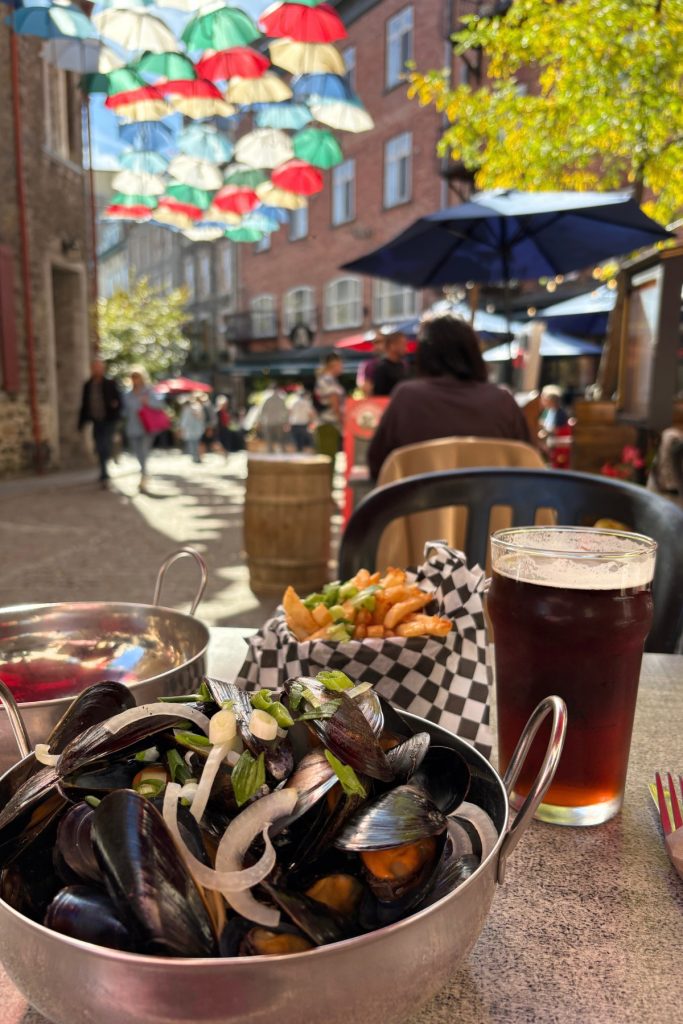
Lunch was mussels, fries, and a local beer at Le Pape Georges, on Rue du Cul-de-Sac. The umbrellas from the morning were still overhead. This time, I got to sit under them.
Place Royale
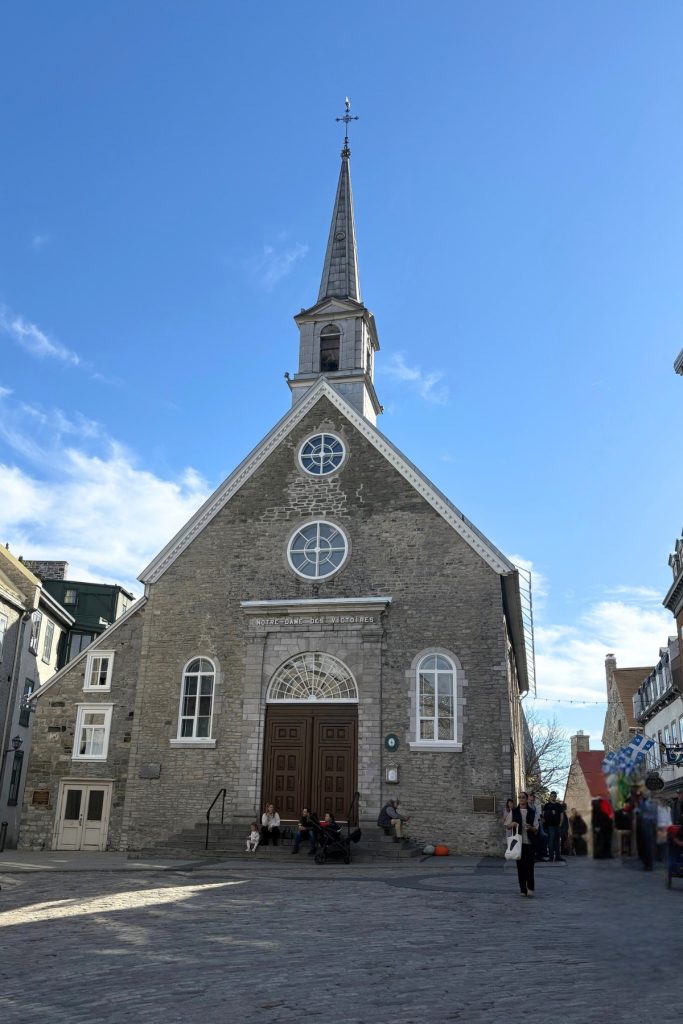
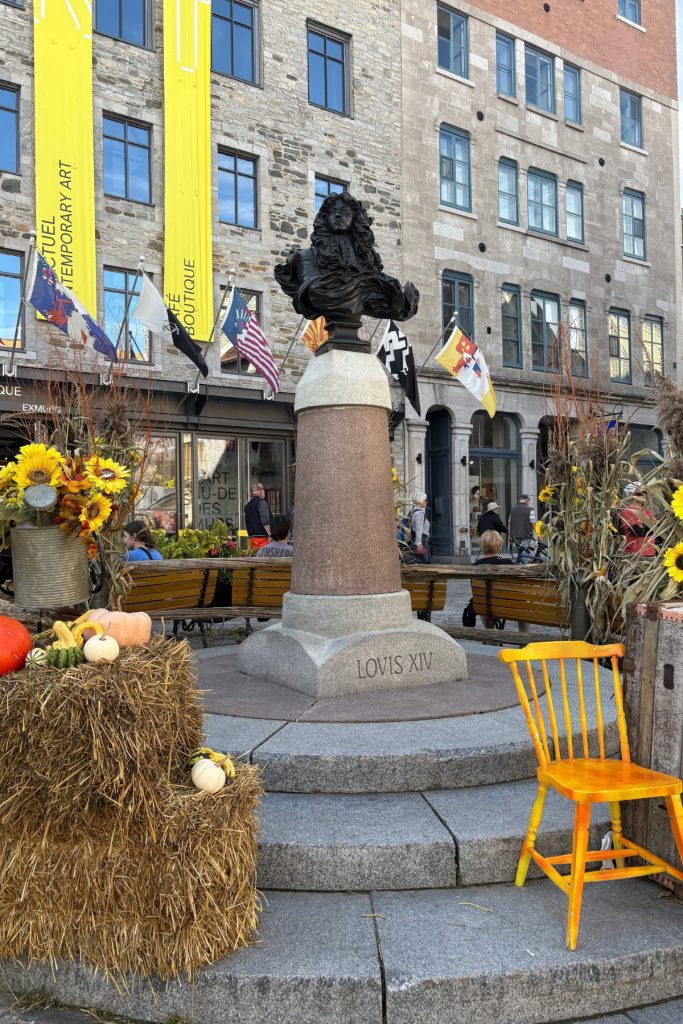
Place Royale is where Samuel de Champlain established his settlement in 1608. Notre-Dame-des-Victoires church, begun in 1688, stands on the square. It is one of the oldest stone churches in North America. In the middle sits a bust of Louis XIV, a replica of the original from 1686. When I visited, it was ringed with hay bales, pumpkins, and sunflowers. There was also one orange chair, for reasons unknown.
The Airport: A Winter Carnival in October
My flight home left the next day, scheduled for late morning. International flights mean arriving early. Then the flight was delayed, which left me with time to fill. The airport filled it for me. Inside the terminal, next to a duty-free shop, a red door with a view of the Château Frontenac in its window made a decent last photo op.

Lunch was A&W. It made me laugh, because the name is said differently on each side of the language line. In English, it is “A and double-you” (AY and DUB-ul-yoo). In Quebec, it is “A et double-vé” (ah ay doo-bluh-VAY). The French name for the letter W is double-v. A&W in Canada split from the American company in 1972. It now runs its own menu. That menu includes poutine, which is fries topped with cheese curds and gravy. I ordered a burger, a root beer (of course!), and the poutine. In a Quebec airport, that counts as research.

A Snowman, an Ice Palace, and 400 Pounds of Snow
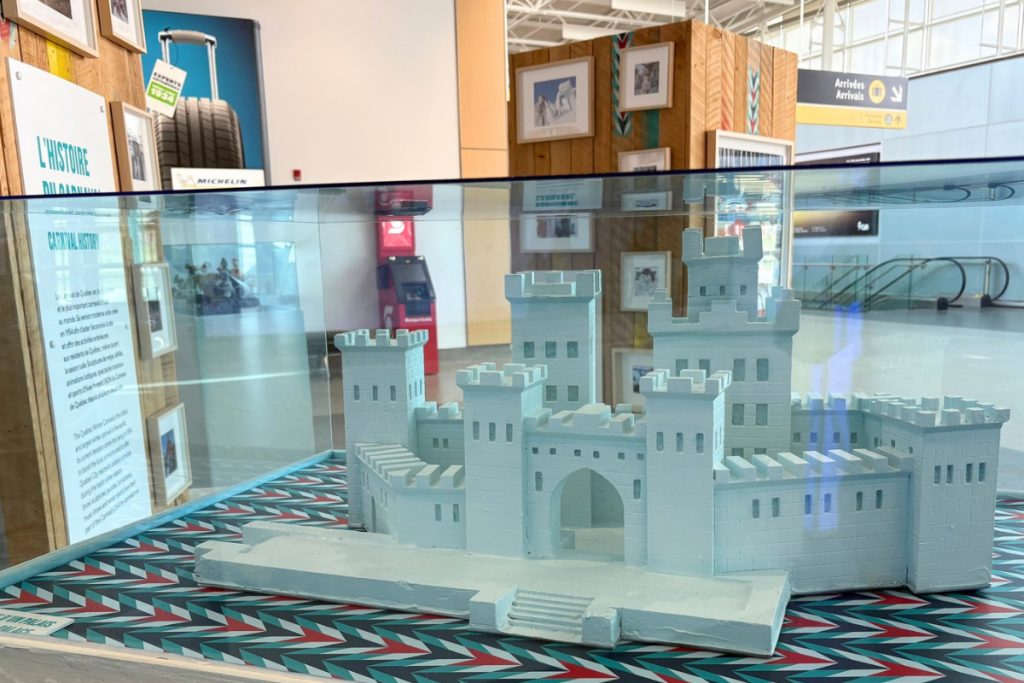
Then I found the exhibit. Yes, it was October, and yes, it was a Winter Carnival display. The star is Bonhomme Carnaval, a snowman in a red cap and an arrow sash. He first appeared in public on January 9, 1955. The mayor of Quebec City still hands him the keys to the city at the start of each Carnival. The airport version waves at everyone who walks past.
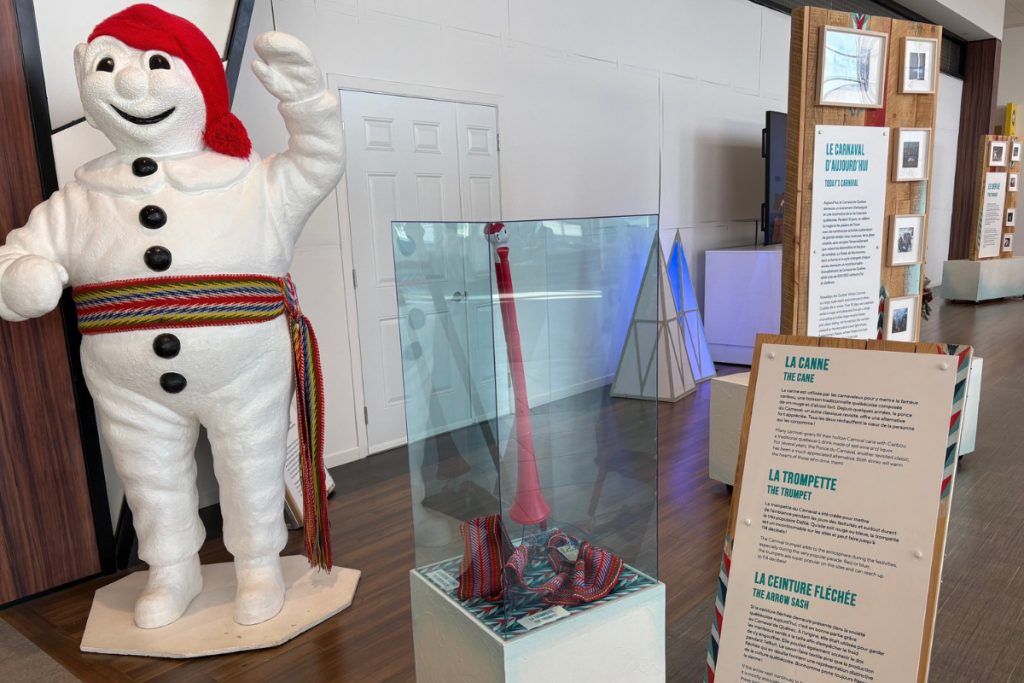
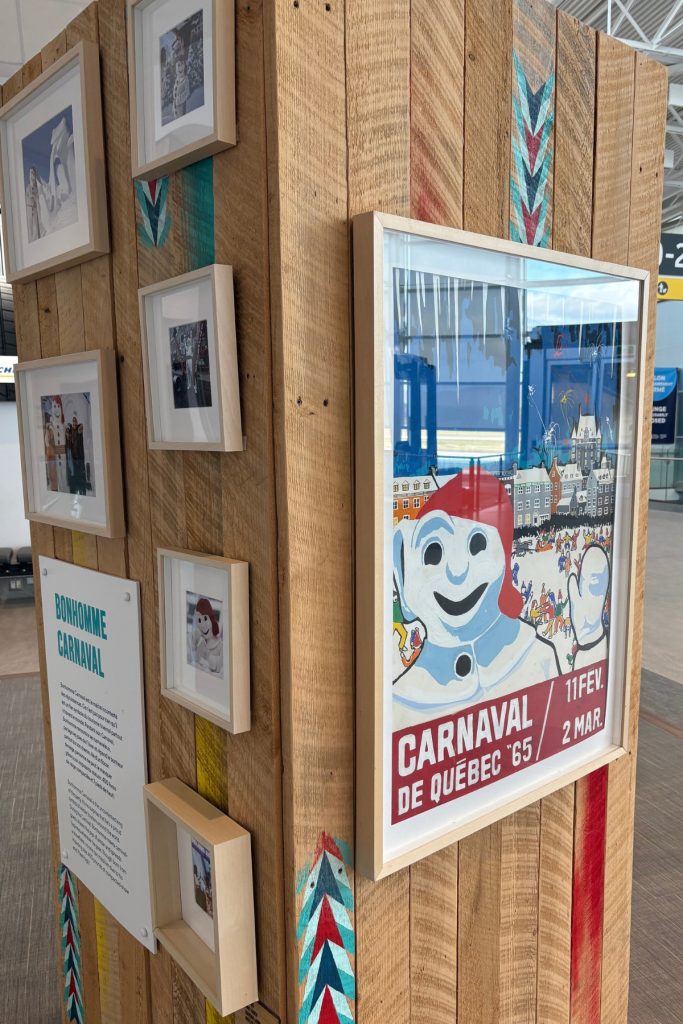
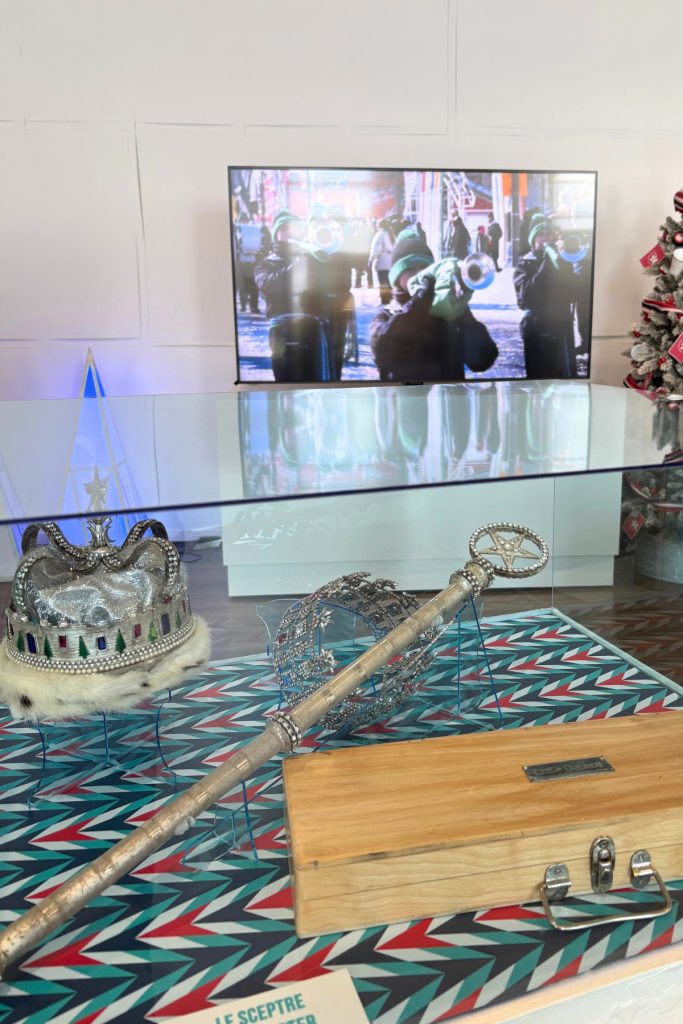
The rest of the exhibit explains the traditions. Carnival-goers fill hollow canes with caribou, a traditional drink of red wine and liquor. The Carnival trumpet, according to the panel, can reach 114 decibels. The arrow sash was originally worn to tighten coats at the waist against the cold. A display case holds effigies, the pins people wear on their coats as passes to Carnival events. Each year has a different design, going back to 1955. There is also a 1965 poster and a model of an ice palace. Bonhomme’s official residence is an ice palace built from blocks of ice every year.

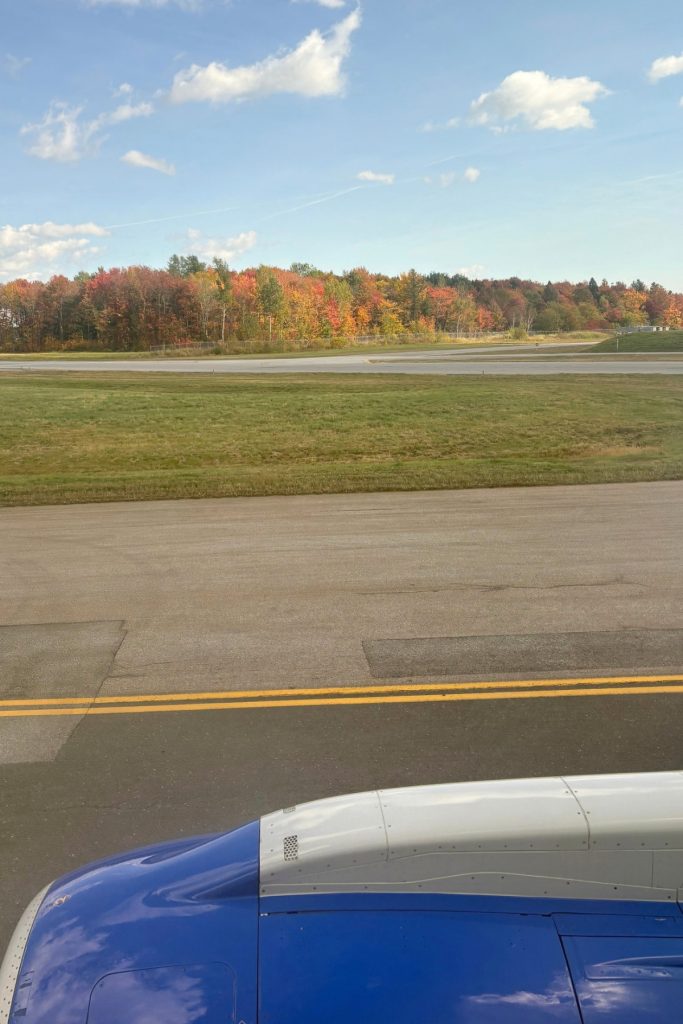
The flight finally left. The last thing I saw of Quebec was a line of red and orange trees beyond the runway. That is not a bad send-off for a visit with no plan.
Worth the Time if You Have It
I did virtually no research before this visit to Quebec City. That means my list of skipped attractions is really a list of things I did not know I was skipping. These are the four that stood out when I finally looked.
- The Citadelle. This star-shaped fortress on Cap Diamant is still home to the Royal 22e Régiment. It is billed as the largest fortress in North America still occupied by regular troops. Visits run as a one-hour guided tour that includes the regimental museum. The Changing of the Guard is a summer event, typically late June to early September. Check the schedule before planning around it.
- The Plains of Abraham. This is where British and French forces fought the decisive battle of 1759. Today it is part of Battlefields Park, about 108 hectares, or 267 acres. It includes a museum, the Joan of Arc Garden, and two Martello towers built between 1808 and 1812. It is a very large park with a great deal of history under the grass.
- Notre-Dame de Québec Basilica-Cathedral. It serves the first Catholic parish in North America north of Mexico, established in 1664. It became a cathedral in 1674. The crypt holds more than 900 tombs, including those of four governors of New France.
- Montmorency Falls. The falls are 83 meters, or 272 feet, tall, which is 30 meters taller than Niagara. They sit about 12 kilometers, or 7.5 miles, from Old Quebec. A cable car, a suspension bridge over the crest, and a 487-step staircase give you several ways to see them. A car, a taxi, a city bus, or an organized tour can all get you there. Choose based on how much of the day you want to spend on logistics. Despite the shared name, this is not Parc Montmorency.
Was One Day in Quebec City Enough?
One day in Quebec City did not require a plan. It required comfortable shoes, a working sense of which way was uphill, and a willingness to stop for a crepe. That was enough to wander the old city, ride the funicular, climb some stairs I had opinions about, and eat several things with maple in them. It was not enough to see everything. It was never going to be.
If you like a plan, make one. I have made a great many. But a few hours of wandering can still leave you with a full camera roll and a decent story. The Citadelle and the falls are the reason to go back. Next time, I will do some research. Probably a little.
Common Questions
Getting To Old Quebec
Most ships use one of two berths. The Ross Gaudreault Terminal, at Wharves 21 and 22, is just steps from the Petit-Champlain district. Wharf 30, on Rue de l’Estuaire, usually handles larger ships, with restricted vehicle access but a shuttle for passengers and crew. My ship docked at Wharf 30. The weather was good, so I skipped the shuttle and walked, following the sidewalk along Rue Abraham-Martin for about 1.6 kilometers, or roughly one mile, to reach Old Quebec. It was a fairly long walk. If you have luggage, mobility concerns, or bad weather, take the shuttle instead, and confirm your berth and the port’s current shuttle guidance before you go.
Québec City Jean Lesage International Airport is about 15 kilometers, or 9 miles, from downtown. A taxi runs a flat rate of $41.40 to the city center, per Visit Québec City, and Uber also works, though fares vary with demand. RTC bus routes 76 and 80 are cheaper, at about $4 per ride, but need a connection and do not run around the clock. I stayed at a hotel near the airport for my early flight, taking a taxi there after storing my luggage at the port and retrieving it later. Staying near the airport trades a morning in the old city for an easier early flight, so weigh it against your schedule.
Funicular and Umbrellas
At the time of writing, the funicular’s website lists the fare at $7 per trip. When I rode it in October 2025, it was cash only. There was an ATM inside the station. Visit Québec City also notes that payment is cash only. Check the funicular’s website for the current fare and payment options before you go.
No. The umbrellas over Rue du Cul-de-Sac are typically installed from June through October. In January and February, they are replaced by suspended hockey sticks for the Québec City International Pee-Wee Hockey Tournament. About 95 umbrellas hang there in a season. A fire safety restriction kept them down for one year before they returned in 2023. Check before you count on them.
Planning Your Day
One day is enough for the highlights of Old Quebec. It is not enough for everything. In one day, I walked the Lower Town, rode the funicular, visited Parc Montmorency, and wandered Petit-Champlain and Place Royale. I skipped the Citadelle, the Plains of Abraham, the Basilica-Cathedral, and Montmorency Falls. If those matter to you, plan a second day, or pick one and let the others wait.
No. Parc Montmorency is a small park at the top of Côte de la Montagne, in the historic core of the city. It has cannons, monuments, and a view of the Château Frontenac. Montmorency Falls is a waterfall about 12 kilometers, or 7.5 miles, from the heart of Old Quebec. It is 83 meters (272 feet) tall. The names match because both honor Henri II, Duke of Montmorency, who served as viceroy of New France.
Keep Wandering
La Rochelle and Île de Ré: Clocktowers, Ramparts, and Donkeys in Pants
Istanbul in One Day: The Blue Mosque, Hagia Sophia, and the Basilica Cistern
Two Days, Three Gaudí Buildings: A Pre-Cruise Barcelona Stay