Tórshavn to Gásadalur: A Day on Vágar Island
I spent one day in the Faroe Islands. That is the kind of sentence that sounds like the start of an apology, and in a way, it is. One day is not enough for a place with eighteen islands and a language that predates most European monarchies. It is definitely not enough for a place with a habit of hiding its best waterfall behind a village most maps barely bother to label. My day came on a cruise from Copenhagen to Reykjavik. I split it between a solo wander through the old streets of Tórshavn and an afternoon excursion across the water to Vágar Island.
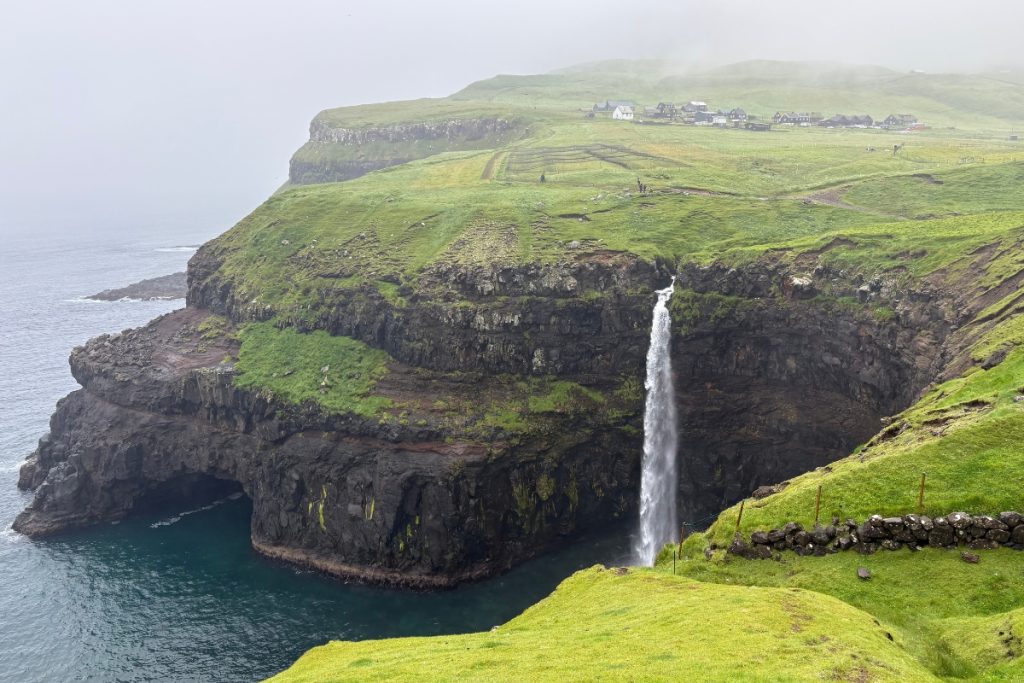
Here is what that day actually looked like: turf roofs and a working harbor in the capital, a church with a thirteenth century runestone and a folk legend carved in bronze next door, a waterfall that drops straight into the Atlantic from a cliff most people only see in photographs, and a village called Bøur where I was served tea and cake in a two hundred year old building that still doubles as someone’s home. Fog showed up for most of it. I am including that part too.
Prefer to watch instead of read? Watch the video →
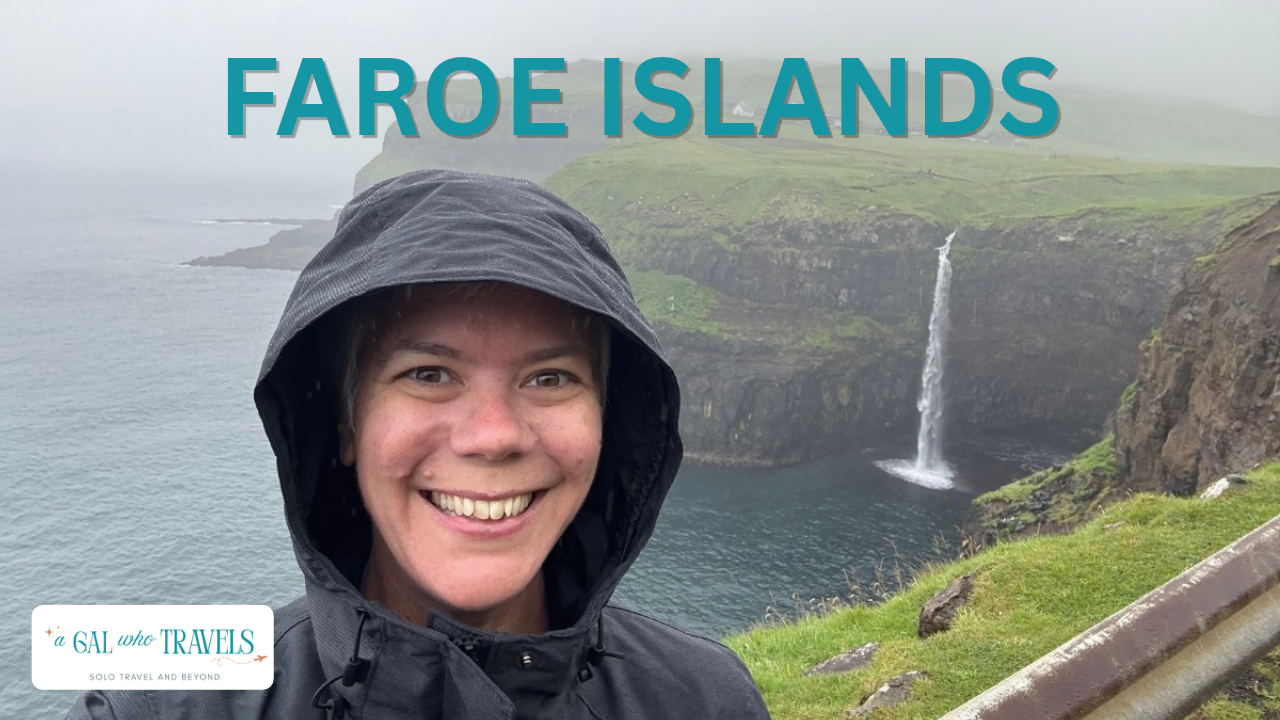
Tórshavn in the Morning, Vágar in the Afternoon
The ship docked in Tórshavn early, which meant a few hours to wander the capital on my own before my afternoon excursion left. That excursion took me west to Vágar Island, home to the country’s only airport. It is connected to Streymoy by an undersea tunnel that opened in December 2002. Before the tunnel, getting to Vágar meant a boat. Now it takes about twenty minutes by bus, most of it underwater.
Tórshavn, on Foot
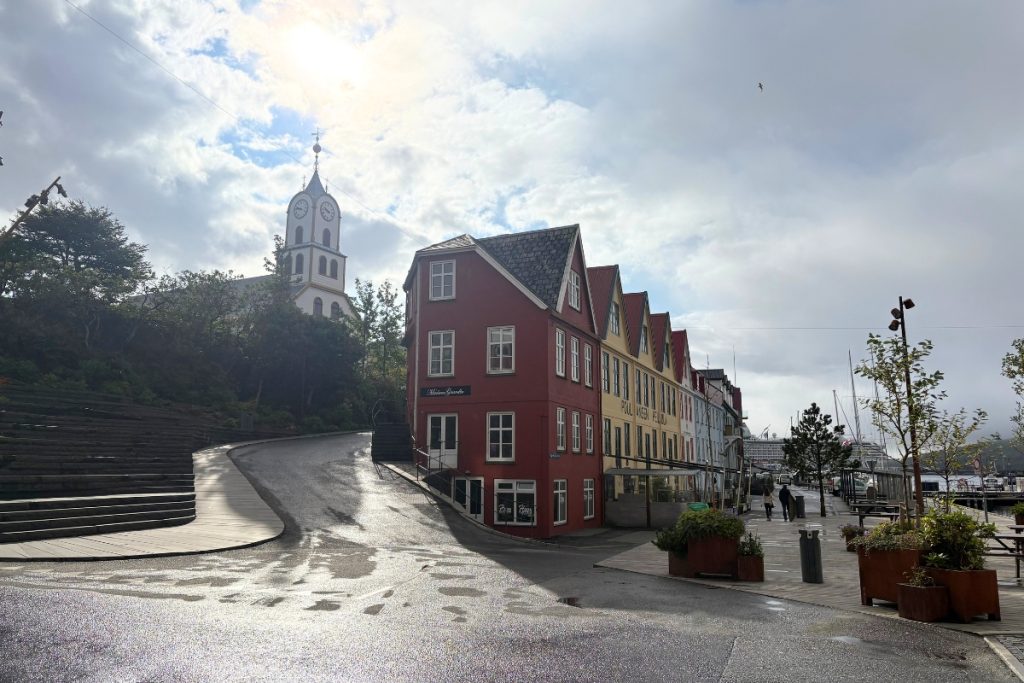
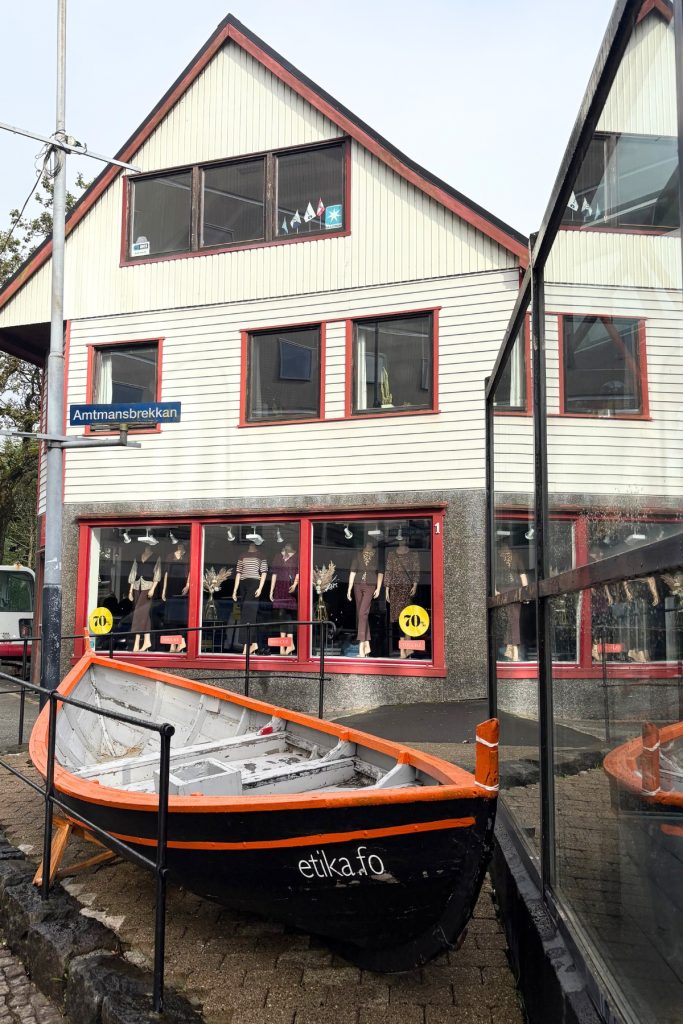
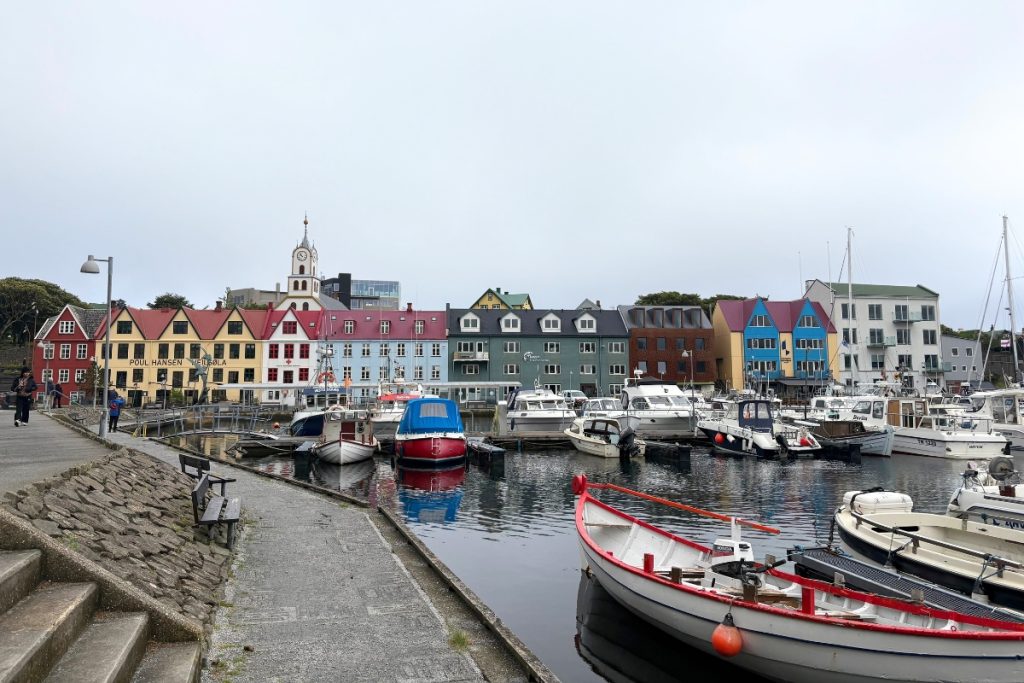
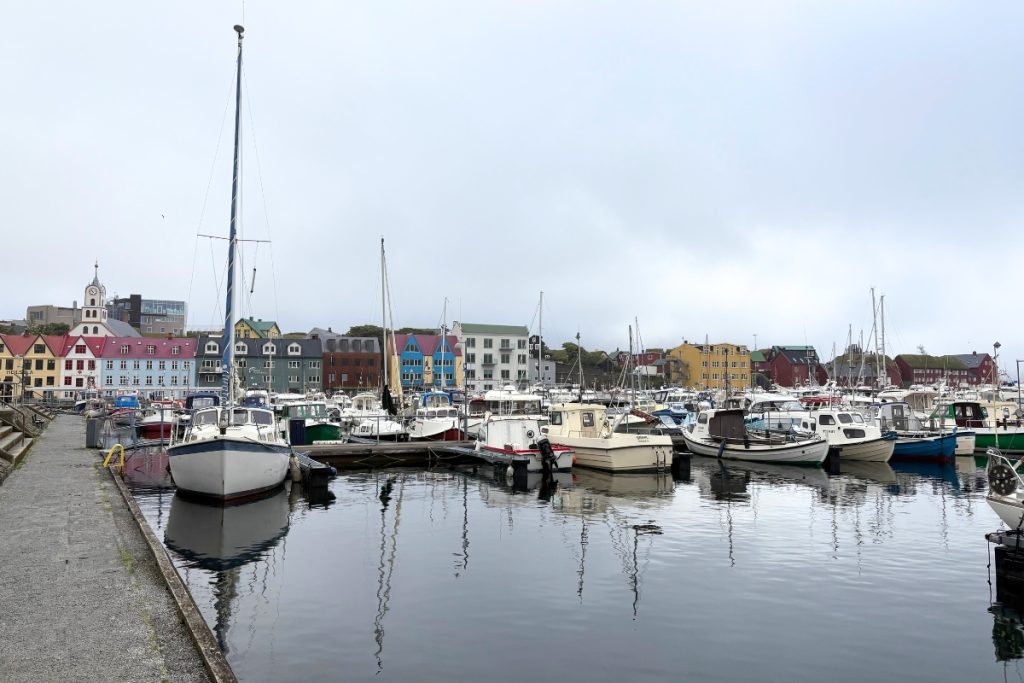
I started at the harbor, where a fishing town does what fishing towns do at seven in the morning: nothing dramatic. Just boats going out and a mannequin display window selling clothes nobody on a boat would wear. From there the streets climb. Climbing is really the whole method for seeing Tórshavn on foot. The old town sits on a hill above the water, so every turn either goes up toward the cathedral clock tower or back down toward the harbor you just left.
Tinganes
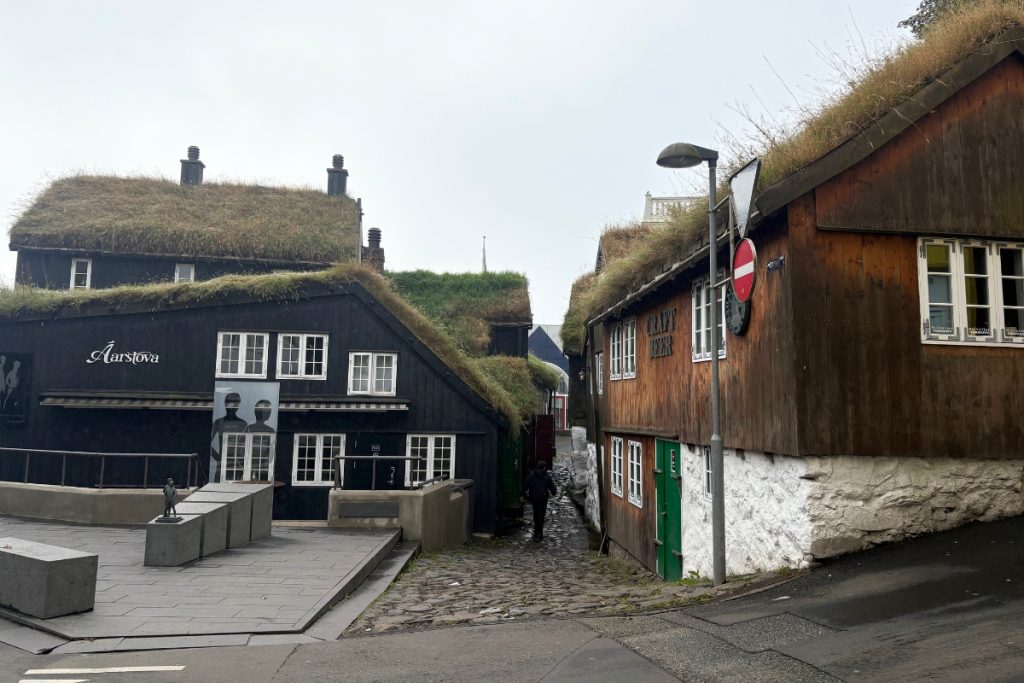
Tinganes is the reason to make that climb. It is a narrow finger of rock dividing Tórshavn’s harbor in two. It is lined with turf-roofed buildings that have been standing since the sixteenth and seventeenth centuries. Faroese governance has met on this spot since around 825, when Norwegian settlers held their assembly here. That makes Tinganes one of the oldest continuous parliamentary sites anywhere. None of that history announces itself. There are no placards, no fences, no gift shop. It is a narrow lane between black wooden buildings with grass on the roof. The country’s government still works out of some of them.
Into the Old Town
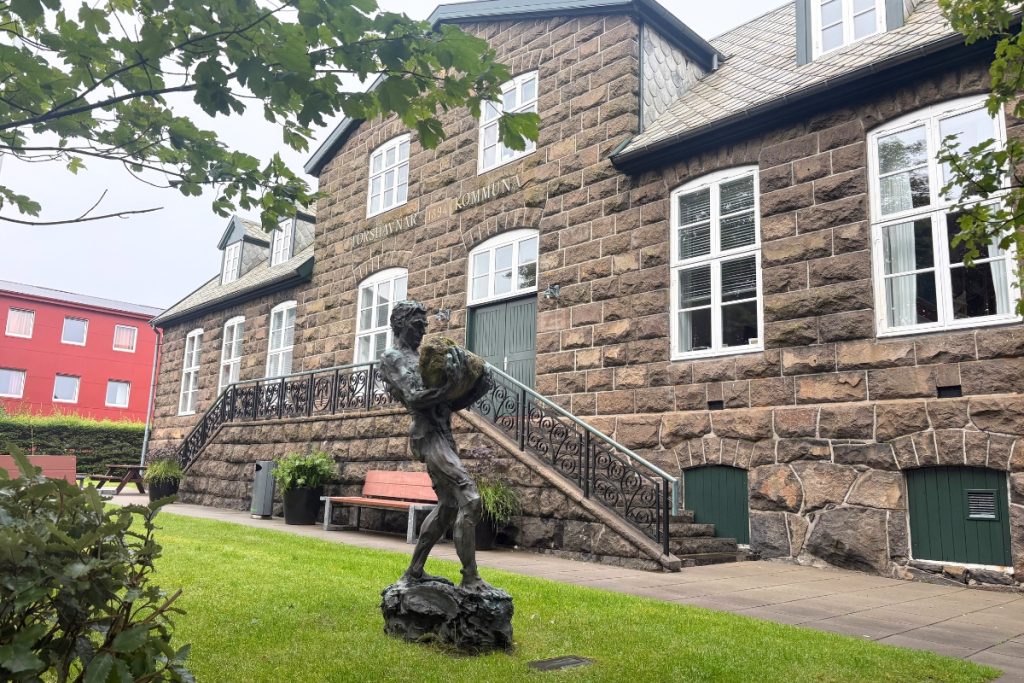
Past Tinganes, the old town narrows further into cobblestone alleys lined with turf-roofed houses, dark wood, white window frames. I passed a restaurant called Áarstova tucked into one of them. I also passed a stone building from 1894, its cornerstone still carved into the facade and a bronze statue on the lawn out front. It reads like a government building because it functions like one now, but it started life in 1894 as the town school. Tórshavn did not get an actual town hall until 1974, when the old school was converted for the job. The whole walk took under two hours. It did not need to take longer. Tórshavn’s old town is compact enough that getting a little lost is really just getting to see it twice.
Sandavágur: A Church Surrounded by Stories
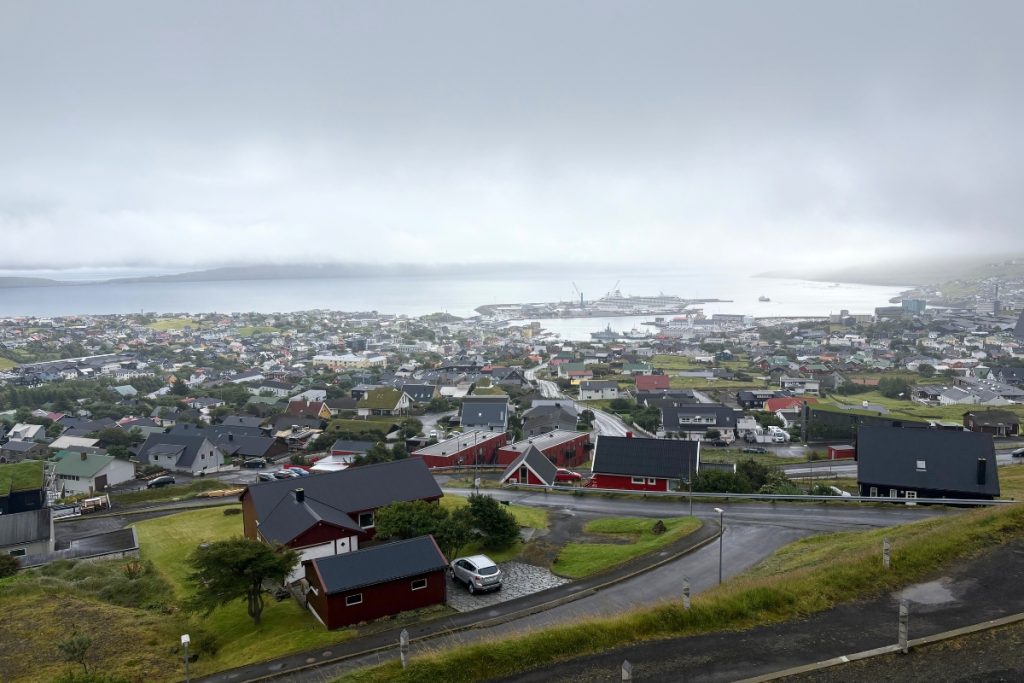
Before Sandavágur itself, the bus stopped at an overlook on the way out of town. It was the kind of quick photo stop that exists because the view earns it. Tórshavn sat below, harbor, ship, the whole town wrapped in fog thick enough that the photos came out more suggestion than record. I took the picture anyway.
A Church With a Runestone
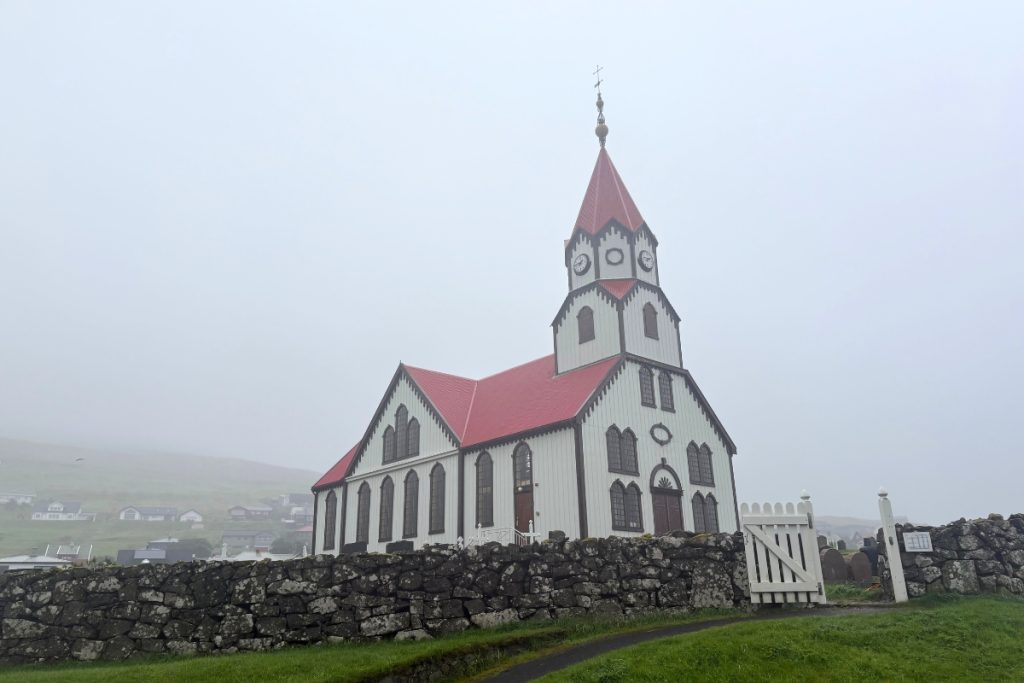
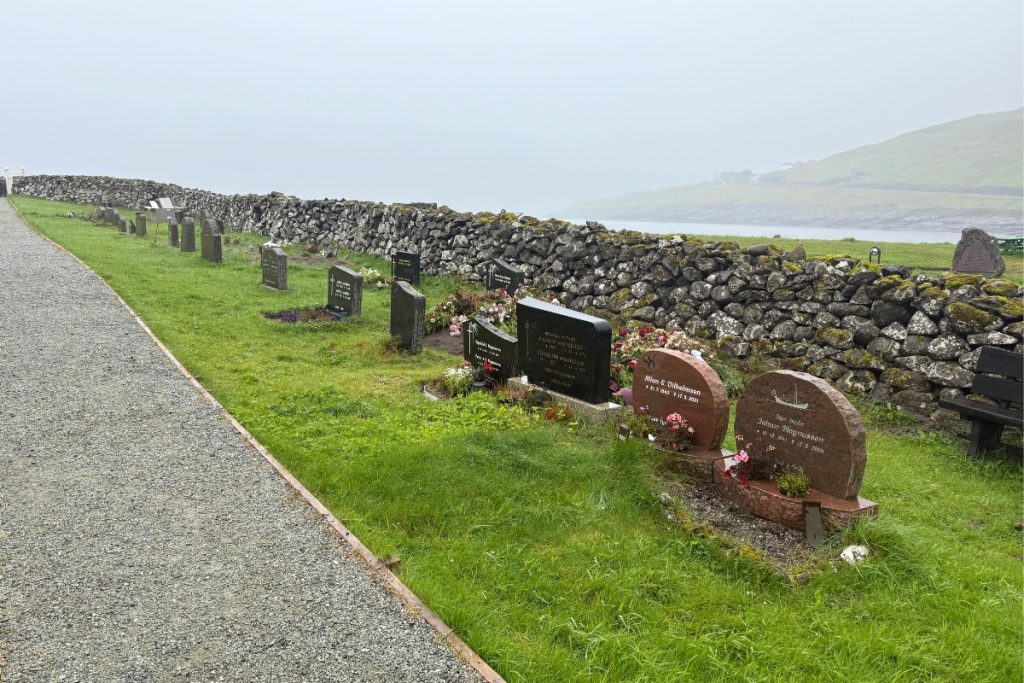
Sandavágur is a small village on the south coast of Vágar. Its church is the reason most visitors stop there at all. It is a bright white building with a red roof and a tiered clock tower, consecrated in 1917. It stands behind a low stone wall, with its own cemetery running along the water’s edge. Inside is a runestone from around the year 1200, carved by a Norwegian settler named Þorkell. He used it to record that he was the first person to live in the area. It is Faroese in the driest possible sense: proof that someone lived here first, in a single sentence, kept behind glass in a church built nine hundred years later.
A Shepherd and a Huldra
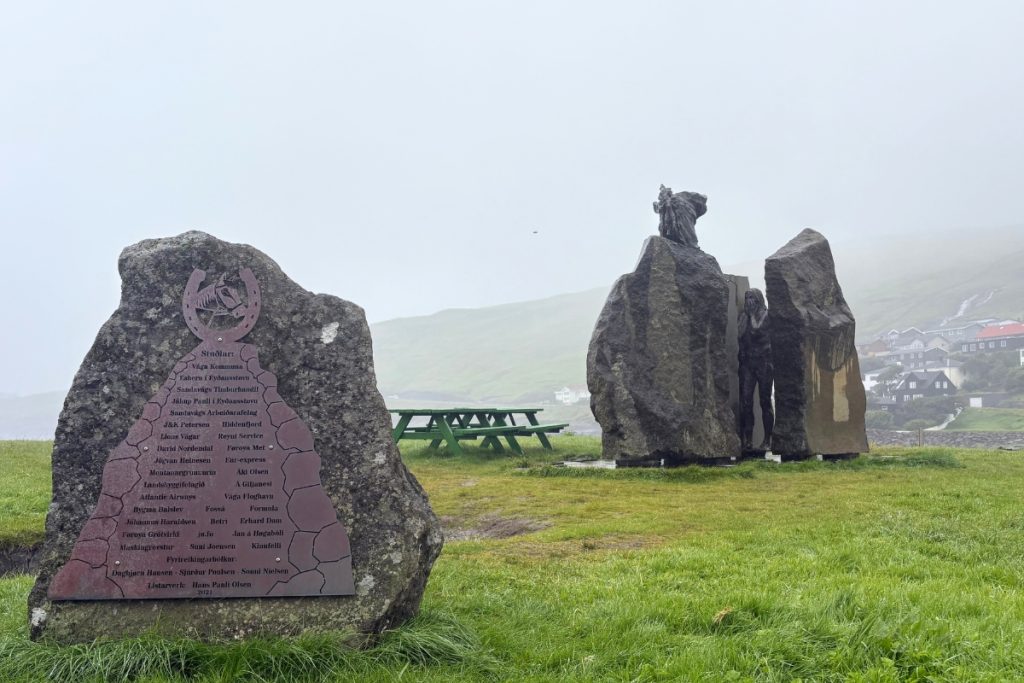
Next to the church stands a large bronze and stone statue called Seyðamaðurin á Sondum, the Shepherd of Sondum. It tells a specific Faroese folk story. A shepherd tending his flock in the mountains spotted a woman in a striking red dress and could not look away. She was a huldra, one of the hidden people of Faroese folklore, and stories like hers rarely end simply. Nearby stood another stone, carved with a horseshoe, whose story I never did catch.
Under the Painted Ceiling
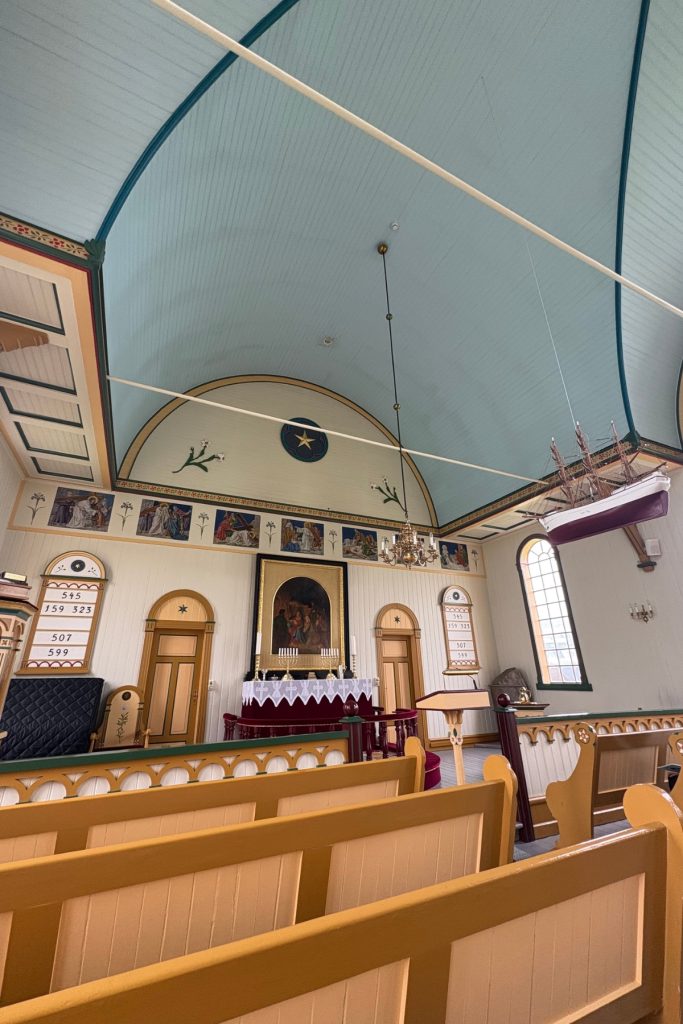
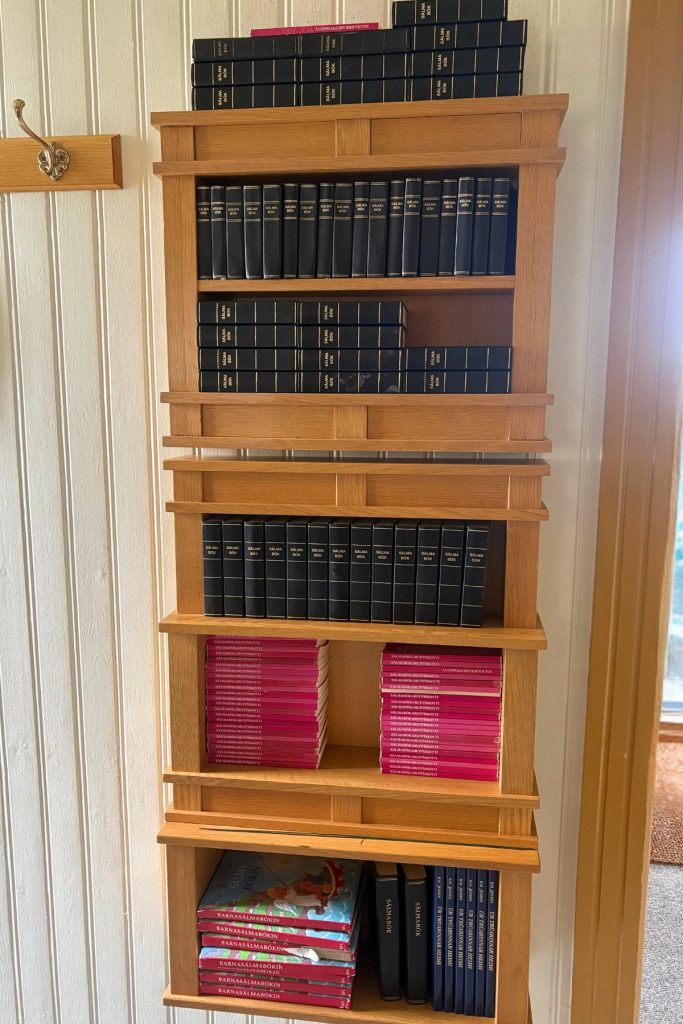
Inside the church, the ceiling is painted pale blue and arched. A model ship hanging from it, the way model ships hang in a lot of old Nordic churches, tied to sailors and safe returns. The pews are carved with small rosettes, one per seat. A shelf by the door holds enough hymnals for a congregation many times the size of the village outside.
Gásadalur: The Waterfall Everyone Comes For
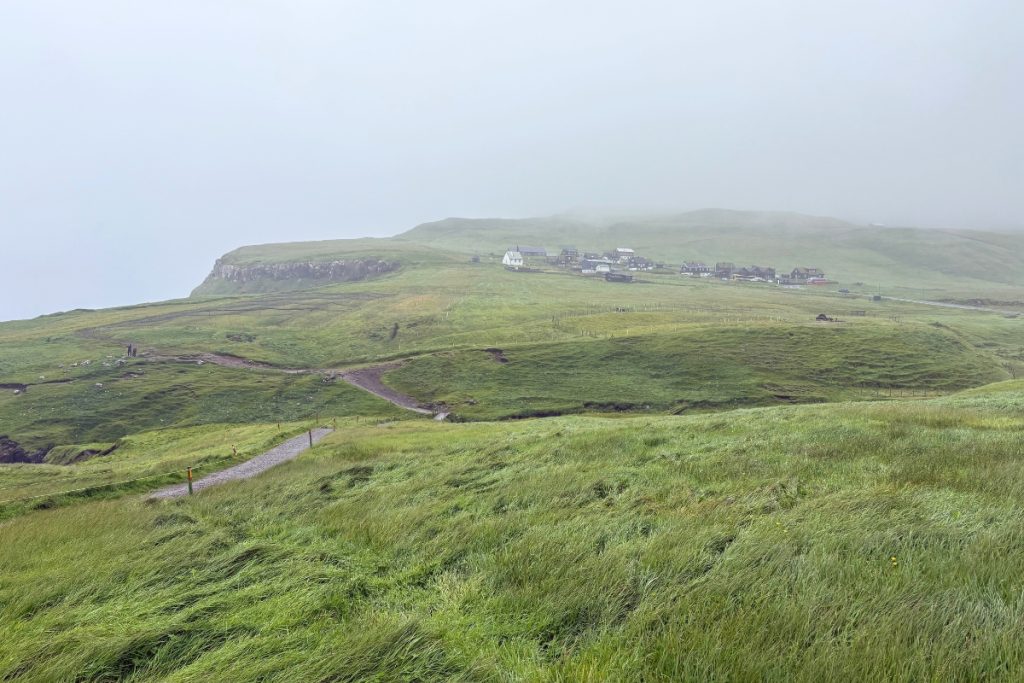
Gásadalur is a village of around a dozen people. Until a tunnel connected it to the rest of Vágar in the early 2000s, the only way in or out was a footpath over the mountain or a boat, weather permitting. Weather in the Faroe Islands does not always permit. The isolation is most of the reason the village stayed this small, and the tunnel is most of the reason a bus full of cruise passengers could show up on a Tuesday afternoon and park a few hundred feet from a waterfall most of us had only seen in someone else’s photos.
Múlafossur
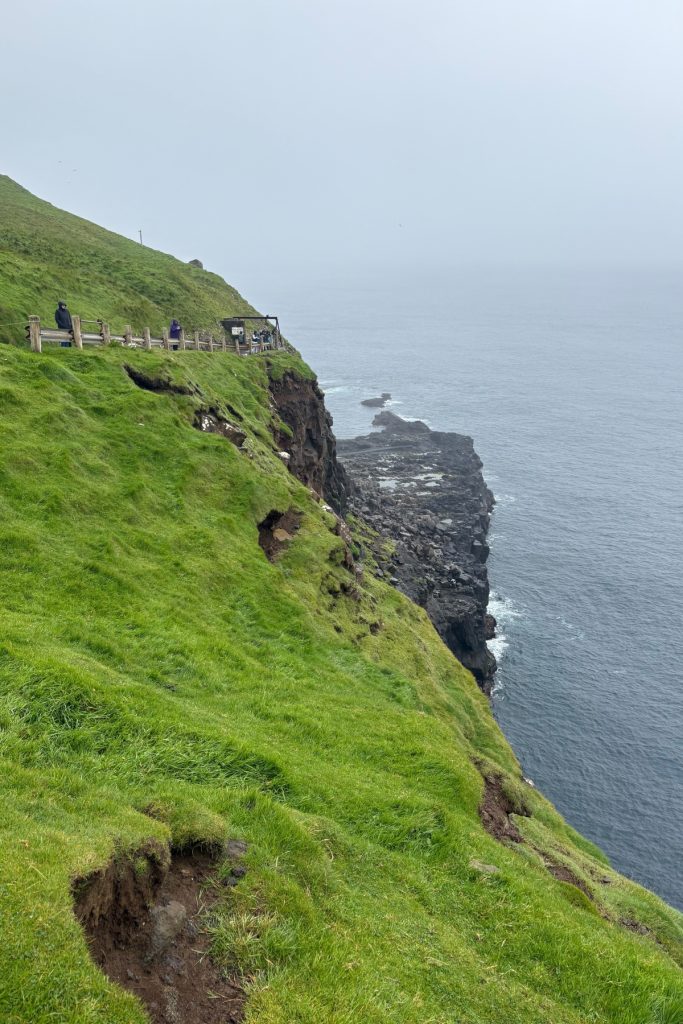
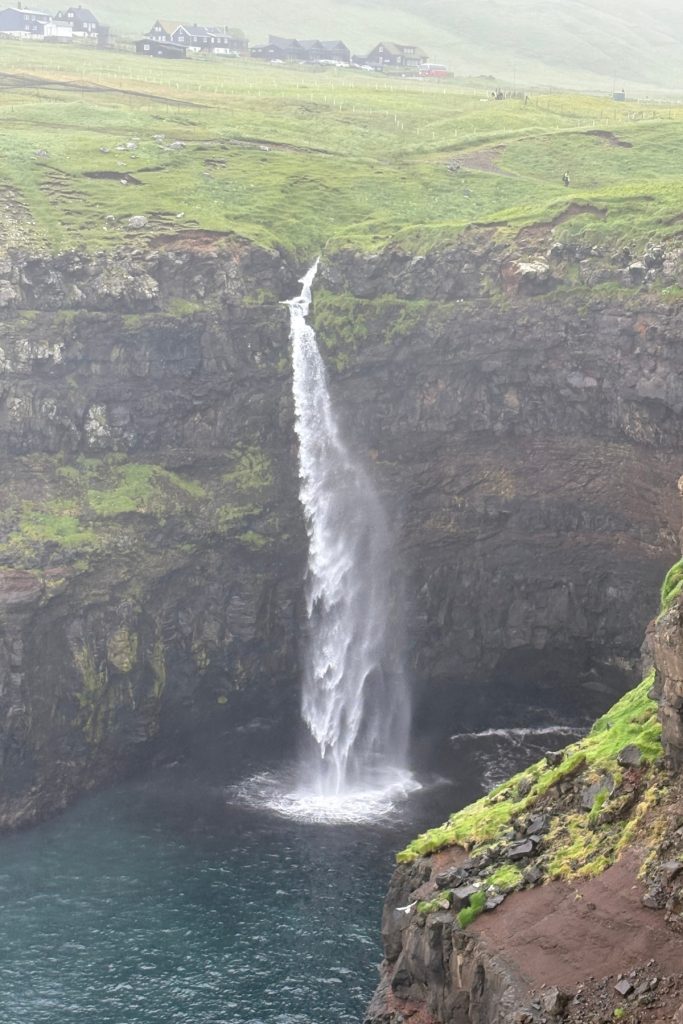
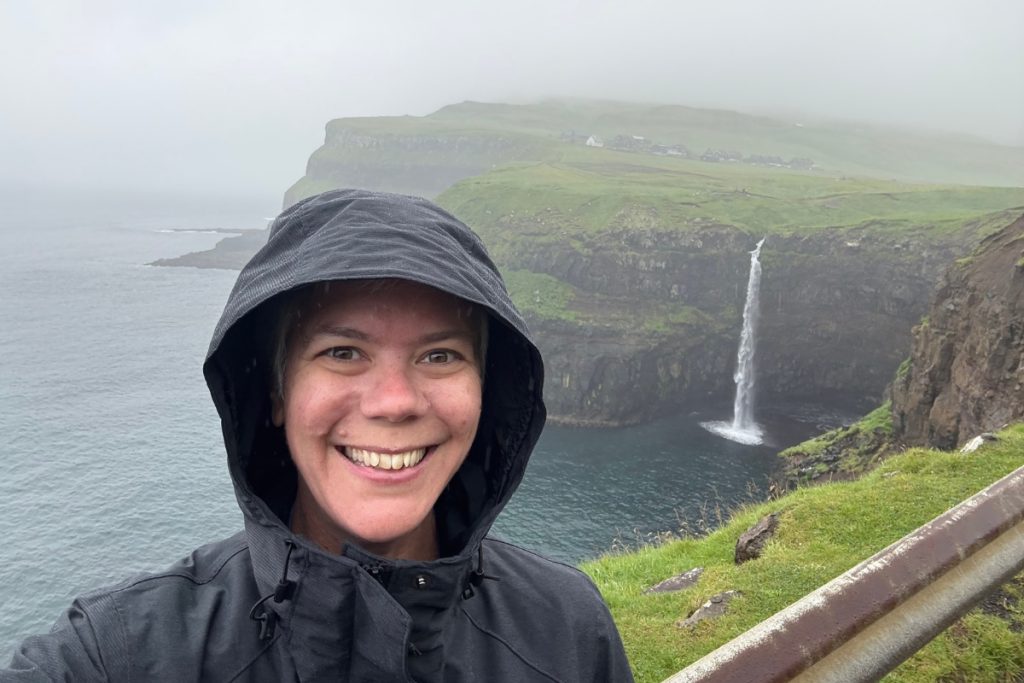
Múlafossur drops more than thirty meters, about a hundred feet, straight off a cliff into the Atlantic. It does this close enough to the village that the two show up in the same frame without any trickery. Getting there is a short walk along a grassy cliff edge, a low railing the only thing between you and a genuinely long drop. From the viewpoint, the falls hang in the air like a thread and land in a cove where the water goes from gray to a deep, cold blue.
Somewhere beyond the cove stand the Drangarnir sea stacks, two dramatic rock formations that show up in half the postcards from this part of the country. I know this because I looked it up afterward. On the day I was there, the fog had them fully committed to a disappearing act. What I got instead was a general sense that something large was out there, unconfirmed.
Half a View, Still Worth It
This is the part of the day where the brochure version and my version diverge the most. The brochure version has blue sky and a clean shot of the stacks. Mine has a waterfall, a village, and about sixty percent of the view, with the rest left to the imagination. Fog or not, it was worth the walk out to that railing.
Bøur: Tea, Cake, and a View That Wouldn’t Fully Show Itself
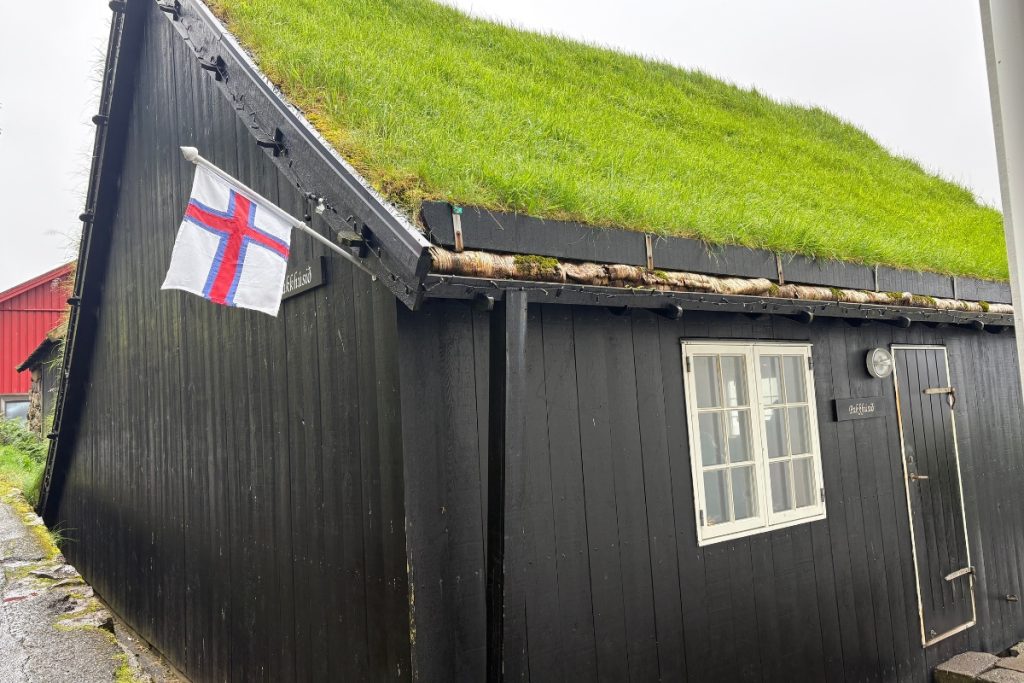
Bøur is the last village before the tunnel to Gásadalur, and it looks the part. Grass roofs, black timber walls, white window frames. All of it faces a view of the islet Tindhólmur, a view that has ended up on more Faroese postcards than almost anywhere else in the country. We were shown into Pakkhúsið, a building from 1861 that started as a warehouse for the fish trade. It briefly held the first shop and post office on this side of Vágar. Parts of it are still lived in today. The room we sat in is now a small café. I would still call it someone’s home before I called it a business.
Tea, Cake, and History
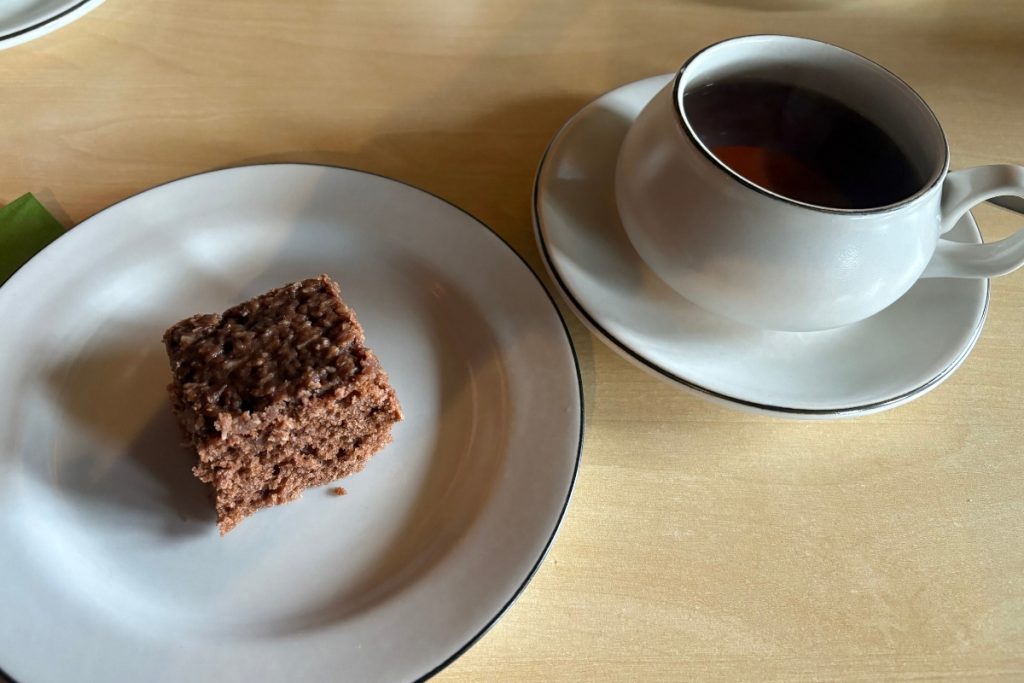
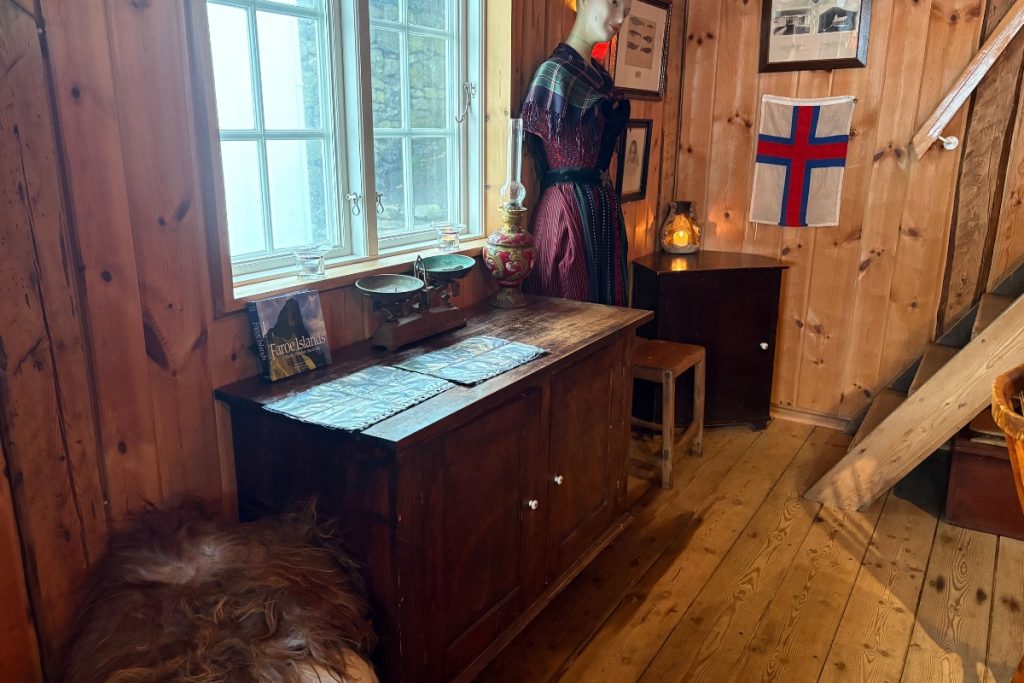
Tea and cake came out not long after we sat down. A dense, dark square of cake, tea in a plain white cup, nothing fussy about either. The room itself did more of the talking. Wood-paneled walls, a woodstove, a mannequin dressed in traditional Faroese clothing standing in the corner like she was waiting to be asked to dance. A Faroese flag hung near a stack of old photographs. It had the feel of a house that had been collecting things for a hundred and sixty years and never saw a reason to stop.
A Porch on the Water
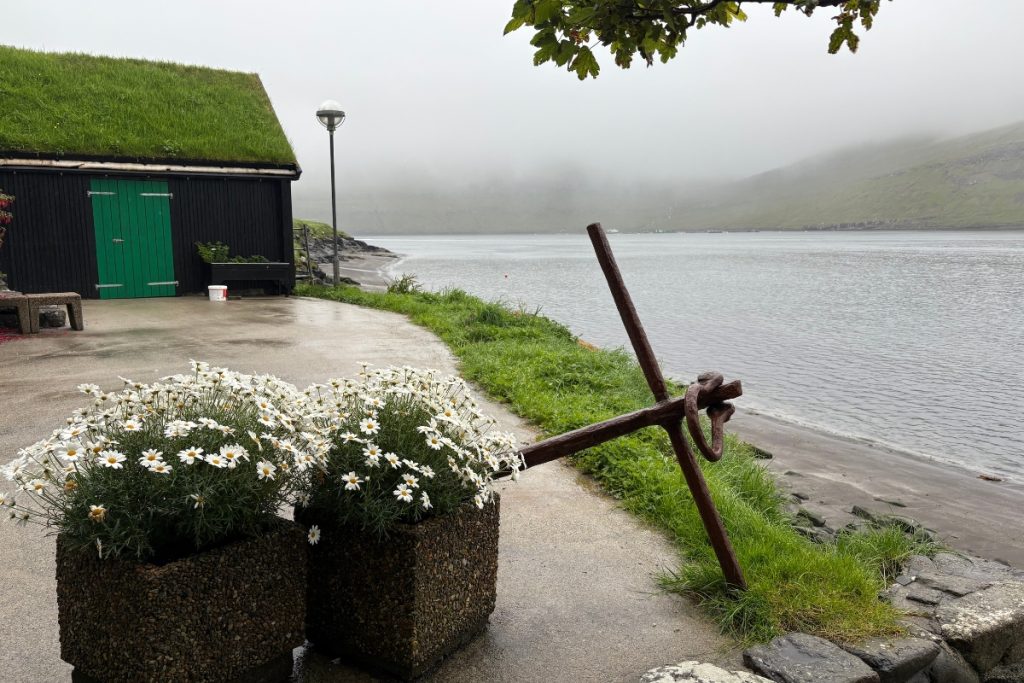
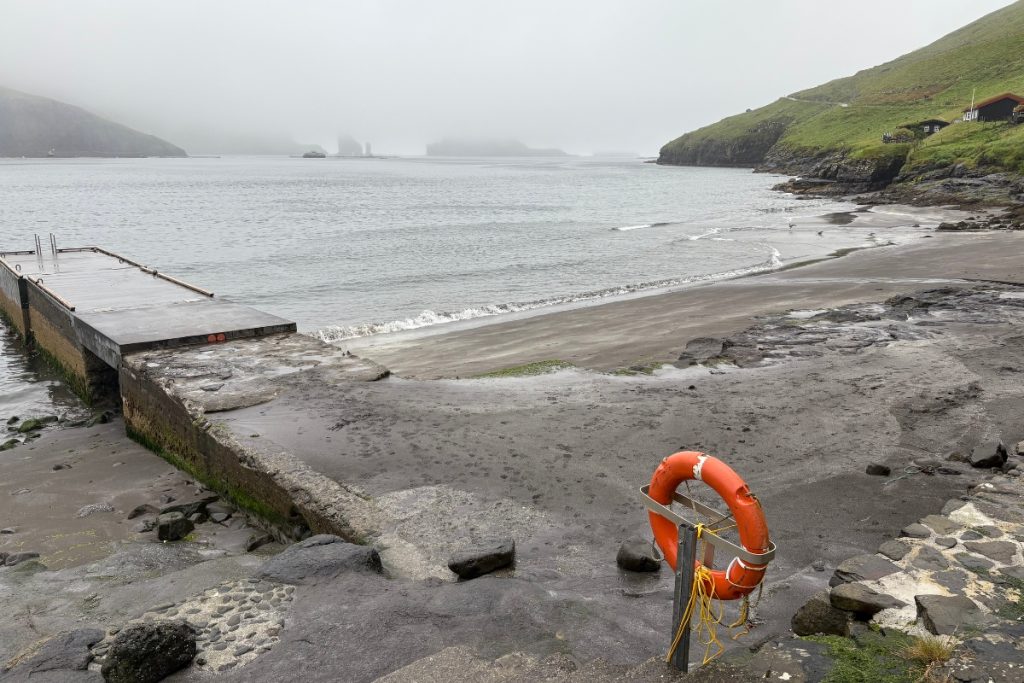
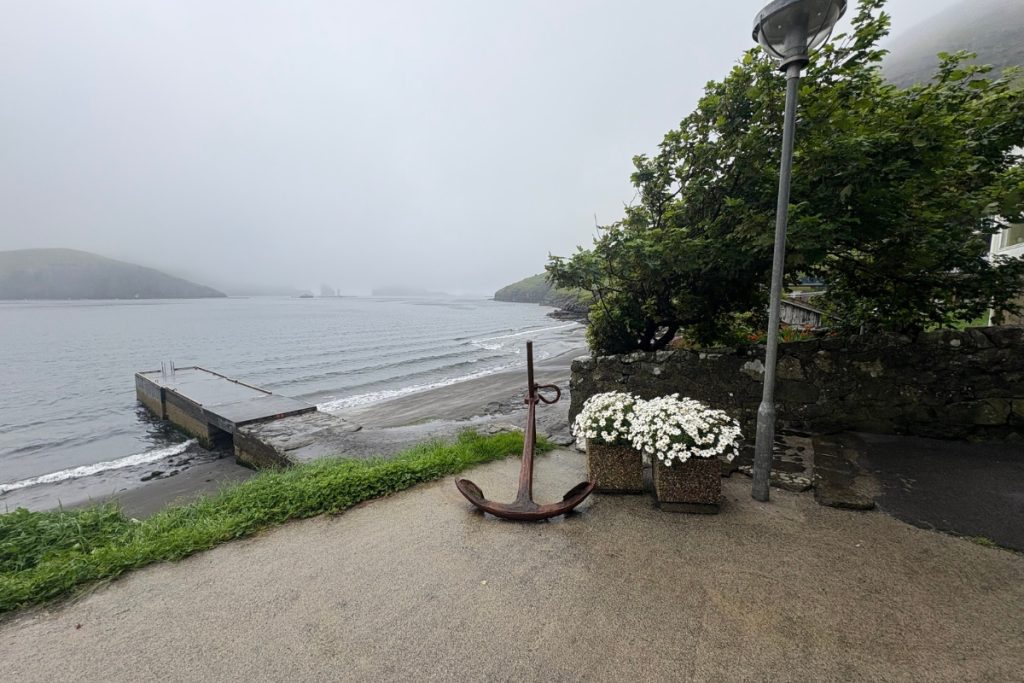
After tea, I stepped out back, onto a small porch that puts Pakkhúsið right at the water’s edge. An old anchor stood upright next to a bed of daisies. Somewhere out past the fog sat the Drangarnir sea stacks, the same ones I had failed to properly see from Gásadalur a couple of hours earlier. The fog had not lifted. I looked anyway.
A Short Loop Through Bøur
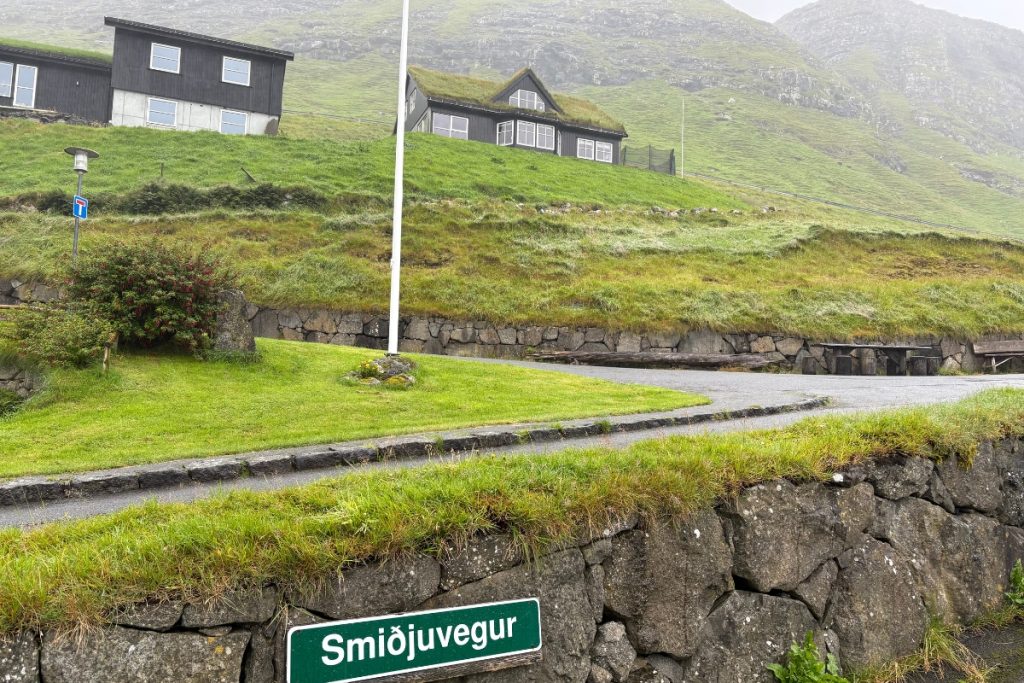
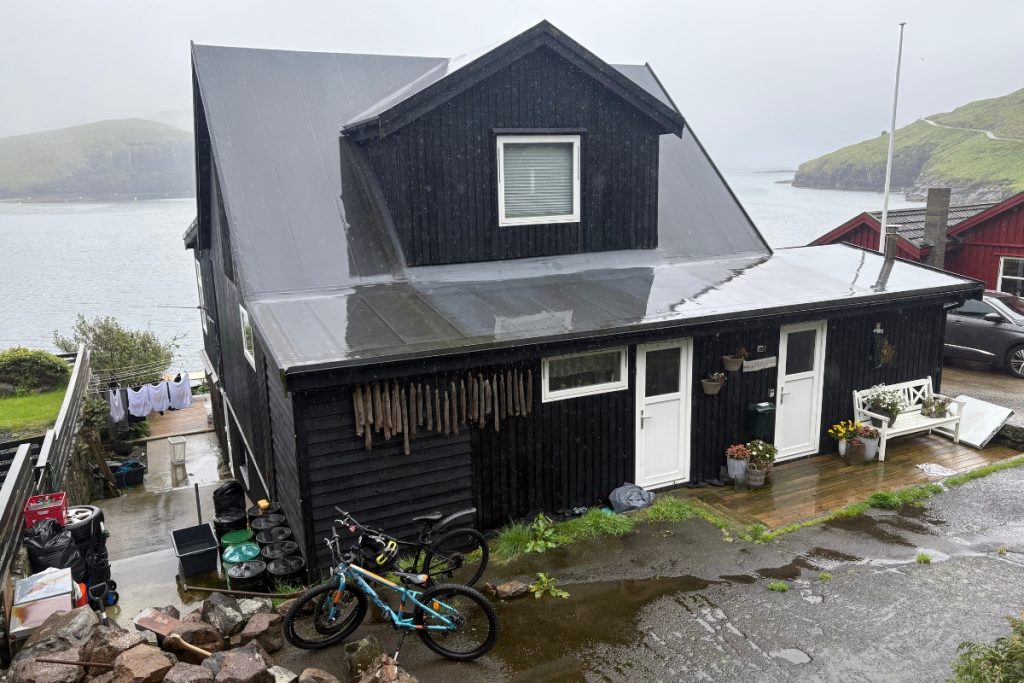
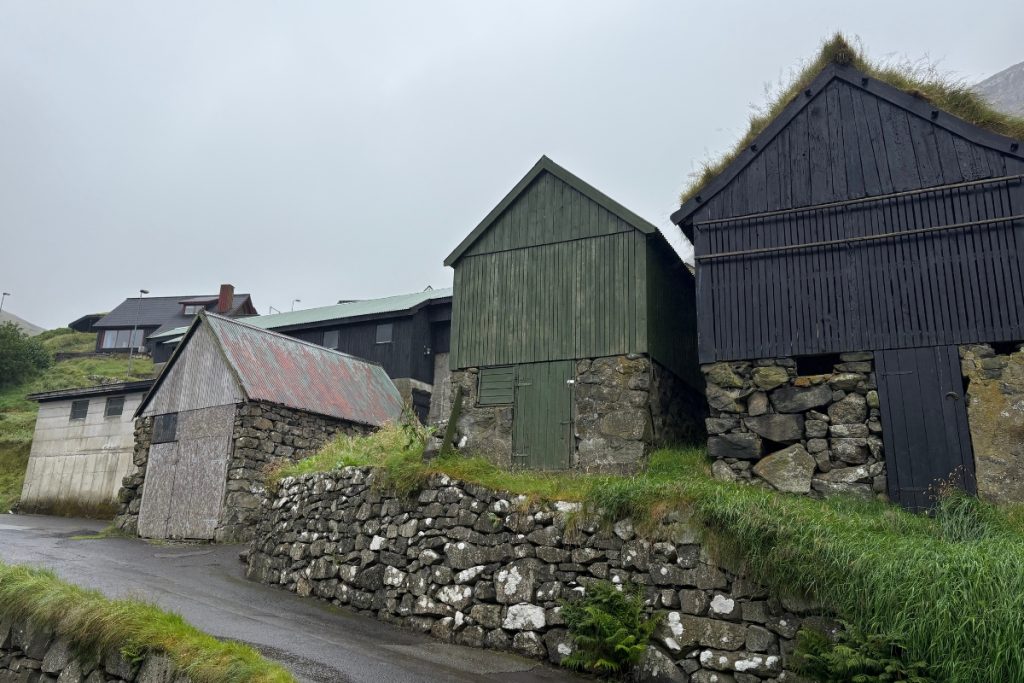
From there I wandered up the narrow street the café sits on, then onto the street above it, past turf-roofed houses and stone walls thick with ferns. I caught a bit of Pakkhúsið’s roofline from the higher vantage point before the street looped back down. I ended up on the lower street again, Pakkhúsið right where I had left it. That felt like a reasonable way to end a walk that had started with someone else’s cake.
Worth the Time if You Have It
A few things I did not get to on my short visit to the Faroe Islands, and would recommend anyway:
- Skansin is a small fortress on a hill above the harbor, a five-minute walk from Tinganes. I somehow missed it. It was built in 1580 by Magnus Heinason to protect Tórshavn from pirate raids. French pirates destroyed it a century later, and it was rebuilt in 1780. During the Second World War, Britain used it as a base. The guns from that period still stand next to the older Danish cannons. It is a small site, more a viewpoint with history attached than a destination on its own. I had no excuse for walking right past it toward the harbor instead.
- Kirkjubøur is a short drive from Tórshavn, and I did not make it there. It was the religious and cultural center of the Faroe Islands through the Middle Ages. It still holds the ruins of Magnus Cathedral, a cathedral begun around 1300 that was never finished. Today it stands as the largest medieval building in the country. Next to it sits Kirkjubøargarður, a farmhouse from the eleventh century. It is often called the oldest inhabited wooden house in the world. The same family has lived there since 1550.
- The Drangarnir sea stacks got the short end of my day twice, once from Gásadalur and once from Bøur. Both times, fog was in the way. Boat tours run out to them from Vágar and get close enough for the kind of photo the brochures actually use. I would take one on a clearer day, mostly out of spite.
- Mykines, the westernmost island in the country, is reachable by ferry from Sørvágur on Vágar. It is known for its puffin colonies in summer. I did not have the extra day it would have taken to get there and back. Worth flagging for the next trip, not this one.
Closing Thoughts
One day in the Faroe Islands is not enough. I said that at the start, and nothing about the day changed my mind. What it did was give me a fair trade. Tórshavn’s old town in under two hours. A church, two statues, and a runestone in Sandavágur. A waterfall that lived up to its photos even with half the view missing. Tea, cake, and a two hundred year old building in Bøur that is still, somehow, someone’s home.
The fog never lifted. I stopped waiting for it to. Some of the best-known views in the country stayed half hidden the entire day, and I got a version of the Faroe Islands that was quieter and less certain of itself than the postcards. I liked that version. I would go back for the clear one too, but I am in no hurry to trade this day in for it.
If you have one day here, spend the morning on foot in Tórshavn and the afternoon on Vágar. It is not enough time. Go anyway.
Common Questions
Not really, but it works. A single day gives you a real walk through Tórshavn’s old town and a focused afternoon on Vágar covering Sandavágur, Gásadalur, and Bøur. You will not get to everything, and you will not get to slow down much. If you have more than one day in the Faroe Islands, split this itinerary across two.
No, but you do need some way to cover ground. These three stops sit along the same stretch of road on Vágar, connected by the Vágatunnilin undersea tunnel. A rental car, a scheduled bus, or a shore excursion from a cruise all work. I did this as part of a ship excursion, and it was an efficient way to hit all three villages without navigating unfamiliar roads.
Yes. The viewpoint sits a short, flat walk from the Gásadalur parking area, close enough for wheelchairs and strollers to manage on a dry day. Rain and fog are common, so plan for slippery ground more than for elevation.
Plan on it happening anyway. The Faroe Islands see fog and rain often, including in August. Múlafossur and the Drangarnir sea stacks were both at least partly obscured on my visit, and the day was still worth having. Bring a real rain jacket, not an umbrella. The wind will win.